
















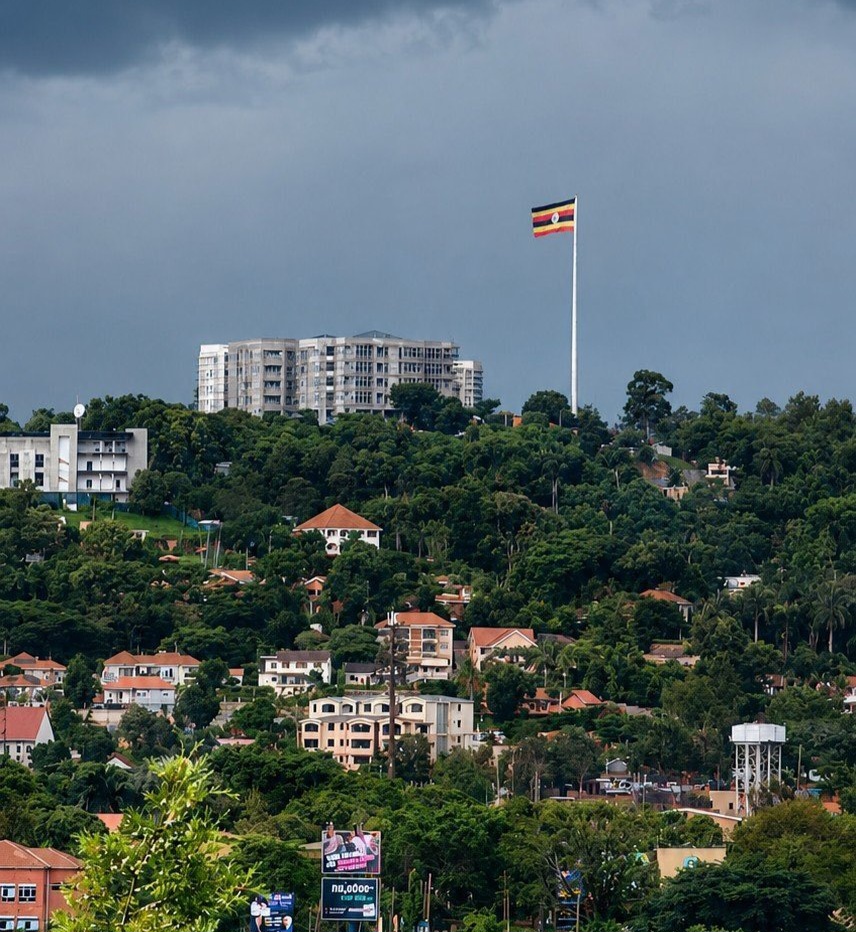
A massive national flag rising above Mbuya Hill has become one of Kampala’s newest and most visible landmarks, drawing admiration from supporters who see it as a symbol of patriotism while also sparking criticism from Ugandans questioning government spending priorities.
The towering flag mast, installed within the headquarters of the Uganda People’s Defence Forces (UPDF) and the Ministry of Defence and Veteran Affairs (MODVA), forms part of the ongoing redevelopment of the military complex overlooking the capital.

Illuminated at night and visible from several parts of Kampala, the giant flag has quickly attracted public attention because of its scale and strategic hilltop location.
Military authorities say the wider headquarters upgrade project is progressing steadily, with the twin-tower complex now substantially complete. The redevelopment, estimated to cost about Shs94 billion, has been championed by Chief of Defence Forces Muhoozi Kainerugaba, who has repeatedly urged UPDF engineers to speed up construction.
Speaking about the flag mast, Gen. Muhoozi recently said the structure was not yet complete because engineers had been waiting for specialised equipment to finalize the installation.
According to him, the mast is expected to become the tallest in Eastern Africa once fully completed.
The project has generated strong reactions from both supporters and critics.
Backers describe the installation as a powerful national symbol intended to inspire patriotism, unity and pride in Uganda’s sovereignty. Among those defending the project is Lillian Aber, the Kitgum District Woman MP, who praised the military leadership for what she called a visible demonstration of love for the country.
She also commended ongoing anti-corruption efforts within government institutions, arguing that national resources should support projects that elevate Uganda’s image.
However, critics argue that the investment reflects misplaced priorities at a time when many Ugandans continue to struggle with unemployment, rising living costs and underfunded public services.
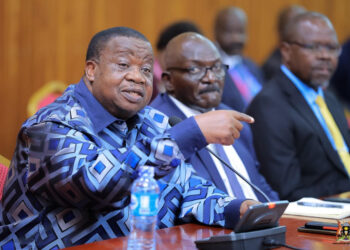
Former Uganda People’s Congress spokesperson Okello Lucima questioned whether patriotism can be promoted through expensive symbolic projects, insisting that love for one’s country comes naturally and does not require grand displays.
Political analyst Gordon Musiige also criticised the initiative, pointing to shortages in hospitals, schools and security personnel housing. He argued that many citizens are likely to see the project as disconnected from their daily realities.
Despite the criticism, the giant mast has strengthened the visual presence of the military within Kampala’s urban landscape. Analysts say the project reflects broader efforts by the UPDF to modernise its infrastructure while projecting institutional confidence and authority.
Some observers also interpret the increasing visibility of military symbolism as part of the growing political prominence of Gen. Muhoozi, whose public profile has expanded significantly in recent years.
Although government officials have not officially disclosed the exact height of the structure, comparisons have already emerged with other major flag masts across Africa.
Egypt currently hosts one of the world’s tallest flagpoles in its New Administrative Capital, standing at more than 200 metres, while Jordan’s Aqaba flagpole rises to about 130 metres. Nigeria recently unveiled a 70-metre flag mast promoted as the tallest in West Africa.
Urban planners note that even without confirmed measurements, the Mbuya installation’s elevated positioning gives it exceptional visibility across Kampala.
Uganda’s national flag itself carries deep historical symbolism dating back to independence in 1962. The black stripe represents the people of Africa, yellow symbolizes sunshine, and red signifies brotherhood, while the crested crane at the centre reflects peace and gentleness.
The display of the national flag is regulated under Uganda’s National Flag and Armorial Ensigns Act, which outlines how the flag should be handled and protected from misuse or disrespect. Authorities have in recent years repeatedly warned against casual or commercial abuse of national symbols.
Situated within a state military installation, the Mbuya flag mast remains part of official government use and is closely tied to the UPDF’s constitutional role of defending Uganda’s sovereignty and territorial integrity.






 English