

















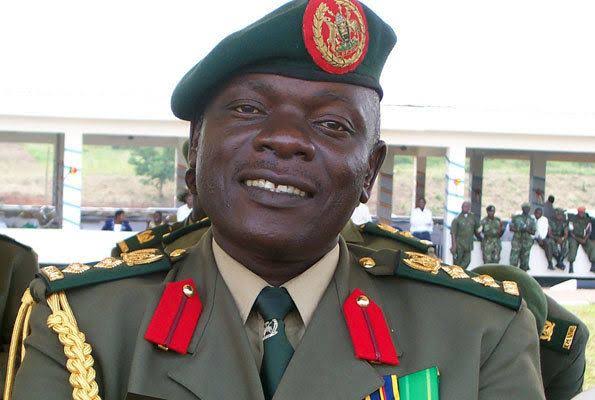
The Court of Appeal has upheld a High Court ruling cancelling a land title held by retired Uganda People’s Defence Forces (UPDF) officer Maj. Gen. Elly Kayanja and his wife, Jennifer Kayanja, over what judges described as a fraudulent acquisition of disputed land in Wakiso District.
In a judgment delivered by Justice Florence Nakachwa, the appellate court found that Kayanja exploited the trust of long-time occupants of the land by pretending to help resolve an ownership dispute, only to later acquire the property for himself and his wife.

The contested land, measuring approximately 53.64 hectares (about 132 acres), is located at Kabulengwa in Wakiso District.
Justice Nakachwa ruled that Kayanja acted dishonestly after presenting himself to the residents as a mediator in a long-running dispute involving Miriam Kikomeko. According to the court, he later collaborated with Kikomeko to register the land in his and his wife’s names before ordering the occupants to vacate the property.
“The first appellant availed himself to the respondents under the disguise of assisting them to solve the dispute… but instead turned around to connive with Miriam Kikomeko,” Justice Nakachwa stated in the judgment.
The case was originally filed in 2009 by six residents of Kabulengwa — Mudiima Issa, Kyendo Ahmed, Mayambala Henry, Walakira Deo, Matovu Michael, and Muzula Abdul — on behalf of other occupants. The group argued that they were lawful occupants of the land and sought cancellation of the title issued to the Kayanjas and Kikomeko.
Court records indicate that the disputed land was part of a larger estate belonging to the Kabaka of Buganda. In 1978, a man identified as Cephas Kikomeko reportedly obtained a lease on the land for five years, set to expire in December 1983.
The residents, however, challenged the lease, claiming it had been obtained fraudulently through false declarations about the land. They further argued that after Cephas Kikomeko died in 1983, the lease expired and reverted to the Kabaka since it had never been lawfully renewed.
According to the residents, no member of the Kikomeko family laid claim to the land again until Miriam Kikomeko allegedly renewed the lease in 1997, a move that also sparked resistance from the occupants.
The court heard that the residents later sought assistance from Kayanja, who at the time was still serving in the military. However, instead of helping them settle the dispute, he allegedly became part of the contested ownership arrangement.
Evidence presented before court showed that Kayanja attended meetings where residents openly warned him that ownership of the land was disputed. During cross-examination, he reportedly admitted that different groups had given conflicting accounts about the rightful owner of the property.
Despite the warnings, Kayanja proceeded with the transaction and later demanded that the residents vacate the land or face eviction.
The High Court subsequently ruled in favour of the residents, cancelled the title, and ordered compensation. Dissatisfied with the decision, Kayanja, his wife, and Miriam Kikomeko appealed.
However, the Court of Appeal dismissed the appeal in its entirety, agreeing with the findings of the lower court.
Justice Nakachwa ruled that the appeal lacked merit and ordered that the judgment of the High Court be maintained. She also directed that the names of Miriam Kikomeko and the Kayanjas be removed from the land title and ordered Kayanja to pay the costs of the appeal.











 English