


















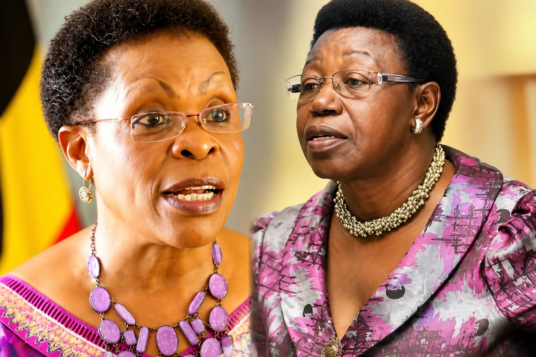
The High Court in Kampala has thrown out a defamation case filed by former Inspector General of Government (IGG) Beti Kamya against former Ethics and Integrity Minister Dr. Miria Matembe, ruling that the contested remarks fell within the bounds of political expression protected under the law.
In a judgment delivered by Justice Bonny Isaac Teko of the Civil Division, the court found that Kamya had failed to prove that Matembe’s comments caused actual harm to her public reputation. The judge noted that the statements complained of were largely political opinions made during discussions on governance and accountability.


The dispute stemmed from television interviews aired on NTV Uganda and NBS Television in 2021 shortly after Kamya’s appointment as IGG. During the broadcasts, Matembe openly questioned Kamya’s integrity and suitability for the anti-corruption office, citing controversies linked to her time as Lands Minister.
Kamya, represented by Anguria & Co. Advocates, argued that Matembe’s remarks portrayed her as corrupt, dishonest, and unethical. She asked the court to declare the statements defamatory, issue a permanent injunction restraining Matembe from repeating them, compel a public apology and retraction, and award her damages.
Among the statements challenged in court were allegations that Kamya interfered in land compensation processes, facilitated payments to ghost beneficiaries, and enabled double compensation claims. Matembe also described Kamya as a “political prostitute,” a phrase Kamya said was insulting and intended to damage her standing.
However, Matembe defended her comments as fair political criticism rooted in issues already discussed publicly, including parliamentary investigations and debates surrounding compensation payments. She maintained that her remarks were expressions of opinion made in the public interest.
In his ruling dated May 11, 2026, Justice Teko emphasized that individuals holding public office are naturally exposed to criticism and scrutiny from citizens and political commentators.
“The plaintiff was a senior political figure who had occupied high constitutional offices and voluntarily participated in public debate,” the judge observed, adding that such leaders inevitably attract strong opinions and criticism.
The court further ruled that comments regarding Kamya’s integrity and fitness for office were opinions rather than direct assertions of criminal wrongdoing. According to the judgment, matters concerning leadership and public accountability are open to public discussion and differing interpretations.
Justice Teko also addressed the controversial phrase “political prostitute,” concluding that it was used metaphorically within a political context and would not reasonably be understood literally by viewers.
“The phrase was rhetorical and political in nature,” the judge ruled, adding that ordinary listeners would interpret it as criticism of perceived political opportunism rather than a factual accusation.
A major weakness in Kamya’s case, according to the court, was her failure to present independent witnesses or evidence showing that her reputation had actually been lowered in the eyes of the public because of the broadcasts.
The court also accepted Matembe’s defenses of fair comment, justification, and constitutional freedom of expression. Justice Teko pointed out that concerns about compensation processes during Kamya’s tenure had previously been raised by Parliament’s COSASE committee and widely discussed in public.
Although some of those findings were later contested, the judge held that they provided sufficient basis for public debate and criticism.
The judgment further warned against using defamation lawsuits to silence political dissent or suppress open discussion on matters of governance.
“It is not the role of defamation law to cleanse political debate or prevent citizens from expressing strong political opinions,” Justice Teko stated.
The court ultimately dismissed the suit and directed each party to bear its own legal costs, noting that the case touched on broader issues of public interest and freedom of expression.










 English