
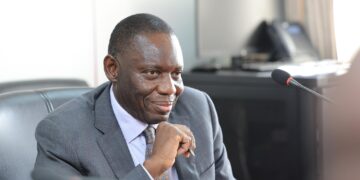


















The Uganda Revenue Authority (URA) has expressed confidence that Uganda can achieve its ambitious domestic revenue targets over the next four years if government, businesses and taxpayers work together to widen the country’s tax base and improve voluntary tax compliance.
Government has set a domestic revenue target of UGX 46 trillion for the 2026/27 financial year, with URA expected to collect UGX 40.16 trillion in tax revenue. The target forms part of a broader strategy to increase tax collections from the current 14.2 percent of Gross Domestic Product (GDP) to 20 percent within four years.


The revenue mobilisation plan is aimed at reducing Uganda’s dependence on borrowing as the country seeks to finance a larger share of its development programmes using locally generated resources. Rising public debt and increasing debt servicing costs have placed pressure on the national budget, while access to concessional loans and grant financing has become more limited.
Although Uganda is expected to begin earning revenue from its oil sector, officials say petroleum income alone will not be sufficient to fund the country’s development priorities, making tax revenue the government’s main source of financing.
Speaking during the launch of the National Post-Budget Dialogue in Kampala, Finance Minister Henry Musasizi said stronger domestic revenue collection would allow government to reduce borrowing and invest more in infrastructure, healthcare, education and job creation.
Musasizi said the success of the strategy would depend not only on effective tax administration but also on improving public service delivery so that citizens see value in paying taxes voluntarily.
He added that government remains committed to fighting corruption and ensuring public funds are used transparently to improve the welfare of Ugandans.
URA Commissioner General John Musinguzi said the country’s medium-term revenue targets are achievable, noting that tax collections have improved from approximately 13 percent of GDP to 14.2 percent despite the authority registering a slight revenue shortfall during the 2025/26 financial year.
He attributed the progress to recent tax reforms approved by Parliament, which he said are intended to strengthen compliance while creating a more predictable and business-friendly tax environment.
Among the reforms is a review of penalties under the Electronic Fiscal Receipting and Invoicing Solution (EFRIS). Instead of the previous flat penalty of UGX 5 million for non-compliance, offenders will now pay twice the tax due on the affected goods or services, or ten currency points, whichever amount is higher.
Musinguzi acknowledged that some of the changes could initially present challenges for businesses but maintained that they are designed to promote fairness, improve compliance and simplify tax administration for compliant taxpayers.
He also unveiled URA’s new Client Service Charter, which outlines service standards, taxpayers’ rights and obligations, and measures aimed at improving taxpayer experience.
The charter introduces mechanisms for resolving tax disputes without going to court, enhances access to tax exemption and customs services, expands digital service delivery and provides clearer procedures for reporting misconduct by URA staff.
The Ministry of Finance said government is investing in digital technologies, data analytics and modern tax administration systems to improve efficiency while broadening the tax base instead of increasing tax rates.
Moses Kaggwa, the Ministry’s Director of Economic Affairs, said the focus is to identify taxable economic activities that remain outside the tax system while supporting businesses and individuals who comply with tax obligations.
He said long-term voluntary compliance will depend on empowering more Ugandans economically through initiatives such as the Parish Development Model and other wealth creation programmes.
Kaggwa also urged government agencies to treat taxpayers as partners in national development, saying trust and fairness are essential in building a sustainable tax culture.
He noted that effective implementation of the national budget would stimulate economic growth, create jobs and expand business activity, ultimately increasing tax revenues.
Civil society organisations welcomed several measures contained in the new budget but called for greater transparency and accountability in the management of public resources.
Julius Mukunda, Executive Director of the Civil Society Budget Advocacy Group, encouraged Ugandans to meet their tax obligations while demanding accountability on how public funds are spent.
Grace Kobusingye, Programmes Manager at the Uganda Debt Network, said prudent use of public resources is critical in strengthening public confidence and encouraging voluntary tax compliance.
She noted that improved accountability, coupled with quality public service delivery, will play a key role in supporting Uganda’s efforts to increase domestic revenue and reduce reliance on borrowing.












 English