













Former State Minister for Foreign Affairs Henry Okello Oryem has publicly expressed disappointment following his removal from Cabinet in President Yoweri Museveni’s latest government reshuffle, ending more than two decades of service in Uganda’s foreign affairs ministry.
Oryem, who has been part of the Ministry of Foreign Affairs since 2004, was among prominent leaders from the Acholi sub-region left out of the new Cabinet lineup announced by the President. He has been replaced by businessman and politician Calvin Echodu.
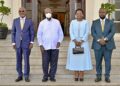

Another Acholi minister, Kenneth Omona, formerly in charge of Northern Uganda Rehabilitation, was also dropped from Cabinet but later appointed ambassador. Omona’s former docket was handed to Beatrice Akello Akori.
Speaking in an interview on Wednesday, Oryem admitted that leaving Cabinet was emotionally difficult after serving continuously in the same ministry for over 20 years.
He however thanked President Museveni for the opportunity to serve Uganda in what he described as one of the country’s most critical government offices.
Oryem said his long stay at the Foreign Affairs ministry gave him rare exposure to international diplomacy, allowing him to represent Uganda at global forums and build relations with leaders and institutions across the world.
During his tenure, he participated in engagements involving the United Nations, African Union, European Union and various bilateral diplomatic missions aimed at advancing Uganda’s interests abroad.
The veteran diplomat defended his record, arguing that he helped strengthen Uganda’s international image and established valuable foreign relations networks during his years in office.
Despite his exit from Cabinet, Oryem indicated that he remains available to serve Uganda in other capacities, including diplomatic assignments, legal practice and consultancy work.
The former minister, who is also a trained lawyer, said public service remains important to him regardless of the position he holds.
Addressing concerns raised by some leaders in Northern Uganda over what they describe as limited Cabinet representation for the Acholi sub-region, Oryem urged residents to remain calm and patient.
He acknowledged the growing political support for the ruling National Resistance Movement (NRM) in Northern Uganda but cautioned against focusing entirely on government appointments.
According to Oryem, leaders in the region should instead prioritise lobbying for infrastructure development and poverty alleviation programmes that directly benefit communities.
President Museveni’s reshuffle retained several senior ministers while introducing new figures into government, a move political observers interpret as part of preparations for the country’s next political phase ahead of the 2026–2031 term.
Among Acholi leaders who survived the reshuffle are Hillary Onek, who was transferred to the Office of the Prime Minister in charge of General Duties, and Norbert Mao, who retained the Justice and Constitutional Affairs ministry.
State Minister for Water and Environment Beatrice Atim Anywar and Lillian Aber, who serves in the Office of the Prime Minister handling disaster preparedness and refugees, also kept their positions.
Reaction to the reshuffle has continued to divide opinion across the Acholi sub-region.
Some local leaders welcomed the changes, arguing that the President had rewarded capable leaders while removing underperforming officials.
Alex Okoya, the LCII Chairperson for Labour Line Ward in Gulu City, praised the reshuffle and said some ministers who had lost touch with the people deserved to be removed.
Political analyst Arthur Owor from the Centre for Africa Research said the reshuffle reflected the President’s efforts to balance regional interests across the country despite limited Cabinet positions.
Owor described Oryem as one of Uganda’s most experienced diplomats and suggested regional considerations may have influenced the decision to replace him.
He also argued that political divisions among Acholi leaders had weakened the region’s bargaining power compared to areas such as West Nile, where leaders reportedly united around common interests before the appointments were made.
Meanwhile, several of the country’s top government officials retained their positions, including Vice President Jessica Alupo, Prime Minister Robinah Nabbanja and First Lady Janet Museveni, who remains Minister of Education and Sports.





 English