


















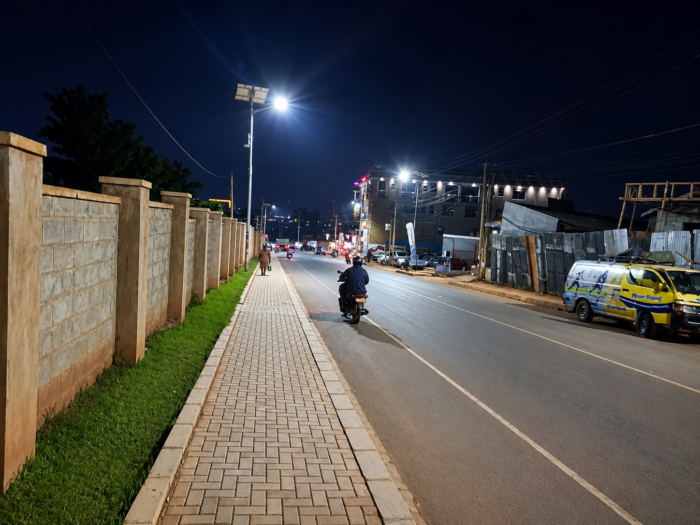
The transformation of Mukono Municipality through newly constructed roads under the Greater Kampala Metropolitan Area Urban Development Program has significantly improved transport, reduced dust and enhanced the appearance of the town.
Wide tarmac roads, street lighting and dedicated pedestrian walkways have made movement easier for motorists and pedestrians alike.


However, barely months after the completion of several roads, a growing culture of illegal parking is threatening to undermine the intended benefits of the multibillion-shilling investment.
Across several roads including Nabuti, Kame Valley and Nasuuti, motorists have increasingly turned pedestrian walkways into parking spaces due to a shortage of designated parking areas within the central business area.
Bodaboda riders have also established informal stages on the same walkways, forcing pedestrians onto the carriageway where they must compete for space with moving vehicles.
The situation has become particularly worrying during peak hours when school children, elderly people and persons with disabilities struggle to use the walkways that were specifically designed to improve their safety.
Urban planners note that pedestrian walkways are not decorative additions to roads but essential safety infrastructure intended to separate people on foot from moving traffic.
Once these spaces are occupied by parked vehicles or motorcycles, the protective barrier disappears, exposing pedestrians to a much higher risk of accidents.
Residents say the problem reflects a gap in urban planning that has emerged alongside rapid commercial growth. As Mukono attracts more businesses, offices and financial institutions, the number of vehicles entering the municipality has increased faster than the availability of parking facilities.
Many workers arriving in town each morning are left with few legal parking options, prompting them to occupy pedestrian spaces. Others simply park wherever it is convenient because enforcement remains limited.
The same challenge extends to commercial motorcycles. In the absence of gazetted bodaboda stages, riders establish informal parking points along busy roads, further obstructing pedestrian movement and creating congestion.
Residents are now calling on the municipality to officially gazette parking areas and bodaboda stages to restore order within the central business area.
They also want the local authority to require developers constructing commercial buildings to incorporate adequate parking facilities, including basement parking where practical, as part of modern urban development standards.
Municipal officials acknowledge the growing concern.
Mukono Municipal Town Clerk Francis Byabagambi says the continued misuse of pedestrian walkways by motorists is becoming a serious challenge despite ongoing public awareness campaigns.
He says the municipality has intensified sensitisation efforts and is drafting by laws that will introduce penalties against individuals who misuse road infrastructure.
According to him, the roads are expected to serve residents for more than twenty years if they are properly used and maintained.
Byabagambi has also appealed to members of the public to report anyone damaging or illegally occupying road infrastructure so that appropriate action can be taken.
Mukono Municipality Mayor Robert Peter Kabanda says residents are excited about the improved road network and street lighting, but many still lack knowledge about proper road use.
He says the municipality has already allocated funds to conduct public sensitisation campaigns aimed at educating residents on responsible use of the new infrastructure.
Kabanda notes that the municipality had initially avoided introducing street parking charges because it did not want to burden residents with additional costs.
However, he says continued misuse of roads may leave authorities with little choice but to introduce regulated street parking fees as a way of promoting order and discipline.
Urban development experts argue that Mukono’s experience mirrors challenges faced by many fast-growing municipalities across Uganda.
Infrastructure development often progresses faster than the establishment of regulations governing its use. Without proper enforcement, investments intended to improve mobility can quickly become compromised.
The issue also raises broader questions about sustainable urban planning. As municipalities expand, road construction alone cannot solve transport challenges.
Adequate parking facilities, designated public transport stages, strict enforcement of traffic regulations and continuous public education are equally important in creating safe and organised urban centres.
For Mukono, the newly upgraded roads represent a major public investment funded through the World Bank under Greater Kampala Metropolitan Area Urban Development Program.
Protecting that investment will require cooperation between authorities, motorists, bodaboda riders, property developers and the wider public.
Unless illegal parking is addressed through a combination of education, enforcement and better planning, the very walkways built to protect pedestrians may instead become some of the municipality’s most dangerous spaces.
ENDS.













 English