
















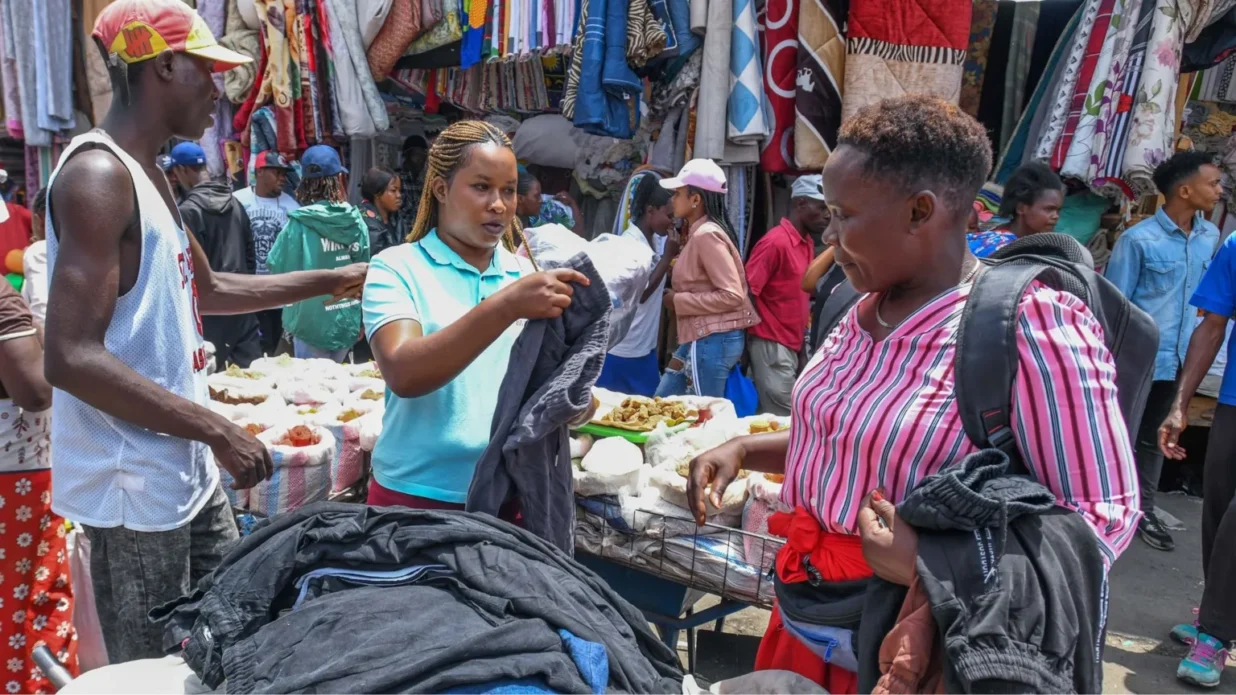
Not even heavy rain can keep shoppers away from Gikomba, a lively Kenyan market that is the largest open-air trading hub in East Africa.
Sections of the site were waterlogged on the day the BBC visited, yet shoppers, some wearing rubber boots, still inched their way through the congested pathways in search of Gikomba’s specialty: second-hand clothing.

The trade in garments imported from the US, Europe, and China poses a perennial problem for the East African Community (EAC), a regional bloc of which Kenya is a member. How can the region build a thriving fashion industry when it is saturated with cheap cast-offs?
“We’re competing with second-hand clothing, but we can’t compete on price,” Zia Bett, founder of Kenyan womenswear brand Zia Africa, told the BBC.
Elizabeth Paul, who owns Kuya Creations in Tanzania’s main city of Dar es Salaam, agrees: “In my shop, the minimum price of a dress is 50,000 Tanzanian shillings (£14.50; $19.20). People tell me: ‘For 50,000, I can get 10 second-hand dresses, so let me buy those.’”
A decade ago, the EAC decried the influx of second-hand clothing and was poised to impose a ban across its member states. After pressure from the US, the proposal collapsed, but the debate has now resurfaced.
Uganda, a country whose president once criticised second-hand clothing as coming from white “dead people,” has introduced an additional 30% tax on imports in an effort to boost the local garment industry and protect the environment.
Days later, the treasury in neighbouring Kenya attempted to change the way it taxed used clothing, saying its proposed system would simplify matters for importers. However, following backlash from Kenyans worried that the changes would lead to price increases, the proposal was swiftly dropped from the Finance Bill.
In a bid to support local clothing manufacturers, Kenya already imposes a 30% customs duty on imports of used clothing, which is 5% higher than the rate charged on new clothes.
According to trade data platform the Observatory of Economic Complexity (OEC), Kenya is currently Africa’s leading importer of second-hand clothing, known locally as “mitumba” in Swahili.
The mitumba-loving nation imported nearly 180,000 tonnes of used clothing in 2022, a 76% increase compared to 2013, according to UN trade data.
In neighbouring Uganda, second-hand clothes are the most sought-after garments, followed by imported new clothing and, lastly, locally manufactured clothes, according to a 2024 report by the government-funded Economic Policy Research Centre.
The new 30% environmental levy on used clothing comes on top of an existing 35% import duty and 18% VAT.
“The levy of 30% on worn clothing is intended to mitigate environmental degradation while promoting domestic production,” the bill says, according to local news outlet the Kampala Report.
The announcement did not sit well with Ugandan mitumba traders such as Aaron Sekky.
“I don’t agree with this, because this has to be a free economy,” he told the BBC.
The second-hand trade “is supporting so many people,” Sekky added, a common argument among supporters of the industry. The supply chain extends beyond retailers like Sekky and includes importers, wholesalers, tailors who repair damaged mitumba, and vendors who sell food and drinks in the markets.
There is no official data on how many people work in the industry, but research commissioned by the Mitumba Consortium Association of Kenya (MCAK) estimates that up to 4.9 million people across East Africa rely on the used clothing trade for employment.
Critics, however, argue that the employment argument is superficial.
“Retail is the most limited form of job creation you can have in an economic sector, compared to production, marketing, and distribution,” said Dr Andrew Brooks, an academic at King’s College London and author of Clothing Poverty: The Hidden World of Fast Fashion and Second-hand Clothes.
“If you’re just importing and selling goods, you’re doing very little to contribute to your nation’s economy.”
Similarly, Lisa Kibutu, a board member of the Kenya Fashion Council, said many jobs linked to mitumba are “hand-to-mouth” roles that offer little opportunity for growth or social mobility.
However, she also believes used clothing provides an important service in Kenya.
“When I left Kenya in the 80s, you would see poor people without clothing. Right now, even the poorest person has decent clothing,” Kibutu, who previously worked in the US for designers such as Giorgio Armani and Eileen Fisher, told the BBC.
Affordability remains a huge selling point, but nowadays mitumba is no longer reserved for the poorest consumers.
Najma Issa, 40, told the BBC while shopping at Ilala Market, a second-hand clothing hub in Dar es Salaam: “Most of the clothes are of good quality… they last long.”
Twenty-two-year-old Juma Awadh agreed: “I buy second-hand clothes because of the quality, and they look unique.”
Even though Tanzania imposes a 35% import tax on used clothes, Ilala Market is still overflowing with customers looking for affordable fashion. This bustling scene is exactly what the EAC once hoped would disappear.
In 2015, the then six-member EAC, Burundi, Kenya, Rwanda, South Sudan, Tanzania, and Uganda, announced plans to impose extremely high tariffs on, and eventually ban, the importation of mitumba.
But the US, a major exporter of second-hand clothing, warned that such measures would violate free trade agreements and threatened to remove EAC countries from the African Growth and Opportunity Act (Agoa).
Agoa allows several sub-Saharan African countries to export thousands of products duty-free to the US.
Following the US ultimatum, all EAC members except Rwanda withdrew support for the ban. Rwanda stood firm, prompting the US to impose 30% tariffs on Rwandan clothing imports that had previously entered duty-free.
Rwanda insists the country has benefited from increasing taxes on second-hand clothing from $0.20 (£0.15) to $2.50 (£1.90) per kilogram in 2016.
The trade ministry says that, in the two years before the increase, used clothes accounted for between 26% and 32% of garment and textile imports. In the following two years, the figure dropped to between 2% and 7%, while increased garment exports suggested the local industry was growing.
However, demand for smuggled mitumba from neighbouring countries still appears strong, with police regularly posting images of impounded bales on social media.
Environmentalists point out that a significant proportion of second-hand clothing shipped to developing countries is of such poor quality that it ends up in landfills. In 2023, the non-profit Changing Markets Foundation estimated that more than one in three used clothing items sent to Kenya fell into this category.
“There is no infrastructure to dispose of these massive amounts of textile waste, and official dump sites have been overflowing for years,” environmental organisation Greenpeace said.
But MCAK chairperson Teresia Wairimu Njenga argued that mitumba sellers are actually “champions of environmental preservation.”
“Can you imagine what would happen to Kenya if we were manufacturing 198,000 tonnes of new clothes every year?” she asked.
Yet second-hand clothing imports worldwide could soon face even higher taxes. Signatories to the Basel Convention, a global waste treaty, are currently debating whether used garments, many of which are made from plastic fibres, should also be classified as waste.
Sceptics like Joel Okalany, a Ugandan designer whose brand Ekikumba Fusion upcycles used clothing into statement pieces, argue that East Africa is not yet prepared for the end of mitumba.
“The reality is, we are not yet ready for our own manufacturing sector to take off,” he told the BBC.
“In farming, the person using a tractor is more efficient than the person using a horse. In the tailoring industry, we are still at the stage of using the horse.”
Even Rwandan authorities appear to have reached a similar conclusion. In a report published in 2022, the country’s trade ministry said it was delaying a total ban on used garments because of “current domestic gaps in the production of textiles and apparel.”
Rwanda’s crackdown on used clothing also offers another lesson for its EAC neighbours: restricting mitumba imports will have limited impact if the influx of cheap new clothes from countries such as China and Turkey is not also controlled.
As the supply of mitumba declined in Rwanda, many consumers turned instead to imported fast fashion.
Across the region, both mitumba traders and local clothing manufacturers say cheap imports from China pose the greatest threat, as they encroach on both markets.
“They’ll copy something from the runway or a designer brand and sell it at a ridiculous price,” Kenyan designer Zia Bett said, though she remains optimistic.
“We need to focus on storytelling, content, and quality. I think the question now should be: ‘How do we build brands that people choose, and not just afford?’”
For Njenga, both second-hand clothing and locally manufactured garments have a role to play.
“We should allow them to coexist,” the MCAK chairperson said. “Let’s not kill mitumba. Give consumers the power of choice.”











 English