














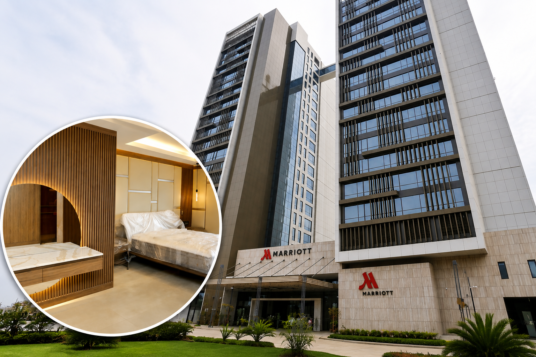
A public debate has emerged after senior officials from the Ministry of Finance publicly revealed government support towards the construction of a multi-billion luxury hotel owned by city businessman Ponsiano Ngabirano, the proprietor of Capital Shoppers.
According to information shared on the Ministry of Finance’s X account, the Director for Economic Affairs, Moses Kaggwa, accompanied by Commissioner Tax Policy John Byahuranga and other ministry officials, toured the five-star twin tower luxury hotel located along Ggaba Road in Nsambya.

The delegation was received by businessman Ponsiano Ngabirano, who personally guided the officials through the massive property that is expected to soon open to the public under the supervision of Marriott International management.
During the tour, Kaggwa reportedly described the project as one of the investments being supported by the Government of Uganda under its broader economic transformation agenda. He explained that government policy seeks to support internationally branded five-star hotels as part of efforts to attract high spending tourists into the country.
According to the Finance Ministry officials, tourism remains one of the country’s anchor sectors under the ATMS strategy, with government targeting an increase in both tourist arrivals and tourism revenues.
The luxury facility, which also includes high-end executive apartments targeting elite clientele, has already attracted attention because of its scale, location and international branding. Officials indicated that the Marriott team is already on site conducting final preparations ahead of the official commissioning of the hotel.
However, the revelation that government is directly supporting the private investment of one of Kampala’s wealthiest businessmen has sparked growing public concern, particularly on social media.
Critics have questioned the nature of the support being extended to the project, with many demanding clarity on whether taxpayers’ money, tax waivers, subsidized financing, infrastructure support or other state incentives were involved.
Others are now asking which budget vote financed the support and whether similar opportunities are available to ordinary Ugandans struggling to access government funding for local enterprises.
Some members of the public also questioned the selection criteria used to determine beneficiaries of such government-backed investments, arguing that smaller local investors and struggling entrepreneurs rarely receive similar state attention despite contributing to employment and economic activity.
The controversy comes at a time when several sectors including public healthcare, education and road infrastructure continue to face funding gaps, prompting fresh scrutiny over government priorities and allocation of public resources.
The government’s decision to openly associate itself with a luxury private hotel project highlights Uganda’s growing push toward elite tourism and foreign-branded investments. Authorities argue that attracting wealthy tourists increases foreign exchange earnings, creates jobs and improves the country’s hospitality standards.
However, the public reaction exposes a deeper trust deficit regarding transparency in government-backed private investments. While strategic incentives for investors are common globally, the absence of publicly available details on the exact nature of state support often fuels suspicion and perceptions of favoritism toward politically connected businessmen.
The situation has also revived a longstanding debate about economic inclusion in Uganda. Many citizens believe government incentive programs tend to favor established tycoons while small and medium enterprises struggle with expensive loans, taxation and limited access to capital.
As discussions continue online, one question appears to dominate public sentiment: if government support is available for private luxury investments, how can ordinary Ugandans qualify for the same opportunities, and under which funding framework are such interventions being implemented?



 English