
















The controversy over dual citizenship has returned to the centre of Ugandan politics as President Museveni’s latest cabinet appointments head into parliamentary vetting.
The debate is no longer about whether Uganda allows dual citizenship. That question was settled through the 2005 constitutional amendments and operationalised in 2009.


The issue now is whether some appointed ministers fall under legal restrictions that bar dual citizens from holding certain state offices, and whether Parliament will apply those restrictions strictly during vetting under Article 113 of the Constitution.
Scrutiny has been triggered by allegations that several appointees may hold multiple citizenships.
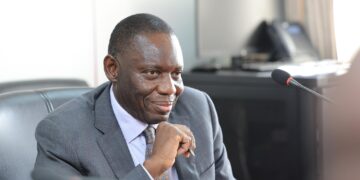
Among those mentioned in public debate are Dr Lawrence Muganga, appointed State Minister for Internal Affairs, and Calvin Echodu, a junior minister linked to Ugandan–US citizenship.
Other figures such as Ambassador Adonia Ayebare and Sanjay Tanna have also been drawn into the broader discussion. These names have become central because the law at the heart of the dispute explicitly includes “Cabinet Minister and other Ministers” among the offices a dual citizen is not permitted to hold.
That legal position is found in the Fifth Schedule of the Uganda Citizenship and Immigration Control (Amendment) Act, 2009, which states: “President. Vice President. Prime Minister. Cabinet Minister and other Ministers.”
This statutory restriction is anchored in the Constitution itself. Article 15(7) provides that “Parliament shall, by law, prescribe the offices of State which a person who holds the citizenship of another country in addition to the citizenship of Uganda is not qualified to hold.”
This means the Constitution did not leave dual citizenship completely unrestricted. Instead, it explicitly empowered Parliament to define where limits should apply.
The debate dates back to May 14, 2009, when Parliament debated and passed the Uganda Citizenship and Immigration Control (Amendment) Bill. The Hansard shows that the House did not set out a single formal explanation for why ministers were included in the restricted category.
Instead, the reasoning appears through the risks MPs repeatedly raised during debate, particularly around loyalty, security, and state control.
One of the clearest expressions of concern came from then Chua County MP Livingstone Okello Okello, who asked: “I wonder what would happen if I belonged to two countries and the two countries went to war. Which one will I support?”
This reflects the core anxiety that shaped the idea of restricting certain offices: the possibility of divided allegiance in moments where government decisions involve national security or international conflict.
Security fears also featured directly in the debate. Charles Angiro, then MP for Erute North, warned: “What about the case… persons who will be recruited to spy either in Uganda or outside?”
This is the only explicit reference in the Hansard to espionage risk, but it is significant because it links citizenship status to access to state systems and intelligence.
That concern helps explain why the final law extends far beyond political office to include military command, intelligence leadership, and sensitive administrative functions such as immigration and national records.
The committee report presented alongside the Bill reinforces this framing by describing the legislation as serving two purposes at once. It stated that the Bill sought “to provide for dual citizenship” while also providing for “the offices of state which a person holding dual citizenship is not qualified to hold.”
In other words, Parliament was not only expanding citizenship rights but simultaneously drawing boundaries around the most sensitive parts of state power.
Although the Hansard does not contain a direct statement explaining why ministers specifically were restricted, their inclusion in the Fifth Schedule sits within this broader logic.
Ministers sit at the centre of executive authority, controlling ministries that handle defence, internal security, foreign affairs, and state administration systems. The restriction therefore follows a systems-based approach focused on control of state power rather than job titles in isolation.
This is why the current vetting process has become legally sensitive. Under the Fifth Schedule, “Cabinet Minister and other Ministers” are explicitly listed among offices that dual citizens are not qualified to hold.
That creates a direct legal question for Parliament’s Appointments Committee when reviewing nominees whose citizenship status is contested or unclear. If dual citizenship is proven, the statutory rule points toward disqualification. If it is not proven, the restriction does not legally apply.
However, in practice, vetting is not purely mechanical.
It depends first on whether citizenship status is clearly verified, since the restriction only applies if dual citizenship is established. It also depends on how Parliament interprets the relationship between Article 113, which governs ministerial appointments by the President with parliamentary approval, and the Citizenship Act’s statutory restrictions under Article 15(7).
So, the likely outcome for the current ministers depends on three practical factors.
If dual citizenship is clearly confirmed and not renounced, the legal position under the Fifth Schedule creates a strong basis for rejection or compulsory compliance before approval.
If citizenship status is unclear, Parliament is more likely to request verification rather than make an immediate decision.
If the matter becomes politically managed rather than strictly adjudicated, approval may still happen, but usually only after clarification or resolution of citizenship status.
The framers of the system were therefore balancing two objectives reflected in the 2009 record.
On one hand, Uganda sought to reconnect with its diaspora and allow dual citizenship for economic and social contribution. On the other hand, MPs expressed concerns about loyalty during wartime and the risk of foreign influence or infiltration into sensitive state systems.
The result was a compromise structure: broad acceptance of dual citizenship combined with targeted restrictions on offices considered central to sovereign authority.
The unresolved issue in 2026 is not whether dual citizenship exists in Ugandan law, but how strictly Parliament will apply the 2009 restrictions during ministerial vetting.
Will the likes of Muganga and Echodu, who reportedly hold dual citizenship, be approved by Parliament? No one can answer that with certainty yet, because Parliament’s Appointments Committee has both legal discretion and political latitude.
The first layer is the legal test. Under the Constitution and the Fifth Schedule of the 2009 Act, the Committee must ask whether a nominee is a dual citizen and, if so, whether they fall under the prohibited offices.
The Schedule explicitly lists “Cabinet Minister and other Ministers.” On paper, this creates a direct statutory risk: if dual citizenship is proven and not renounced, disqualification follows.
Yet Article 15(7) also makes Parliament the body empowered to define and apply these restrictions, meaning vetting is not entirely mechanical but partly discretionary.
In practice, three factors usually determine approval.
The most immediate is the legal clarity of citizenship status. If a nominee is confirmed as solely Ugandan, approval is straightforward. If dual citizenship is confirmed, the statutory bar is triggered. If status is unclear or contested, Parliament often delays proceedings or requests verification before proceeding.
This makes documentation and verification central to the vetting process.
The second factor is political strength. Historically, the Appointments Committee has often aligned with the executive unless there is a clear legal disqualification or strong public resistance. Even where ambiguity exists, political consensus frequently shapes the outcome.
The third factor is institutional interpretation. The current dispute reflects a constitutional grey area: one side insists the Fifth Schedule bars dual-citizen ministers outright, while the other points to constitutional rights and presidential appointment powers under Article 113.
Until a court issues a definitive interpretation under Article 137, Parliament operates in a space where law and politics overlap.
From this evidence, three realistic outcomes emerge.
Approval without challenge is likely if nominees are confirmed as sole Ugandan citizens or if they renounced other citizenships before finalisation.
Approval after political interpretation is possible if Parliament adopts a flexible reading of the Fifth Schedule or treats the restriction as administratively manageable, though this could invite future legal challenges.
Delay, rejection, or withdrawal becomes likely if dual citizenship is formally confirmed and not renounced, especially if opposition pressure intensifies or the Committee insists on a strict reading of the law.
The bottom line is that approval depends on three variables: whether citizenship status is proven, whether Parliament adopts a strict or flexible interpretation, and whether political consensus holds during vetting.
The law restricts dual citizens from ministerial office. The Constitution empowers Parliament to define those limits. The Hansard shows the concerns were rooted in loyalty and security.
But Uganda’s political history suggests that constitutional interpretation rarely operates in isolation from executive influence and parliamentary arithmetic.










 English