


















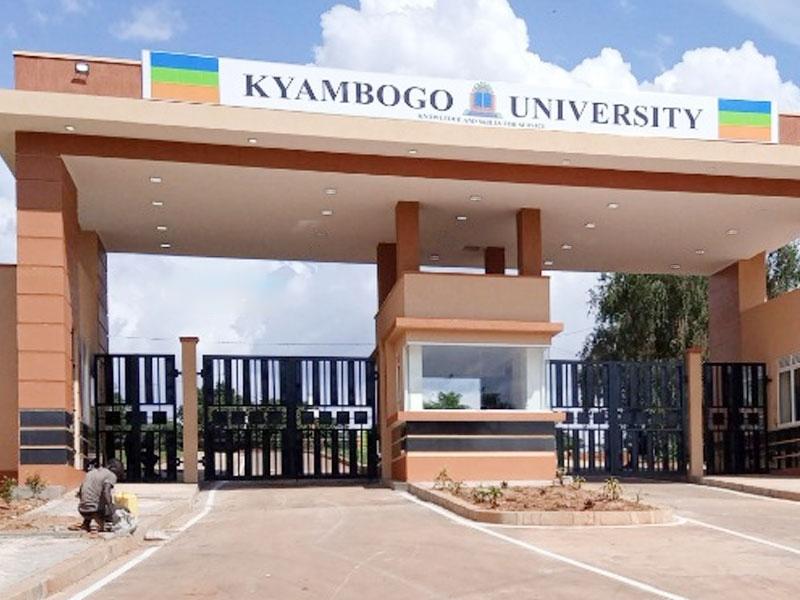
The Industrial Court has ordered Kyambogo University to pay a former kitchen attendant Shs19 million in salary arrears and exemplary damages after finding that the public university unfairly discriminated against her by placing her on a non-existent salary scale and denying her confirmation despite her long service.
The court also awarded Magdalene Atono two months’ salary in lieu of notice and half the costs of the case, in a ruling delivered on October 27, 2026, by the head of the Industrial Court, Justice Linda Lillian Tumusiime Mugisha, sitting with three panelists.


In its award, the court directed the university to pay Atono Shs8,996,952 in salary arrears for the period between November 2009 and December 2012, together with interest at 10 per cent per annum for the period specified in the award.
The university was further ordered to pay Shs10 million in exemplary damages, with interest at 10 per cent per annum from the date of the award until full payment.
The court found that Kyambogo University had treated Atono unfairly by categorising her as a group employee under salary scale M20, which was not provided for in the university’s salary structure, instead of placing her on the M15 scale applicable to kitchen attendants.
The judges said the university had failed to provide a justifiable explanation for treating Atono differently from colleagues who were appointed to the same position and later confirmed under the M15 salary scale.
“The distinction and exclusion were not only arbitrary but also disproportionate,” the court observed, finding that there was no evidence that the university’s decision served a legitimate objective.
Atono had worked at Uganda Polytechnic Kyambogo before it merged with the Uganda National Institute of Special Education and the Institute of Teacher Education Kyambogo to form Kyambogo University in 2003.
She was initially employed on casual terms in May 2000, earning Shs40,000, before her services were transferred to the newly established university. From 2004, she worked under successive short-term contracts until her last contract expired on December 31, 2012.
During her employment, Atono obtained a Certificate in Hotel and Institutional Catering from Kyambogo University in 2007. She argued that she had upgraded her qualifications and deserved to be confirmed on permanent terms, particularly because other kitchen attendants with allegedly lower or comparable qualifications had been confirmed.
She also accused the university of underpaying her by placing her on the M20 salary scale rather than M15, seeking Shs38.27 million in salary arrears in her original claim. She later revised the claim to Shs52.54 million based on a higher salary calculation.
The university, however, argued that Atono had been employed on contractual terms and that obtaining an additional certificate did not automatically entitle her to permanent employment or promotion. It maintained that she was not shortlisted for a permanent kitchen attendant position advertised in 2012 because she lacked a credit in English, which was among the requirements in the advertisement.
The university further argued that her final contract had lawfully expired and that she had received the contractual benefits due to her.
Salary scale dispute
In examining the evidence, the court noted that the university’s approved salary structure, which took effect on January 25, 2005, classified kitchen attendants as support staff under salary scale M15, with an O-Level certificate listed as the academic requirement.
The court found that when Atono was formally appointed under the university’s structure in November 2009, she was placed on the M20 scale as a group employee, despite the kitchen attendant position being classified under M15.
The judges compared her employment records with those of Daniel Muhumuza, Najjuma Musisi, Tumwesigye Ben and Christine Achan, who had also initially worked on casual terms before being appointed as kitchen attendants and placed on the M15 scale.
The court noted that the four employees were subsequently confirmed under the same salary structure, while Atono remained on successive contracts and was paid less.
It rejected the university’s argument that her failure to obtain a credit in English justified the earlier difference in treatment, noting that the approved structure required an O-Level certificate and that the additional English requirement appeared in the 2012 job advertisement.
The court said the university’s Appointments Board was required to apply the approved employment structure consistently unless there was a justifiable reason for treating an employee differently.
It concluded that the university had failed to justify Atono’s exclusion from confirmation and her placement on the M20 scale.
Court upholds expiry of contract
Despite finding that Atono had been unfairly discriminated against, the court did not declare her termination unlawful.
The judges held that her employment from 2003 until the expiry of her final contract in December 2012 constituted continuous service, even though she had worked under successive fixed-term contracts.
The court said the university could not rely solely on the temporary nature of the contracts to disregard the length and continuity of her service, particularly because she had performed the same job for several years.
However, the court found that the university had issued notice of non-renewal in accordance with the terms of her final contract. It therefore held that the expiry of the contract did not amount to unlawful termination.
The judges nevertheless ruled that, having served continuously for about nine years with the university, Atono was entitled to two months’ salary in lieu of notice under the Employment Act, rather than the one month provided in her final contract.
Consequently, the court declined to award the Shs10 million in general damages she had sought for unlawful termination but granted exemplary damages because of the university’s unjustified treatment of her.
NSSF contributions unresolved
Atono had also asked the court to order the university to pay outstanding National Social Security Fund contributions based on the M15 salary scale, arguing that her underpayment had resulted in lower statutory contributions.
The university maintained that it had remitted the contributions due based on her contractual salary.
However, the court found no evidence showing that the university had remitted her NSSF contributions from the time her employment was transferred to the institution or that she had been registered with the fund for that purpose.
The judges said they could not conclusively determine the claim on the available evidence and observed that the matter was one the NSSF should consider pursuing.
The final award therefore provides for salary arrears of Shs8,996,952, exemplary damages of Shs10 million, two months’ salary in lieu of notice and half the costs of the case, with the applicable interest as directed by the court.
The case was initially filed in the High Court on February 24, 2014, before being referred to the Industrial Court for determination.









 English
