










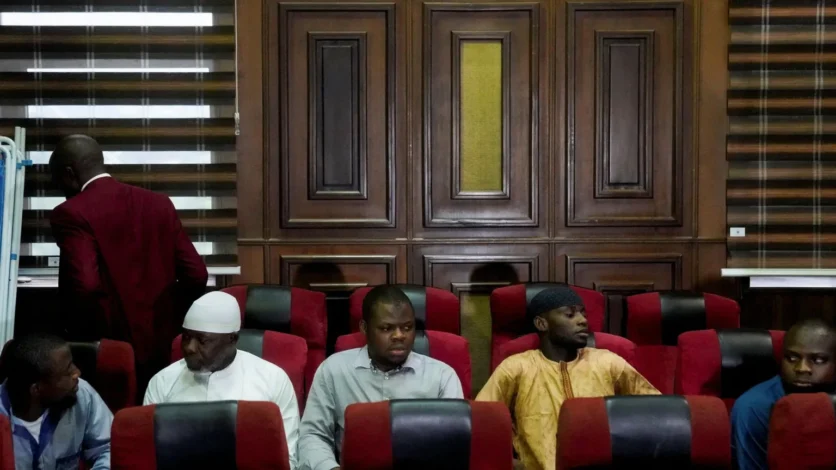
A court in Nigeria has sentenced four men to death for attacking a church in the south-western Ondo State in 2022, in a case that sent shockwaves across the nation.
Forty-one worshippers were killed and more than 100 others injured when the men opened fire at St Francis Catholic Church in the town of Owo during a Pentecost service.
The court in the capital, Abuja, also sentenced the men, Idris Abdulmalik Omeiza, Al Qasim Idris, Jamiu Abdulmalik, and Abdulhaleem Idris, to 20 years in prison for belonging to a terrorist group.
Presidential assent is required before any death sentence is carried out in Nigeria. There have not been any executions in the country for several years.
Judge Emeka Nwite, who presided over the case, said the evidence presented against the men was “neither shaken nor contradicted during cross-examination”.
He had ordered an accelerated hearing after the high-profile trial commenced in August 2025.
In his judgment, Justice Nwite said the prosecution had proved its case beyond reasonable doubt, as it had brought before the court witnesses who saw the attack, including one who testified to recognising two of the defendants as attackers.
“Hence, this court finds the first to fourth defendants guilty on all nine counts,” he added.
One of the witnesses the court heard from was a woman who had both legs amputated below the knees and had lost her left eye as a result of a dynamite explosion detonated by the attackers.
The nine counts included joining a terror group, as well as planning and carrying out killings.
Prosecutor Ayodeji Adedipe said: “Justice has been served; justice has been done to the deceased who were murdered in cold blood.”
The men’s defence lawyer said he would appeal against the sentencing.
A fifth defendant, Momoh Otuho Abubakar, was discharged and acquitted by the court due to insufficient evidence against him.
He was accused of financing the attack by allegedly receiving 800,000 naira (£440; $590) twice from another suspect, who is still at large, and then disbursing the funds to the attackers.
During cross-examination, however, Abubakar said the money in his account was proceeds from his farming business, as well as activities from his cooperative society. He denied that the four other defendants were beneficiaries of the money.
Since the Owo attack, Nigeria has witnessed several more attacks on churches across the country as it continues to grapple with rising insecurity.
US President Donald Trump has accused Nigeria of failing to protect its Christian population from jihadist attacks.
On Christmas Day, the US struck two camps run by a jihadist group in north-western Nigeria and threatened further action if attacks continued.
Claims of a genocide against Nigeria’s Christians have circulated for some time in right-wing US circles, but organisations monitoring political violence in Nigeria say most victims of jihadist groups are Muslims.
The Nigerian government also denies that Christians are being persecuted in the country.








 English