














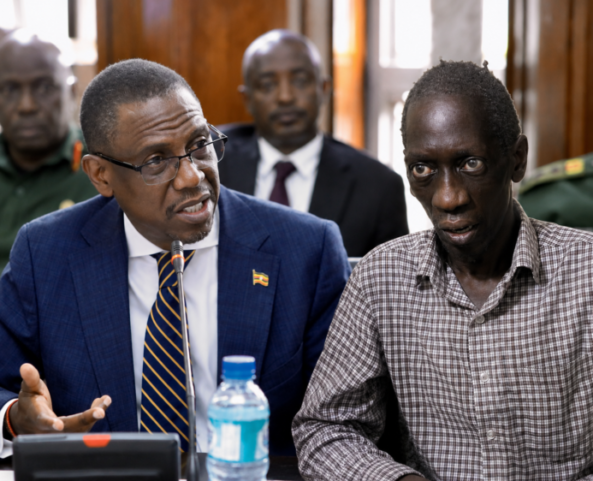
Government has admitted that it does not know the whereabouts of several people reported missing, including political activist Sam Mugumya, prompting renewed demands in Parliament for accountability over alleged enforced disappearances and unlawful detention.
The issue sparked a heated debate on Wednesday after the Leader of the Opposition, Joel Ssenyonyi, pressed the government to explain the fate of individuals who were allegedly arrested by security operatives but have since vanished without trace.


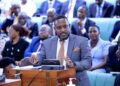
Responding on behalf of the government, the Minister of Defence and Veteran Affairs, Kiryowa Kiwanuka, said the government had no information on the whereabouts of those reported missing.
“If they are missing as you have said and you don’t know where they are, we also don’t know where they are,” Kiwanuka told Parliament, drawing murmurs across the chamber.
His remarks came as opposition legislators questioned why the government had repeatedly failed to account for people whose families and lawyers have spent months seeking information about their whereabouts.
Ssenyonyi argued that Uganda’s laws do not recognise enforced disappearances and insisted that anyone suspected of committing a crime should be arrested lawfully, charged and presented before a competent court within the time prescribed by the Constitution.
He cited several cases, including Christopher Godin, also known as Kim Zero, who was reportedly taken on April 21, William Walisa, allegedly arrested on February 10, and Sam Mugumya, who has reportedly been missing since August 26, 2025.
“If these people have committed offences, why doesn’t government produce them in court?” Ssenyonyi asked.
He also referred to widely circulated videos purportedly showing Mugumya appearing weak and in poor health, urging the government to clarify whether the footage was genuine or fabricated.
The Opposition leader reminded Parliament that President Yoweri Museveni had recently condemned torture, noting that confessions obtained through torture are inadmissible in court. He questioned why security officers accused of torture had not faced disciplinary action.
“If the Commander-in-Chief has condemned torture, why is action not being taken against those responsible?” he asked.
Ssenyonyi emphasised that the Opposition was not seeking immunity for suspects but was demanding adherence to the rule of law.
“We are not saying some people are above arrest. We are saying conduct arrests within the law,” he said.
He cited Article 23 of the Constitution, which guarantees the right to personal liberty and requires anyone arrested to be brought before court within 48 hours. He also referred to Article 24, which prohibits torture, cruel, inhuman and degrading treatment, and Article 44(a), which makes freedom from torture a non-derogable right that cannot be suspended under any circumstances.
He further noted that the Prevention and Prohibition of Torture Act, 2012 criminalises torture by both state and non-state actors, while the Human Rights (Enforcement) Act, 2019 empowers courts to provide remedies for violations of constitutional rights.
Responding to the concerns, Government Chief Whip Dr Jane Ruth Aceng acknowledged that Parliament had repeatedly raised the issue of missing persons and pledged to follow up with the relevant ministries before presenting a comprehensive government statement.
“It is not the first time the Leader of the Opposition is raising it, and it is not the first time we are promising a response. But I promise to follow up this time,” Aceng said.
Her assurance, however, highlighted legislators’ growing frustration over previous government commitments that have not resulted in clear explanations or updates on the reported cases.
Deputy Speaker Thomas Tayebwa urged ministers to avoid allowing accountability matters to accumulate into a backlog of unanswered statements. He said ministers should provide immediate responses whenever possible, particularly on issues raised under Parliament’s Rules of Procedure.
While acknowledging that the government needed time to verify facts surrounding the reported disappearances, Tayebwa agreed that the matter required urgent attention.
Attorney General Dr Sam Mayanja cautioned against the routine use of terms such as “abducted”, “kidnapped”, “picked” and “disappeared” in public discourse, saying allegations of enforced disappearances are too serious to be treated as ordinary political exchanges.
He recalled an earlier ruling by Speaker Anita Among, which recognised allegations of enforced disappearances as matters warranting dedicated parliamentary debate.
“This is a very serious matter, and it requires a special sitting of the House,” Mayanja said.
He called for continued cooperation between Parliament and the Executive, adding that the Minister of Internal Affairs would be expected to brief the House on the reported cases once the government had verified the facts.





 English