







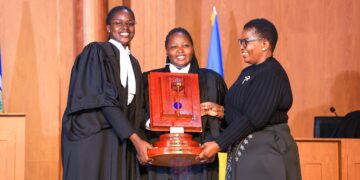











Was Jailed Lady Justice Lydia Mugambe a Victim of Rampant Unscrupulous Abuse of the Geneva Convention 1951 & Article 4 of ECHR?
By Barrister Peter Magomu Mashate


One of the elementary questions for interrogation in jurisprudence is simply this; “IS A COURT OF LAW NECESSARILY A COURT OF JUSTICE”?
Justice Lydia Mugambe
a judge of the United Nations International Residual Mechanism for Criminal Tribunals, who had been studying in the UK for a PhD in law at the time, was found guilty at Oxford Crown Court on 13 March 2025 of conspiring to facilitate the commission of a breach of UK immigration law, facilitating travel with a view to exploitation, forcing someone to work, and conspiracy to intimidate a witness, after forcing a woman to work as her domestic ‘slave’.

On 2 May 2025, Oxford Crown Court imposed a prison sentence of six years and four months and an indefinite restraining order, preventing Mugambe from contacting the victim directly or indirectly. Mugambe was also ordered to pay the victim £12,160 in compensation. Further, the University of Oxford reportedly also commenced a disciplinary process, which could result in the removal of students who have been convicted of serious criminal offences.
In addition, the Crown Prosecution Service authorised the police to charge Mr Mugerwa with conspiracy. However, its submitted that he would have been covered at the relevant time by diplomatic immunity, which the Ugandan Government seems to have not waived.
In any event, pursuant to the Diplomatic Relations (Vienna Convention) Act 1972;
Except in so far as additional privileges and immunities may be granted by the receiving State, a diplomatic agent who is a national of or permanently resident in that State shall enjoy only immunity from jurisdiction, and inviolability, in respect of official acts performed in the exercise of his functions.
The question of whether Lady Justice Lydia Mugambe had got a diplomatic red passport and therefore diplomatic immunity as a judge of the JUDICATURE of a commonwealth member state was answered in the negative hence the trial and the conviction.
This is because sovereign and diplomatic immunity is governed by the Vienna Convention a universal declaration to which most, if not, all countries including UK and Uganda are signatory.
The UK has ratified the convention and enshrined into UK law by the Sovereign and diplomatic immunities Act 1972. However, not all the embassy staff enjoy the immunity.
Its only the Ambassador or High Commissioner and their Deputies who enjoy this privilege and Mr Mugerwa was the Deputy High commissioner with a Red Diplomatic passport enjoying this privilege therefore enjoyed lawful (may not be necessarily moral) diplomatic immunity.
For clarity all diplomatic representatives of commonwealth jurisdiction are called High Commissioners and if outside this arrangement are Ambassadors.
Notwithstanding, both convey the same diplomatic status. Indeed, both are addressed by the titles of His/Her Excellency Ambassador/High Commissioner.
The question of whether their Excellencies the Presidents enjoy this privilege while out of office was extensively tested in the British courts of law in the Case of Chile’s former President General Augusto Pinochet when he was arrested in Britain and arraigned in court for extradition to Spain over allegations of torture while he was President.
Therefore, merely holding a red diplomatic passport is not conclusive. While it affords you opportunity of brushing shoulders with their Excellencies & VIPs in the VIP lounge at airports and having priority while boarding aircrafts, but does not specifically endow immunity.
But what then is Article 4 of the European convention on Human Rights ECHR 1998 under which Justice Mugambe was convicted?
ECHR Act 1998 stipulates thus; “…Prohibition of slavery and forced labour”. The case law so far developed further clarifies and provides thus;
“1. No one shall be held in slavery or servitude.
2. No one shall be required to perform forced or compulsory labour”.
As a matter of fact the parent declaration on Human rights is encapsulated in the Universal declaration on human rights. This is where the ECHR derives its mandate which was also incorporated in UK law by Prime minister Tony Blaire Labour government in 1998 by the Human rights Act 1998.
Incidentally, Uganda too is a signatory to the Universal declaration on human rights and has gone ahead to incorporate its dictates by Chapter 4 and article 45 of the Uganda constitution of 1995.
Whereas any victim of persecution by reason of freedom of worship, association or political opinion may potentially come under the ambit of Geneva Convention 1951 relating to refugees, over time the judicial definition of persecution has been stretched to cover persecution not expressly covered by Convention reason into the ambit of human rights legislation so as to afford the victims to qualify for international protection.
This includes the categorisation of “battered” women in domestic violence by the case law of “woman in Pakistan” that caters and provides for such battered women as a “Social group” therefore eligible for international protection. The same case law has provided for the LGBTQ as a “social group”.
In here lies the difference between the Geneva convention that bestows full refugee status and once this is done such refugee recognition is an international recognition whereas HUMANITARIAN protection is only afforded and superintended by the UK initially five years recognition of whose extension is subject to proving that the initial circumstances being the basis of initial grant of protection still abide.
WHAT THEN IS THE STATUS OF ALLEGED VICTIM OF JUSTICE LYDIA MUGAMBE & OTHERS IN THE CATEGORY?
On the facts Justice Mugambe was convicted and with that the victim qualified for international protection residence in the UK.
However, its worth explaing what happens in general cases under Article 4 of the ECHR. Amongst other aspects the Home office department known as the National Referral Mechanism (NRM) welcomes all such victims of article 4 of the ECHR and often automatically grants them interim 2 years pending investigation and subsequent determination of their case. Save for this instant Justice Mugambe case, this initial and indeed hasty Home NRM recognition does not necessarily mean the victim has a valid claim.
Indeed, if in the course of the NRM investigation in interim period deception is ascertained then her/his claim for refugee or human rights protection fails.
However, given the UK mandatory statutory criminal realm tight trial schedule and because in this the accused would have lost liberty even before the NRM concludes its own investigation of the alleged article 4 victim, the accused is normally tried on the basis of the charges as proffered by the Crown Prosecution service (CPS). These include having travelled/aided and abetted an alleged article 4 victim but not on the evidence of the intentions/active and vigorous willingness or objective mission of the alleged victim. This is where the contradiction and conundrum lies. That a victim who could be subsequently adjudged to be a liar and probably if not often an ECONOMIC REFUGEE throw an innocent accused person under a London bus to be crashed and sends to jail an otherwise innocent person just to further her/his selfish search for green pasture as ECONOMIC REFUGEE.
Article 4 is grossly abused by the alleged victims and to a great extent mismanaged by the British Home office National Referral Mechanism (NRM). For instance, there are cases that have gone beyond the two year threshold into 6 years and beyond and by this time the alleged victims have luxuriously wined and dined and even have gotten children and accrued both limbs of Article 8 of the ECHR namely family and private life and qualified for UK residence on a completely different basis. This is because they know that they would have failed to sustain and prosecute conclusively article 4 claims of the ECHR.

Save for the instant case of Justice Lydia Mugambe, what’s happening to the Ugandan High Commission in London is not evidence of rampant abuse of diplomatic privilege but a world wide diplomatic loophole and conundrum of diplomatic domestic servants. Kenya, Tanzania, etc have even suffered more with these smear innuendos and premeditated and rehearsed blackmail even before the alleged victims land in the UK. The allegations and purported abuses are well rehearsed.
Therefore, condemning the Uganda diplomatic core at our London High Commission who are really doing a DIFFICULT job in the most difficult circumstances would be arbitrary. Don’t forget the best diplomat is; one who puts the “NASTIEST THINGS IN THE NICEST WAY” is it not? As for our Lady Justice Lydia Mugambe one of the elementary questions for interrogation in jurisprudence is this; “is a court of law really a court of justice”?
The Writer Is: London-based Barrister Peter Magomu Mashate, an Administrative, Constitutional and Human Rights Barrister-at-Law of the Honourable Society of Lincoln’s Inn of Court, London, UK.









 English