


















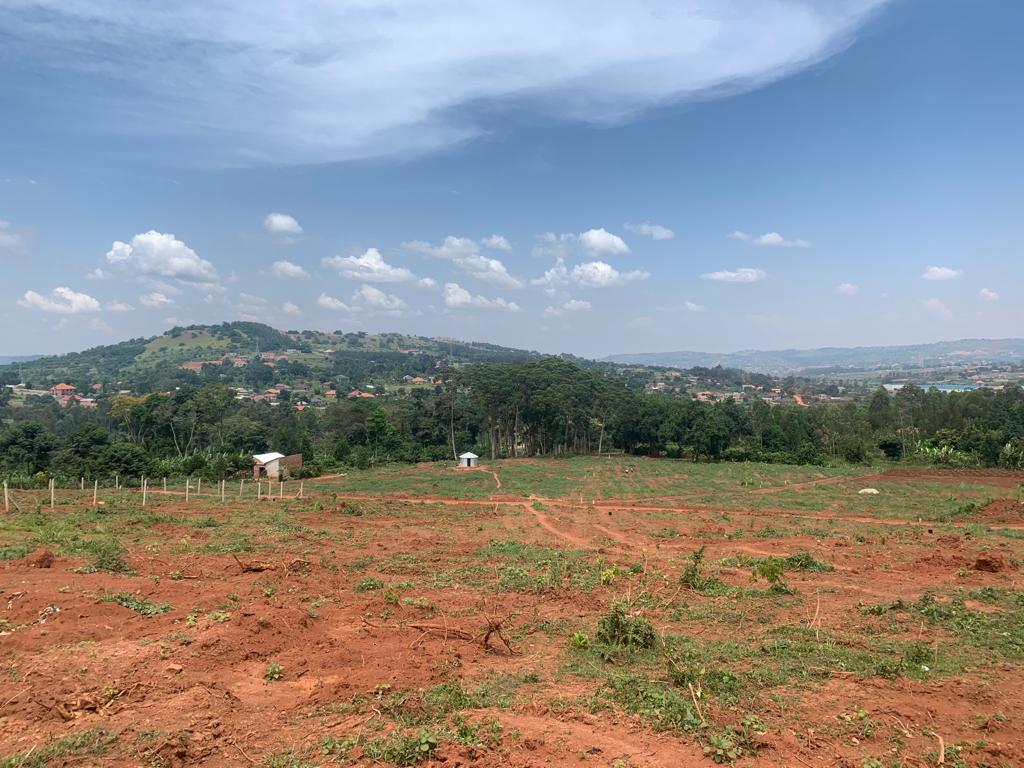
ENTEBBE — The High Court has dismissed a long-running land dispute involving the Registered Trustees of the Uganda Brothers of Christian Instruction and two other occupants who claimed ownership of portions of land in Kisubi, Katabi, after ruling that their alleged kibanja interests were not legally acquired.
Justice Flavia Nabakooza dismissed the suit against Jovia Akandanaho and ordered the plaintiffs to pay costs, finding that they had failed to prove that they were lawful or bona fide occupants of the disputed property.


The case, initially filed as Civil Suit No. 91 of 2005 and later re-designated HCT-27-LD-551/2025, concerned land described in the records as LRV 1629 Folio 23, Plot 43, Nambigirwa Swamp, Busiro Block 409-420.
The plaintiffs included the Registered Trustees of the Uganda Brothers of Christian Instruction, Namuli Galiwango Teopista and Mubiru Chris Galiwango, administrators of the estate of the late Charles Galiwango, and Fred Bugembe.
They claimed to have acquired separate portions of the land from Petro Lukonge in the 1970s. The church trustees said they bought their kibanja in 1976 for Shs200,000, while Charles Galiwango was said to have acquired his portion in 1978. Bugembe also claimed to have bought approximately 2.5 acres from Lukonge.
The plaintiffs told court that they had occupied and used the land for decades, planting eucalyptus trees and food crops and, in some cases, putting up structures.
Their dispute with Akandanaho arose after she entered the area and began developing the land. The plaintiffs alleged that her workers cut down eucalyptus and fruit trees, destroyed crops, blocked access routes and threatened to evict them.
They further challenged Akandanaho’s certificate of title, alleging that it had been fraudulently obtained and did not correspond with the land they occupied.
Akandanaho denied the allegations and maintained that she was the lawful registered owner. Through her representatives, she told court that she had purchased the property from Emmanuel Mpiima and Harriet Mpiima, who had obtained a 49-year lease from the Uganda Land Commission.
The title was subsequently transferred to Akandanaho on April 28, 1995.
The court heard evidence from four witnesses for the plaintiffs, one defence witness and a court-appointed witness, Florence Namboze, who participated in the examination of the land and boundaries.
During the proceedings, the court also visited the disputed property.
A major issue in the case was whether the plaintiffs had acquired legally recognizable kibanja interests before the land was leased by the Uganda Land Commission.
Justice Nabakooza found that the plaintiffs’ alleged purchases took place after the Land Reform Decree of 1975, which declared land in Uganda public land and vested it in the Uganda Land Commission.
The judge relied on Supreme Court decisions which require compliance with statutory procedures when customary interests in public land are transferred.
The court found no evidence that the plaintiffs’ vendors had issued the mandatory notice to the Uganda Land Commission before transferring the alleged kibanja interests.
As a result, the judge ruled that the transactions relied upon by the plaintiffs were legally invalid and could not confer lawful interests in the disputed property.
The court also rejected the plaintiffs’ allegation that Akandanaho’s title was fraudulent.
The plaintiffs had alleged several irregularities, including discrepancies in the location, block numbers and measurements appearing on the title and other land records.
However, the judge found that the evidence established that the disputed property existed on the ground and corresponded with the land described in Akandanaho’s title.
The court acknowledged a discrepancy in the description of the land, particularly concerning its size. The certificate indicated 155.19 hectares, while the deed plan indicated 155.19 acres.
The court-appointed witness found that the correct measurement was 155.19 acres, equivalent to about 62.8 hectares, and concluded that the larger figure recorded in hectares on the certificate was an error.
Justice Nabakooza treated the discrepancy as a minor inconsistency rather than evidence of fraud.
The court also noted that although some documents referred to the property as Nambigirwa Swamp while another referred to Nantabulirirwa, evidence from the survey and the court’s own inspection established that the descriptions related to the same physical property.
The judge therefore concluded that the plaintiffs had failed to prove any of the specific allegations of fraud against Akandanaho.
On whether Akandanaho was a bona fide purchaser, the court found that she had acquired the property for valuable consideration from registered proprietors and held a valid certificate of title.
The judge further found no evidence that Akandanaho knew of any defect in her predecessors’ title at the time she purchased the property.
She was consequently declared a bona fide purchaser for value without notice.
Justice Nabakooza said the plaintiffs had failed to establish any legally recognizable interest in the disputed land and were therefore not entitled to the declarations, cancellation of title, injunctions or damages they had sought.
The suit was accordingly dismissed with costs.
The judgment was signed and delivered at Entebbe on October 6, 2026.









 English