

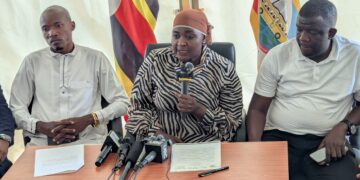

















KAMPALA — The High Court has struck out and expunged 97 affidavits filed by David Lewis Rubongoya in his petition challenging the election of Kampala Central Division Member of Parliament Minsa Kabanda.
Justice Flavia Nabakooza ruled on Wednesday that the affidavits were filed after the main election petition without permission from the court and were therefore irregularly introduced into the proceedings.


The ruling arose from two applications filed separately by Kabanda and the Electoral Commission, seeking the removal of the affidavits from the court record and the dismissal of several grounds contained in Rubongoya’s petition.
Rubongoya filed Election Petition No. 10 of 2026 on March 30, challenging the January 15 parliamentary election in which Kabanda was declared the winner.
According to the Electoral Commission results, Kabanda secured 22,280 votes, while Rubongoya obtained 18,211, giving Kabanda a majority of 4,069 votes.
Rubongoya disputes the outcome, alleging, among other irregularities, that more than 1,335 votes were improperly added to Kabanda’s tally in several areas, including Nakivubo, Mengo, Kisenyi, Kamwokya II, Old Kampala and Kololo III.
His petition also challenges aspects of Kabanda’s nomination, her academic qualifications and variations in her names. He further contests the establishment and location of 23 polling stations in areas he claims were subject to security restrictions.
Kabanda and the Electoral Commission, represented by lawyer Steven Kalali, argued that the complaints concerning the nomination process, academic qualifications, names and polling-station locations were matters that ought to have been challenged before the election through the mechanisms provided by law.
Justice Nabakooza, however, declined to strike out the grounds concerning Kabanda’s nomination, academic qualifications and names.
The judge noted that Rubongoya had sought certified copies of Kabanda’s nomination and academic documents before the election but did not receive the documents until February 26, 2026, more than a month after the January 15 poll.
The court considered previous decisions of the Court of Appeal, which have generally held that nomination-related complaints should be raised before an election where the person challenging the nomination knew, or could reasonably have known, about the alleged irregularity.
In Rubongoya’s case, however, the judge found that the documents forming the basis of the complaints were obtained only after the election, making it difficult for him to pursue the matter through the pre-election dispute-resolution process.
The grounds concerning Kabanda’s nomination, academic qualifications and names will therefore remain part of the petition.
Justice Nabakooza took a different position on Rubongoya’s complaint concerning 23 polling stations allegedly established in restricted areas of Nakasero II and Kololo II.
Rubongoya, through lawyers led by Jude Byamukama, argued that the presence of military personnel in the areas created an environment in which voters and candidates’ agents could not freely participate in the electoral process.
The judge held that the establishment and location of polling stations was an administrative matter that should have been challenged before polling day.
The court noted that the Electoral Commission had gazetted Nakasero II and Kololo II as electoral areas and published the voter register showing the locations of the polling stations before the election.
Justice Nabakooza found that Rubongoya was aware of the arrangements but did not raise a complaint with the Electoral Commission before the January 15 election.
She relied on previous appellate decisions which require disputes concerning the establishment and location of polling stations to first be presented to the Electoral Commission through its statutory complaint process, with the possibility of an appeal to the High Court where the law permits.
The judge consequently found that the High Court could not entertain the polling-station complaint in the first instance and ordered that the ground be struck out.
97 affidavits struck out
The court also addressed the 97 affidavits filed by Rubongoya after the main petition had been lodged.
Rubongoya’s lawyers maintained that the affidavits contained evidence gathered from voters, polling agents and election officials in different parts of Kampala Central. They argued that the documents did not introduce fresh grounds or seek additional remedies and had been filed before the scheduling conference.
The lawyers therefore contended that they did not require prior permission from the court.
Justice Nabakooza rejected that argument.
The judge referred to Rule 4(8) of the Parliamentary Elections (Interim Provisions) Election Petitions Rules, which requires an election petition to be accompanied by an affidavit setting out the facts relied upon by the petitioner, together with a list of documents intended to be relied upon.
Rubongoya lodged his petition on March 30, 2026, accompanied by supporting affidavits. The 97 affidavits in question were subsequently filed in June and August.
The judge relied on the Court of Appeal decision in Mutembuli v Nagwomu and Another, which treated affidavits filed after an election petition as supplementary affidavits requiring leave of court.
Justice Nabakooza therefore found that the affidavits filed by Rubongoya after the petition amounted to supplementary evidence and should not have been introduced without the court’s permission.
She declared the affidavits irregularly filed and ordered that all 97 affidavits, together with their attachments, be struck out and expunged from the court record.
The judge further declared the pleadings in Election Petition No. 10 of 2026 closed, meaning the case will proceed on the evidence and pleadings that remain properly on the court record.
The case will now proceed to a scheduling conference before the substantive petition is heard.
The applications filed by Kabanda and the Electoral Commission were therefore successful in part. While the complaint over the 23 polling stations in Nakasero II and Kololo II has been removed from the petition, the grounds challenging Kabanda’s nomination, academic qualifications and names remain alive.
The court ordered that costs be in the cause.
The ruling did not determine whether Kabanda was validly elected. The substantive allegations concerning the election results, including the alleged addition of votes in her favour, will be determined when the petition proceeds to full hearing.











 English