












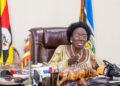
KAMPALA — Minister for the Presidency Babirye Milly Babalanda has called on Ugandans living abroad to look beyond remittances and invest their skills, knowledge, technology and capital in Uganda to accelerate the country’s economic transformation.
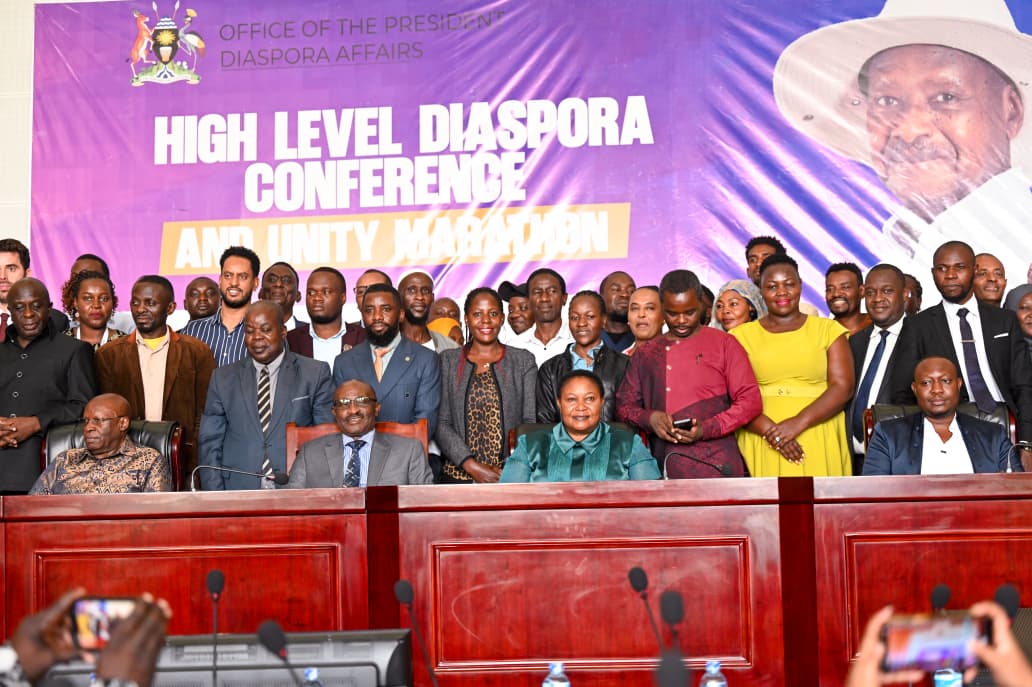
Babalanda made the call on Wednesday while opening a High-Level Conference for Diaspora and Forced Migrant Communities at the Office of the President Conference Hall in Kampala.


The conference was held under the theme, “Bridging Worlds: Diaspora & Forced Migrants for Shared Prosperity.”
Babalanda said Uganda’s diaspora has a significant role to play in the country’s development, particularly through knowledge transfer, technology, investment, partnerships and skills development.
According to the minister, Ugandans abroad remitted approximately US$2.8 billion, equivalent to more than Shs10 trillion, in the 12 months to March 2026, up from about US$1.9 billion recorded during the previous year.
While commending the contribution of remittances to households and the wider economy, Babalanda urged Ugandans abroad to complement financial support with investments that can create jobs, transfer expertise and strengthen local industries.
She said the government, through the Office of the President Diaspora Affairs headed by Senior Presidential Advisor on Diaspora Affairs Ambassador Abbey Walusimbi, is working with Ministries, Departments and Agencies to ensure that Ugandans abroad participate meaningfully in the country’s development agenda.
Babalanda also used the conference to reaffirm the government’s commitment to protecting the rights and dignity of Ugandans, whether living at home, abroad or returning from other countries.
She described migration as fundamentally a human experience driven by the search for hope and better opportunities.
Uganda’s commitment to supporting displaced people, she said, is also reflected in its open-door refugee policy, which has made the country one of Africa’s largest refugee-hosting nations.
“This demonstrates the character of our people: we know what it means to need a helping hand, and we believe every person deserves dignity,” she said.
However, Babalanda urged forced migrants whose stay in Uganda has not been regularised to work with the relevant authorities to obtain the necessary documentation in accordance with Ugandan law.
She also reminded all communities living in Uganda to respect the country’s laws, just as Ugandans living abroad are expected to comply with the laws of their host countries.
The minister said the government remains committed to assisting Ugandans who encounter difficulties abroad, citing recent interventions to rescue and repatriate Ugandans subjected to exploitation.
She also pointed to the rehabilitation of thousands of returnees from South Africa at NALI-Kyankwanzi, where they have received start-up and resettlement support.
Turning connections into practical support
Walusimbi said the conference was intended to move beyond discussions and create practical links between Ugandans in the diaspora, returnees and forced migrant communities.
“This conference is about connecting them in practical ways. We want the knowledge, networks, skills, and resources of the Ugandan diaspora to open doors for forced migrants and returnees,” he said.
He added that the experiences and resilience of people who have been displaced or returned from abroad should also be recognised and supported.
Walusimbi said the conference was expected to produce several practical outcomes, including a clearer understanding of the challenges and opportunities facing Ugandan diaspora communities, returnees and forced migrants.
Participants are also expected to develop practical ideas through which diaspora networks can support livelihoods, skills transfer, mentorship and reintegration, including through initiatives such as the National Return and Reintegration Framework being advanced by the Ministry of Gender, Labour and Social Development.
The conference is further intended to strengthen coordination among institutions responsible for diaspora affairs, migration, refugee management and reintegration.
Walusimbi said this would help ensure that the Office of the President Diaspora Affairs, Ministry of Foreign Affairs, Ministry of Gender, Labour and Social Development, refugee management agencies and local governments complement rather than duplicate one another’s work.
“We believe that these outcomes are deliberately modest and achievable. We prefer a few things done well to many ideas that remain on paper,” he said.
Families at the centre
Walusimbi said discussions about migration and diaspora affairs should remain focused on the people affected by them.
He cited families that depend on remittances for education and household needs, returnees attempting to rebuild their livelihoods after difficult experiences abroad, forced migrants seeking stability and host communities sharing resources and services.
He acknowledged that Uganda’s refugee-hosting policy and diaspora contributions have brought significant benefits but also noted the pressure migration can place on public services, social cohesion and local economies.
These pressures, he said, are felt in Kampala, refugee-hosting districts and regions such as Karamoja.
“When systems work and people support one another, hope grows. When people are left behind or processes are unclear, the whole nation feels the cost,” Walusimbi said.
He said the Office of the President Diaspora Affairs would continue working to bridge these gaps by convening stakeholders, listening to communities and supporting practical collaboration while respecting the mandates of other institutions.
Walusimbi urged participants to engage openly, share their experiences, listen to one another and focus on solutions that can be implemented within Uganda’s institutional framework.
“Let us work together to turn dialogue into practical bridges that serve the people of Uganda and strengthen our shared future,” he said.
The conference brought together heads of diplomatic missions, senior government officials, representatives of diaspora and forced migrant communities, and civil society organisations.









 English