


















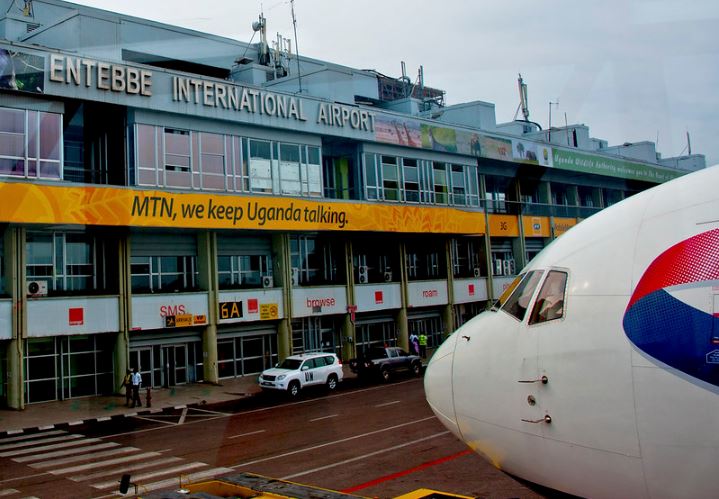
The Uganda Civil Aviation Authority (UCAA) has announced plans to separate its aviation regulatory responsibilities from airport management functions by mid-2027, a move intended to strengthen industry oversight, enhance operational efficiency and eliminate possible conflicts of interest.
Speaking on Friday after a major aviation security exercise at Entebbe International Airport, UCAA Director General Fred Bamwesigye said the authority has been working on reforms that will create two independent entities—one responsible for regulating Uganda’s aviation sector and another dedicated to managing airport operations.


According to Bamwesigye, the rapid growth of the country’s aviation industry has made it necessary for the regulator to carry out its oversight mandate independently, while allowing a separate institution to focus on running airports.
He explained that the transition is being implemented gradually to ensure both organisations are financially and operationally sustainable once established.
Bamwesigye said the legal instruments required for the separation are expected to be ready by the middle of next year before being presented to Cabinet and Parliament for approval. The process will also involve drafting new legislation and regulations to guide the operations of the two institutions.
The announcement coincided with a full-scale aviation security simulation exercise, dubbed EX 2026, conducted at Entebbe International Airport to assess the readiness of agencies responding to a potential aircraft hijacking.
The two-and-a-half-hour drill, which started shortly after midday, simulated the hijacking of a Fenna Airlines aircraft carrying 67 people, including 62 passengers and five crew members.
Under the exercise scenario, a hijacker managed to enter the cockpit before take-off when the pilot briefly left his seat, overpowered the co-pilot and took control of the aircraft. The simulation featured ransom demands, negotiations and a coordinated response involving several security and emergency agencies.
Bamwesigye said the exercise was designed to test emergency response systems, inter-agency coordination and airport incident management under high-pressure circumstances.
He noted that such exercises are compulsory for international airports within member states of the International Civil Aviation Organization (ICAO) and must be conducted every two years to validate airport contingency plans. The drills are required under Annex 17 of the Chicago Convention and Uganda’s Civil Aviation Security Regulations of 2022.
He commended security agencies, airline operators, ground handling companies, health workers and other government institutions that took part in the simulation.
Following the exercise, participating organisations held a debriefing session to review their performance, identify strengths and address areas that need improvement.
Bamwesigye said these post-exercise assessments play a critical role in improving preparedness for real-life emergencies.
UCAA last conducted a full-scale aviation security exercise in October 2023, followed by a tabletop simulation in 2024. Another full-scale aviation safety exercise was held in May 2025.
Uganda recently attained a score of 81.6 percent in the International Civil Aviation Organization’s Universal Security Audit Programme–Continuous Monitoring Approach, surpassing both regional and global averages, according to Bamwesigye.









 English