















Concerns over the security of President William Ruto have intensified following a series of unsettling incidents in which individuals managed to breach his security perimeter during public engagements in different parts of Kenya.
The most recent incident occurred on Tuesday, April 28, during a development tour in Soweto, Lang’ata.


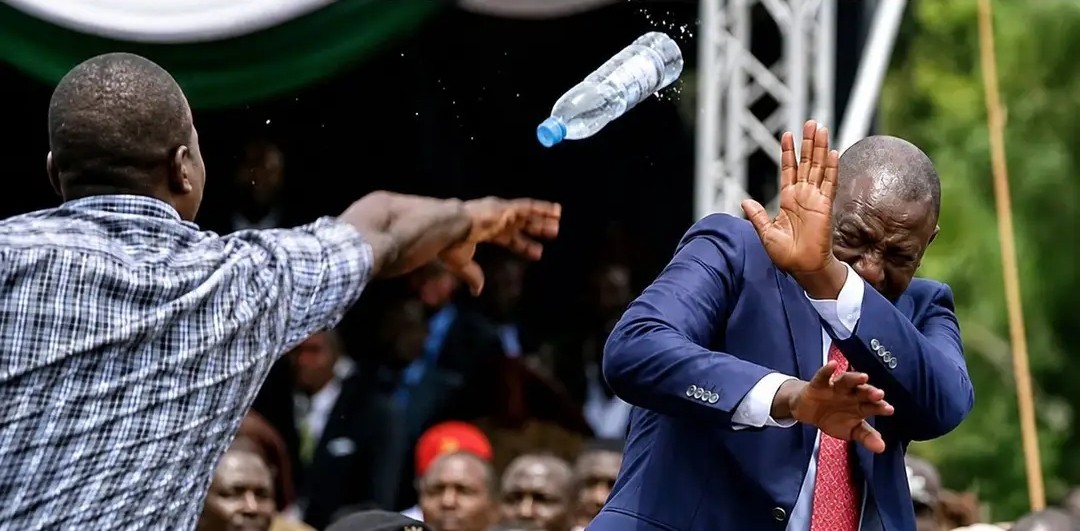
The President, who was accompanied by Lang’ata Member of Parliament Phelix Odiwuor (Jalang’o) and other senior government officials, was walking through the area interacting with residents and local traders when a white object, believed to be a bottle, was suddenly hurled from within the crowd.
Witnesses reported a brief moment of tension as the object was thrown from behind the crowd, prompting immediate reaction from his security detail.
The President was swiftly surrounded and moved to safety as officers attempted to identify the person responsible. However, both the suspect and the object were not immediately recovered.
This incident adds to a worrying pattern of security lapses. In May 2025, during a separate public address, another object was reportedly thrown toward the President, striking his left arm while he was speaking to supporters.
The moment, captured in videos widely shared online, sparked public debate about crowd control measures at high-level political events.
In a third incident earlier in Wajir County, a man identified as Ahmed Mohamed allegedly rushed toward the President while he was addressing a gathering.
Security personnel quickly intervened, restraining the individual before he could reach the head of state. He was later taken in for questioning to establish his intentions.
The repeated breaches have triggered criticism and concern among Kenyans, with many questioning the effectiveness of presidential security arrangements during open public engagements.
Social media platforms have been flooded with reactions, with citizens debating whether the incidents reflect growing political tension, lapses in crowd management, or intelligence failures.
While government officials have not issued a comprehensive statement addressing the pattern of incidents, security analysts say the episodes highlight the challenges of protecting high-profile leaders in crowded, politically charged environments.
For now, the incidents continue to fuel public discussion about state security preparedness and the risks associated with high-level political tours across densely populated areas.








 English