






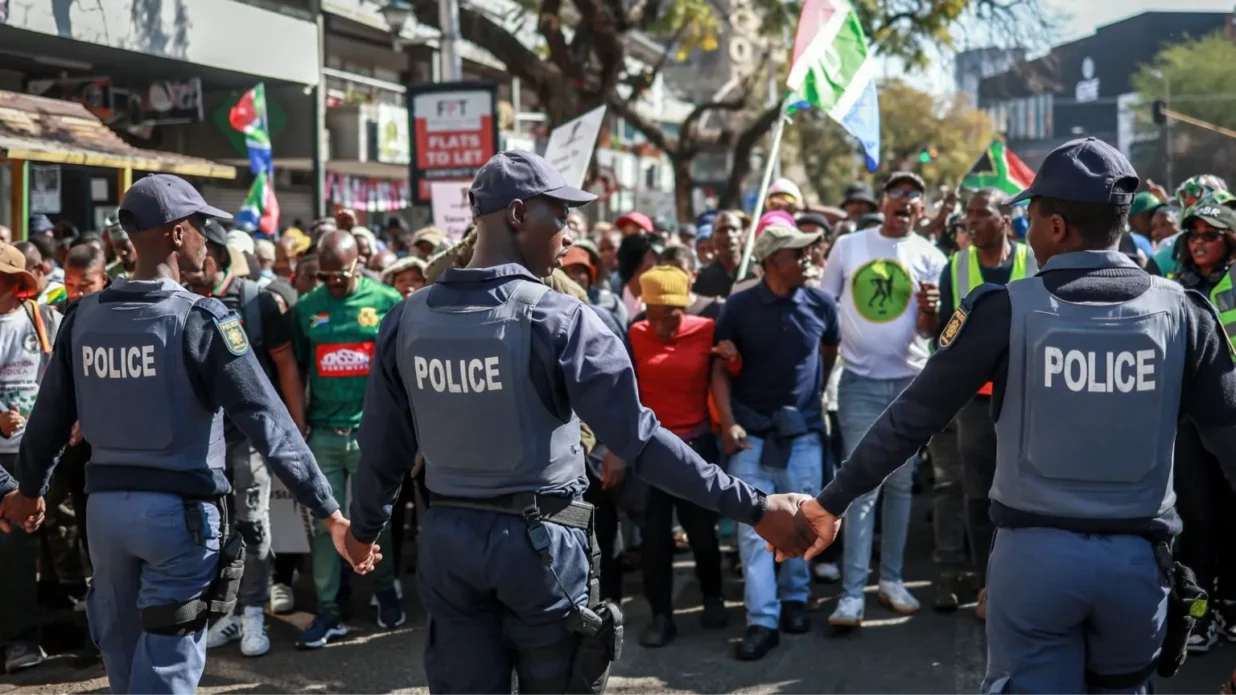
Thousands of people are marching in South Africa’s main cities to demand that all undocumented migrants leave the country.
Police officers, backed by private security guards, have been deployed because of fears that the protests could turn violent. Anti-migrant groups had set Tuesday as the deadline for undocumented migrants to leave.
Many foreigners have already fled to escape violence and intimidation. South African police say 25,000 have been repatriated so far. Most are from other African countries.
One undocumented Malawian told the BBC he was “happy to be going back” but “heartbroken” to be leaving behind four young children.
The Ministry of Police said the protests were largely peaceful across the country, with isolated incidents of looting and attempted looting.
Johannesburg, where one of the protests is taking place, is unusually quiet. Shops in the city centre are closed, while police visibility is high on major streets.
Some protesters threw bricks, breaking the windows of some homes in Yeoville, a suburb of Johannesburg where many African migrants live.
Police said they had arrested five people for the alleged looting of a foreign-owned shop in Johannesburg’s biggest township, Soweto.
About 10 people were also arrested for looting in KwaZulu-Natal Province, while a woman was arrested for assaulting a police officer and a man for “intimidation” following reports of a foreign national being beaten up, police said.
Many businesses in central Durban, the main city in the province, are also shut. A police helicopter has been circling the city.
President Cyril Ramaphosa met some of the protest leaders on the eve of the marches in a bid to defuse tensions.
He has repeatedly warned demonstrators to act peacefully, while also accepting the need for immigration reforms.
“Some foreign nationals who live in South Africa are here lawfully,” he reminded citizens in his weekly newsletter.
“They work, study, raise families, invest in our economy, and contribute positively to our society. They too are entitled to the protection of our laws and our Constitution.
“The right to protest and freedom of expression do not allow people to threaten or intimidate others, or to engage in acts of vandalism or violence,” he wrote.
There are more than three million documented foreign nationals in South Africa, according to official figures.
The statistics do not record the many more migrants believed to be in the country without papers—a bone of contention for the protesters.
Police said that about 50,000 migrants had been arrested since January for being in the country illegally.
A Soweto resident told the BBC that protesters merely wanted foreigners “to comply” with the laws of South Africa.
She said that, with the heavy police presence, she did not believe the march in Johannesburg would turn violent.
Another protester, who is part of the anti-migrant group Operation Dudula, said they would “push the police to do their job” if undocumented migrants did not leave South Africa.
Many African migrants moved to South Africa around the time white-minority rule ended in 1994, hoping for a better life.
But with South Africa facing an unemployment rate of more than 30%, anti-migrant sentiment has risen.
Nigeria flew out 269 of its citizens on the eve of the protests, bringing the number evacuated so far to around 600. More evacuations are expected to take place in the coming days.
Ghana, Malawi, Mozambique, and Zimbabwe have also been repatriating their citizens by plane or bus.
Ahead of the deadline, thousands of migrants have been awaiting processing in temporary camps for several weeks out of fear for their safety.
In Durban, which has seen some of the biggest protests, white tents housing mostly Malawians are being dismantled as authorities race to clear the transit camp.
About 7,000 Malawians have already been repatriated, Malawian media report.
Women in colourful sarongs sat on top of their belongings, waiting in line to board buses home to Malawi.
One man, Nelson Mbewe, said he had gone to South Africa in search of employment to support his family in Malawi.
“But we’ve faced challenges—they’re saying we should go back home because we do not have the right documents,” he told the BBC.
“They say we are ‘makwerekwere'”—a xenophobic slur used to refer to African migrants from other countries—Mbewe said.
“It’s their country, so what can we do? That’s why we have accepted that we just have to [unwillingly] go back home.”
Hassan Phiri, a Malawian who is still waiting to be processed, had a message for the protesters: “All I want to say to South Africans is that we are all one. No matter what is happening, no matter what will happen, Africa must remain Africa.
“Africa can’t be Africa without South Africa… without Malawi, without anywhere,” he told the BBC, adding, “So whatever happens, we must love each other and stick together as Africa.”
Anti-migrant marches have been authorised in Durban, Johannesburg, and other cities.
The authorities have warned organisers to ensure there is no violence but say they are prepared for any potential disruption.
Police say traditional weapons are not allowed. This could lead to tension between protesters and the police because many of the protesters are ethnic Zulus and carry their shields, whips, and sticks when they go on marches.
However, police have so far allowed them to carry the weapons, seizing only a machete at a march in Durban.
Xenophobia has long been an issue in South Africa and has sometimes led to violence.
According to the African Centre for Migration and Society’s (ACMS) xenophobic violence tracker, Xenowatch, two people have been killed this year.
In 2008, more than 60 people died during a wave of rioting against non-South Africans.






 English