


















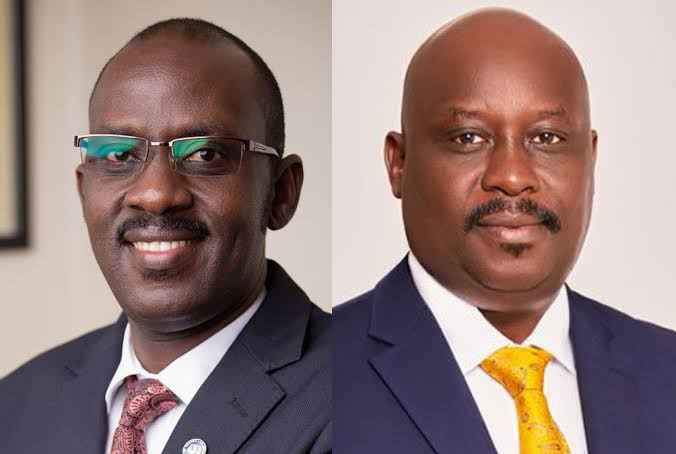
Sembabule District Returning Officer Gracious Aryeija has told the High Court that Mawogola North MP Aine Godfrey Kaguta Sodo did not present his original Uganda Certificate of Education (UCE) and Uganda Advanced Certificate of Education (UACE) certificates during nomination, but instead relied on verification letters issued by the Uganda National Examinations Board (UNEB).
Aryeija also revealed inconsistencies in the names appearing on Sodo’s academic records and identification documents, saying the UNEB verification letters bore the name Aine Godfrey, while his deed poll carried Aine Godfrey Kaguta Sodo and his National Identity Card indicated Aine Godfrey Kaguta.


The returning officer said he sought guidance from the Electoral Commission’s legal department in Kampala after noticing the differences before proceeding with Sodo’s nomination.
The disclosures emerged on Friday during cross-examination by election petitioner Jet John Ndamagi Tumwebaze before Kampala High Court Civil Division Judge Bernard Namanya.
Tumwebaze, who lost the Mawogola North parliamentary election, is challenging Sodo’s victory, arguing that irregularities in his nomination documents, coupled with questions surrounding his academic qualifications, rendered his candidature invalid.
During the proceedings, Tumwebaze sought clarification on the academic documents Sodo submitted during the nomination exercise, particularly the absence of his original UCE and UACE certificates.
Asked whether Sodo had presented his Primary Leaving Examination (PLE), UCE and UACE certificates, Aryeija told court that he had not received the original documents. Instead, the candidate presented UNEB verification letters confirming his Ordinary and Advanced Level qualifications.
Tumwebaze questioned whether candidates who present original UCE and UACE certificates are also required to obtain verification letters from UNEB.
Aryeija said the Electoral Commission does not require additional verification letters from candidates who submit their original academic certificates. He, however, acknowledged that UNEB verification letters can be accepted as substitutes where original certificates have been lost.
The petitioner further sought to establish whether Sodo had presented a letter from his former school confirming that he had sat the examinations but lost his certificates, alongside a police document relating to the reported loss.
Aryeija said he could not recall whether the candidate had submitted those supporting documents.
The cross-examination also focused on the discrepancies in the names appearing on Sodo’s academic verification letters, deed poll and National Identity Card.
Aryeija confirmed that the UNEB letters were issued in the name Aine Godfrey, while the deed poll bore Aine Godfrey Kaguta Sodo. His National Identity Card, however, carried the names Aine Godfrey Kaguta.
The returning officer told court that Sodo submitted both the deed poll and National Identity Card during nomination. He added that he checked the voters’ register and established that the candidate was registered as Aine Godfrey Kaguta, matching the names on his National Identity Card.
Explaining how he handled the discrepancies, Aryeija said he noticed the additional name, Sodo, in the deed poll and consulted the Electoral Commission’s legal department in Kampala before clearing the candidate.
He maintained that he acted lawfully and within his mandate.
However, Tumwebaze questioned whether Aryeija had effectively transferred his responsibility to scrutinise nomination documents to the Electoral Commission headquarters instead of independently making the decision at the district level.
The petitioner accused the returning officer of surrendering his authority to the commission’s legal department and failing to safeguard the integrity of the nomination process by clearing a candidate whose documents allegedly contained unresolved discrepancies.
Aryeija rejected the suggestion, maintaining that he had acted independently and within the law.
Tumwebaze also asked whether the returning officer knew that nominating a candidate using illegally assumed names could render the nomination invalid. Aryeija answered in the affirmative.
The cross-examination subsequently shifted to the declaration of election results, with Tumwebaze questioning the procedures followed in declaring Sodo the winner.
Asked to explain a tally sheet, Aryeija described it as a document summarising the votes obtained by candidates at a polling station.
Tumwebaze alleged that the returning officer declared Sodo the winner without having the relevant tally sheet to guide him. He also questioned the timing of the declaration form, claiming it had been generated and printed approximately three hours before the tally sheet.

The petitioner suggested that the sequence raised questions about whether the declaration form had been backdated.
In response, Aryeija said the timestamps appearing on the documents were system-generated and that Electoral Commission information technology personnel would be better placed to explain how the times were recorded.
Tumwebaze further accused the returning officer of favouring some candidates during the electoral process.
Aryeija’s testimony followed Sodo’s appearance in court on Thursday, when the legislator explained that he lost his original Ordinary and Advanced Level academic certificates in 2019 while moving from one residence to another.
Sodo told court that he subsequently obtained verification letters from UNEB to establish his academic qualifications.
He maintained that he possessed the minimum academic qualifications required by law and that the differences in the names appearing on his academic records and official identification documents had been addressed through a deed poll.
Beyond the academic qualification and nomination disputes, Tumwebaze accuses Sodo and individuals allegedly associated with his campaign of involving armed Uganda People’s Defence Forces (UPDF) personnel in the election.
He alleges that soldiers were deployed at several polling stations, where they intimidated voters, assaulted election agents and supervisors, and interfered with the voting process.
The petitioner has also challenged the declaration of results, citing alleged discrepancies between declaration forms in his possession and those presented by the Electoral Commission.
Tumwebaze maintains that he garnered 6,955 votes against Sodo’s declared 15,923 votes.
Sodo has denied the allegations, maintaining that he was duly nominated and lawfully declared the winner of the January 2026 parliamentary elections.




 English
