

















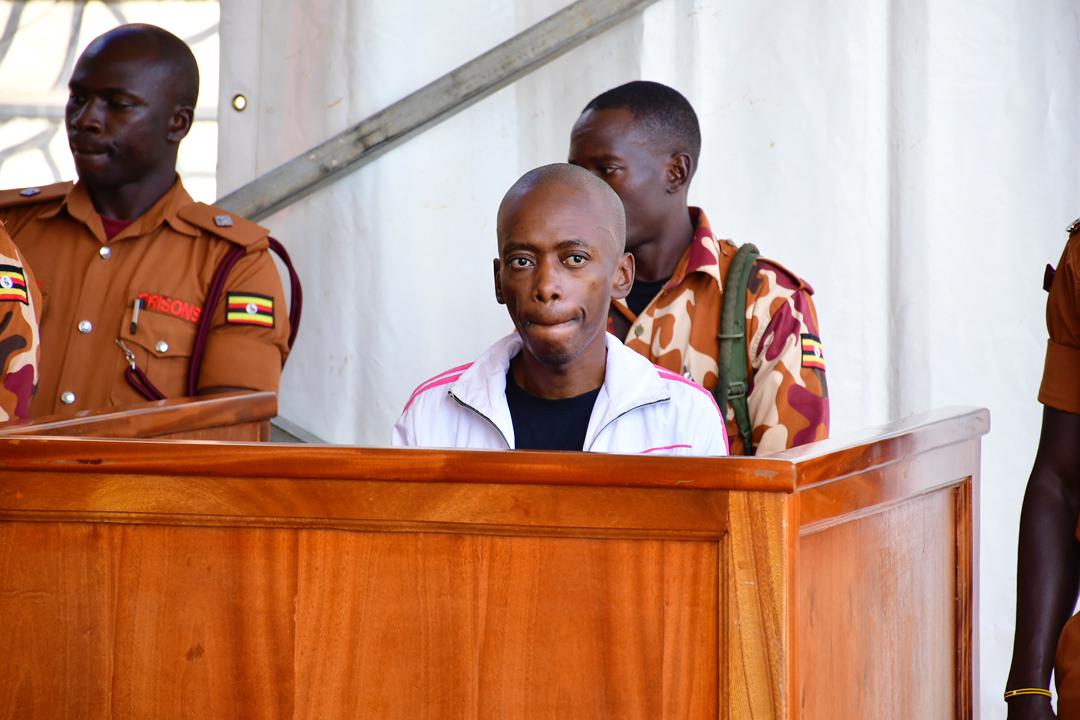
Christopher Okello Onyum, a 39-year-old Ugandan-born American, has been found guilty of murdering four toddlers at a daycare in early April this year in Uganda’s capital, Kampala.
After a marathon of mobile High Court sessions held at Ggaba Community Church in Ggaba Parish, Makindye Division, not far from where the brutal deaths occurred, Justice Alice Komuhangi Khaukha on Thursday (April 30) convicted Okello on four counts of murder.


The young victims, all aged below three, were Ryan Odeke, Keisha Agenorwoth Otim, Gideon Eteku, and Ignatius Sseruyange.
The four children, three boys and one girl, were fatally stabbed by a knife-wielding Okello on what had been a routine day at the Early Childhood Development Programme Centre on April 2. The daycare was founded by Ggaba Community Church.
Eleven days after that dark day, Okello appeared in court for the first time and was charged with four counts of murder, one for each of the slain children. He pleaded not guilty to all charges.
Under Ugandan law (Penal Code Act), the punishment for murder is either the death penalty or life imprisonment.
Beyond Reasonable Doubt
On the ingredients or elements of murder, the prosecution must prove beyond reasonable doubt that there was the death of a human being, that the death resulted from an unlawful act, that the accused participated in the death, and that there was malice aforethought.
In her ruling, Justice Komuhangi said the prosecution presented evidence in the form of postmortem reports by Dr Abdul Katongole of City Mortuary, who conducted the autopsies, confirming that death had indeed occurred.
The parents of the victims and two staff members of the daycare, a caretaker and a coordinator, also appeared in court and confirmed the children’s deaths.
The judge said eyewitness accounts and the nature of the injuries on the children’s bodies proved that their deaths resulted from an unlawful act.
On the participation of the accused, Komuhangi said the accused himself did not deny killing the children. The prosecution also adduced corroborated evidence showing that Okello actively took part in the murders, including a report by scene of crime officers, CCTV footage, and DNA analysis reports.
“Defenseless, Innocent Babies”
Delivering their joint lay opinion on Monday this week, the three-member team of assessors found Okello guilty of the crime.
Musa Musana, Racheal Ainomugisha, and Maria Theopista Kyolijja told the judge that the prosecution team of chief state attorneys Jonathan Muwaganya and Anna Kiiza had sufficiently proved that Okello was culpable of the four murders.
They cited medical expert reports as evidence that Okello was in a stable mental state at the time of committing the crimes.
The assessors also relied on CCTV footage, call data records, and testimony from daycare staff.
They concluded that the prosecution had not only placed Okello at the crime scene but also demonstrated his participation in the killings.
In her judgment on Thursday, Komuhangi said the court agreed with the assessors that the accused committed the offences.
On the fourth element of murder, malice aforethought, the judge noted that it is a mental element that is not easily proven by direct evidence.
However, she said inferences may be drawn from several factors, including the nature of the weapon used, the part of the body targeted, the nature of injuries, and the conduct of the accused before, during, and after the offence.
She cited prosecution evidence from two daycare staff members, who testified that they saw the accused “aggressively and gruesomely cut the necks of the four children with a knife” on the morning of April 2.
Justice Komuhangi also referred to evidence from scene of crime officers showing images of the severe injuries inflicted on the children, as well as the recovery of the knife allegedly used, which had been tossed over a chain-link fence.
“The above evidence would be sufficient to prove malice aforethought, because there would be no other inference when a person pounces on defenseless, innocent babies and cuts their necks as if slaughtering a goat or chicken, in that precise and deliberate manner,” the judge ruled.
During final oral submissions on Monday, the defence team of Richard Kumbuga and Sarah Awero argued that Okello was suffering from schizophrenia, a mental disorder, and therefore should be acquitted.
Kumbuga relied on provisions of the Penal Code Act, arguing that a person is not criminally responsible if, at the time of the act, they are, due to a disease of the mind, incapable of understanding their actions.
In his unsworn testimony last week, Okello told court that he had endured a “distressing period” between January and March this year.
He described being pursued by individuals over money, which forced him into hiding. He also claimed he attempted to rob a bank and harm his brother’s family.
He did not deny killing the children but said he did not do so deliberately, insisting there were circumstances that influenced his actions on April 2.
Only two of his four defence witnesses appeared in court, while the others could not be reached as the provided phone numbers, including one American number, were switched off.
In her ruling, Justice Komuhangi said Okello failed to clearly explain the circumstances that allegedly forced him to commit the crime, nor did he identify the friends he claimed had threatened his life.
The defence team had relied on the insanity defence. “When an accused raises insanity, it becomes his responsibility to prove that he was suffering from that condition at the time of the offence,” Komuhangi said.
The judge then evaluated whether:
- the accused was suffering from a disease of the mind at the time,
- the disease rendered him incapable of understanding his actions, and
- he knew or did not know that his actions were wrong.
Komuhangi noted that Okello was the only witness to claim he was mentally unwell at the time of the killings. She also observed that he did not call his biological parents, who are alive, to testify regarding his alleged previous admission to Butabika Hospital six years ago.
Diminished responsibility
The judge said another possible defence would have been diminished responsibility, which can reduce murder to manslaughter if the accused’s mental capacity was substantially impaired.
However, she said there was no evidence that Okello suffered from such impairment.
“The only condition mentioned by witnesses is sickle cell disease,” she noted.
She added that medical expert Dr Roger Agenda of C-Care IHK, who examined Okello during his citizenship process, confirmed that sickle cell disease is not a cause of mental illness, though it may be a risk factor due to pain and strong medication.
However, the doctor testified that Okello showed no symptoms of mental disability during examination.
The court also dismissed the argument that medication such as Diclofenac, found in Okello’s possession at the time of arrest, was related to mental illness.
“In light of the above, I also find that the defence of diminished responsibility is not available to the accused person,” Komuhangi ruled.
“On the contrary, the prosecution adduced evidence showing that at all material times, the accused was of sound mind and in control of his actions.”
Okello was also found to have searched online for car rental services, schools for young children, and videos of beheadings by ISIS, an extremist armed group.
The judge concluded that Okello was fully aware and in control of his actions in the killings, and ruled that the prosecution had proved all elements of murder.
She agreed with the assessors that Okello is guilty on all counts.
Court adjourned and was set to resume for sentencing.










 English