


















Women entrepreneurs who missed out on government-backed loans under the Generating Growth Opportunities and Productivity for Women Enterprises (GROW) Project will have another opportunity to expand their businesses through grants of up to Shs107.07 million.
The grants, which do not require repayment, are intended to support women-owned micro and small enterprises that failed to access GROW loans because of financial constraints, banking requirements or credit limitations.


The initiative, known as the Business Plan Competition Grant, is expected to benefit at least 2,626 women-owned businesses across Uganda, including at least 767 enterprises in refugee-hosting districts.
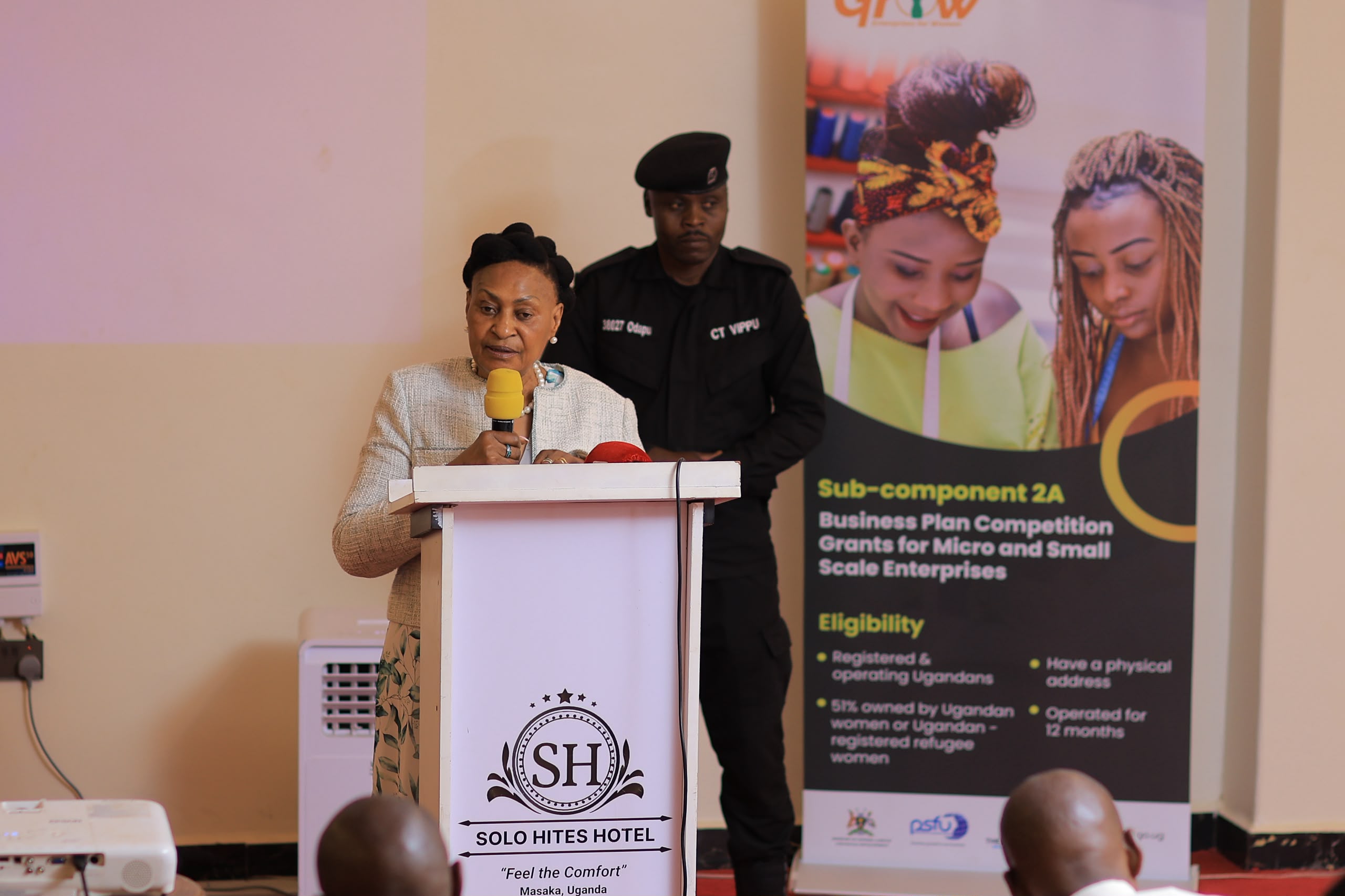
Minister of State for Elderly Affairs Jackline Mbabazi said the grants were introduced to widen access to government support and ensure that women entrepreneurs who could not secure loans are not excluded from opportunities to grow their businesses.
Speaking during a regional orientation meeting for local government leaders at Solo Heights Hotel in Masaka City on October 6, 2026, Mbabazi said the programme would help women transform small-scale businesses into competitive and sustainable enterprises capable of creating jobs and contributing to economic growth.
“The Business Plan Competition Grant provides a direct, non-repayable capital opportunity to finance business expansion,” Mbabazi said, urging local government leaders to mobilise eligible women and guide them through the application process.
Under the funding arrangement, eligible micro enterprises will receive grants ranging from Shs3.5 million to Shs35.69 million. These businesses should employ up to four people and have annual sales or assets of up to Shs10 million.
Small enterprises employing between five and 49 people, with assets ranging from Shs10 million to Shs100 million, will qualify for grants ranging from Shs39.259 million to Shs107.07 million.
The funding is intended to support business expansion, formalisation, the acquisition of production equipment and working capital. Larger grants will prioritise enterprises with significant economic potential, particularly those operating in male-dominated and non-traditional sectors.
The programme will promote businesses based on science, technology, engineering and mathematics (STEM), as well as green enterprises and climate-resilient innovations. Priority sectors include construction, metal fabrication, robotics, solar energy, irrigation, waste management, commercial agricultural processing, health technology and childcare facilities for children aged between zero and three years.
Women entrepreneurs in refugee-hosting districts, persons with disabilities and other vulnerable groups will benefit from broader eligibility provisions covering businesses such as poultry and goat rearing, food processing, tailoring, childcare, mobile money services and catering.
Mbabazi called on resident district commissioners, district chairpersons, mayors, chief administrative officers, commercial officers and women entrepreneurs’ platform leaders to ensure that information about the grants reaches eligible applicants, particularly those in rural communities who may have limited access to government programme information.
She emphasised that the grants are intended for women who did not receive GROW loans, meaning previous beneficiaries of the project’s loan component will not qualify for the new funding opportunity.
The minister also warned against fraud and extortion, saying women should not be exploited by individuals claiming to have connections that can help them secure government funding.
Applications will be free of charge, and applicants will not be required to pay officials, consultants or brokers to obtain application forms or access the grants.
The application process will be conducted digitally through the official GROW Project website or mobile application. The call for applications is scheduled to open on October 15, 2026, and remain open for 30 calendar days.
To help applicants prepare competitive proposals, business clinics will be organised across Uganda’s 19 sub-regions and 12 refugee settlements from the end of October. The clinics will provide guidance on preparing business proposals, budgets and supporting documentation.
Grant awards are expected by the end of December 2026, with implementation and monitoring scheduled for 2027. Successful applicants will be required to implement their projects over nine to 12 months, with all funded activities expected to be completed by June 2027.
To qualify, businesses must be legally registered in Uganda and owned by a Ugandan woman or an eligible registered refugee woman. They must also have been operational for at least one year, supported by business records.
Applicants will be required to provide a National Identification Number or refugee identification documents, together with at least 12 months of bank statements.
The grant programme is part of the $217 million GROW Project, implemented by the Ministry of Gender, Labour and Social Development with support from the World Bank. The wider initiative includes $40 million dedicated to refugees and host communities.
The project aims to support 60,000 female-owned enterprises, including 3,000 refugee-owned businesses, and reach 280,000 women entrepreneurs and employees. It is also expected to benefit an estimated 1.6 million people indirectly.
The new grant window provides an alternative for women entrepreneurs whose businesses could not meet lending requirements, although applicants will still need to satisfy the programme’s registration, operational and documentation criteria.
Mbabazi urged local government leaders to help eligible women register their businesses, obtain the required documentation and participate in the business clinics. She also called on officials and community leaders to report suspected cases of corruption or exploitation to the relevant authorities.
She said effective mobilisation, transparent selection and proper monitoring would be essential to ensuring that the grants reach women entrepreneurs with viable business ideas and the potential to expand production, create employment and contribute to Uganda’s economic development.









 English