















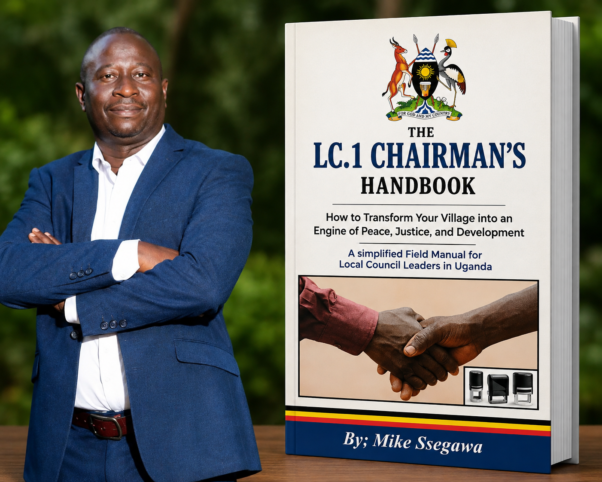
Ugandan journalist, community leader and public servant Mike Ssegawa has launched a practical handbook aimed at equipping Local Council One (LC1) chairpersons with the knowledge and skills needed to improve governance, strengthen security and drive development in their villages.
The publication, titled The LC1 Chairman’s Handbook: How to Transform Your Village into an Engine of Peace, Justice, and Development, is designed as a user-friendly guide for grassroots leaders.


Drawing on his experience as a journalist and later as a Deputy Resident District Commissioner (RDC), Ssegawa says the handbook responds to the day-to-day challenges faced by village chairpersons in administering their communities.
He has pledged to distribute the handbook free of charge to LC1 chairpersons across Uganda, saying many grassroots leaders assume office with limited access to practical guidance despite their critical role in local governance.
The handbook is divided into 12 chapters that address the key responsibilities of LC1 leaders. It covers leadership and ethics, village security, grassroots justice, public health, local economic development, emergency response, meeting management and the revival of bulungi bwansi, Uganda’s long-standing culture of community voluntary work.
Beyond theory, the guide includes practical tools such as official registers, meeting templates, standard forms, a 12-month village transformation calendar and simplified explanations of the Succession Act and the Marriage Act to help leaders handle common legal and administrative matters.
Ssegawa also highlights the importance of close collaboration between LC1 chairpersons and Resident District and City Commissioners (RDCs and RCCs), arguing that effective coordination is essential for maintaining security, monitoring disputes and ensuring government programmes reach communities efficiently.
According to Ssegawa, village leaders serve as the first point of contact between citizens and government and therefore play a crucial role in identifying emerging security concerns, mobilising residents and supporting public service delivery.
In the opening chapter, The Mind of a Transforming Leader, he encourages LC1 chairpersons to embrace servant leadership instead of treating public office as a source of personal authority.
“You are not a king; you are a caretaker,” Ssegawa writes, stressing that respect is earned through service, integrity and accountability rather than intimidation or power.
He further explains the constitutional and legal foundation of the LC1 office, noting that village chairpersons occupy the frontline of Uganda’s local governance system under the Constitution and the Local Government Act.
Ssegawa says the handbook is intended to become a practical reference for both newly elected and experienced LC1 chairpersons, enabling them to improve governance, resolve disputes peacefully, work effectively with security and administrative agencies, and promote sustainable development at the village level.










 English