


















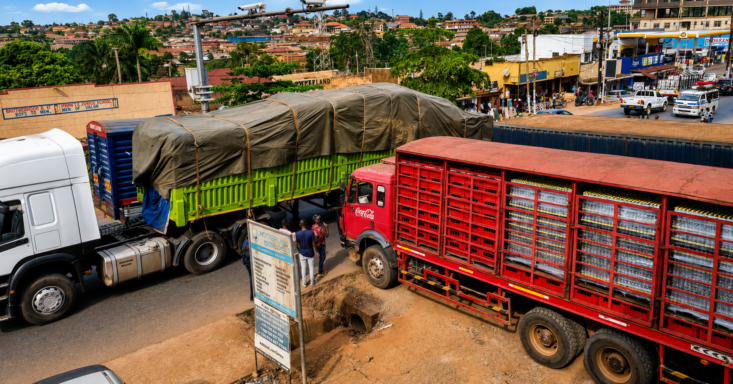
Along the busy Kampala–Jinja Highway in Mukono Municipality, a Coca-Cola distribution depot has become the center of growing public concern, with residents, transport operators and urban planners questioning why it continues to operate within a designated road reserve despite an ongoing trade order enforcement programme in the town.
The depot, located near Satellite Beach Building opposite security camera installations, has drawn criticism for its heavy presence of delivery trucks, congested loading activities, and obstruction of pedestrian walkways. What was intended as a logistics point for beverage distribution has, according to observers, gradually turned into a traffic choke point on one of Uganda’s busiest transport corridors.


Yet, despite a wider municipal exercise aimed at restoring order in urban trading spaces, the depot remains operational, raising accusations of selective enforcement and inconsistent application of the law.
A depot in the wrong place?
The facility, associated with operations of The Coca-Cola Company distribution network, sits within what urban planners describe as a sensitive road reserve zone along the Kampala–Jinja Highway, a strategic national artery linking Kampala to eastern Uganda and beyond.
At peak hours, long trailers delivering crates of soda and smaller canters collecting stock frequently queue along the roadside. The loading and offloading process often spills onto pedestrian paths, forcing walkers into the main carriageway where fast-moving vehicles pass.
Motorists say the situation becomes worse when trucks attempt to enter or exit the depot. Vehicles on the highway are often forced to slow down or stop entirely, creating brief but dangerous traffic interruptions. On a highway known for heavy cargo transport, even a few minutes of blockage can trigger a ripple effect of congestion stretching several kilometres.
Transport operators along the route describe it as a “silent hazard” that builds gradually during the day, especially in the morning and evening peaks when commuter traffic is at its highest.
The human cost of congestion
Beyond inconvenience, the depot’s location raises serious road safety concerns. Pedestrians navigating the stretch near the facility are often forced to share limited space with boda bodas and heavy trucks, increasing the likelihood of accidents.
Traffic safety experts argue that highways are not designed for frequent stopping, loading, and commercial queuing. When such activities spill onto the road reserve, the risk multiplies.
“Every minute a heavy truck blocks movement on a highway like this increases the probability of a collision,” Derrick Ddembe, one transport analyst notes. “Drivers are forced into sudden braking, risky overtaking, and unpredictable lane changes. That is how chain accidents begin.”
Mukono’s section of the Kampala–Jinja Highway has in recent years recorded multiple road incidents linked to congestion, roadside trading, and unauthorized parking within the road reserve. While not all incidents can be directly attributed to the depot, observers say its presence adds to an already fragile traffic environment.
Trade order enforcement under scrutiny
The controversy comes against the backdrop of a trade order enforcement programme implemented by local authorities in Mukono Municipality aimed at decongesting streets, removing illegal structures, and restoring pedestrian access across the town.
However, residents argue that enforcement has not been uniform. While small-scale traders, kiosks, and informal vendors were reportedly removed or displaced under the programme, larger and more established commercial operations appear to have remained untouched.
This perceived imbalance has fuelled accusations of selective implementation of the trade order. Critics say the exercise risks losing legitimacy if it is seen to target the informal sector while sparing influential or corporate actors occupying equally problematic spaces.
During earlier phases of enforcement, municipal officials indicated that the depot’s location would be reviewed. The town clerk, Francis Byabagambi, reportedly promised to engage the commercial office which issued a license for cancellation and also the planning department to identify a more suitable site for relocation. However, that promise has yet to translate into visible action.
As enforcement momentum later intensified, the community was briefly relieved when restrictions appeared to tighten around roadside activity. But according to local accounts, enforcement around the depot softened, and operations gradually returned to normal.
Allegations of selective enforcement
At the centre of public frustration is the belief that urban governance rules are being applied unevenly. While enforcement officers have been active in clearing informal structures from sidewalks and roadside areas, similar scrutiny appears absent in relation to the depot.
Some field reports suggest that enforcement teams may have informally advised depot managers to slow operations during the peak of enforcement activity. These claims, however, remain unverified.
Municipal authorities have not issued a comprehensive public explanation addressing why the depot continues to operate within a sensitive road reserve area despite ongoing clearance efforts elsewhere.
The silence has created a governance gap that residents interpret as either administrative hesitation or selective protection.
Why depots don’t belong on highways
Urban planners and transport engineers consistently warn against locating large depots, warehouses, or distribution centres directly along highways, especially within road reserves.
The reasons are both practical and safety-driven.
First, highways are designed for continuous traffic flow, not intermittent stopping. When heavy trucks enter or exit a depot, they disrupt that flow, creating bottlenecks that can extend far beyond the immediate area.
Second, loading and unloading activities require space that road reserves cannot safely provide. When operations spill onto pedestrian paths or shoulders, they eliminate safe walking space and force pedestrians into traffic lanes.
Third, highways carry mixed traffic, including long-distance trucks, commuter taxis, private vehicles, and motorcycles. Introducing stationary or slow-moving logistics operations increases conflict points between these different users.
Fourth, road reserves are legally protected spaces intended for future road expansion, drainage, utilities, and safety buffers. Encroachment reduces a road’s long-term capacity and complicates future infrastructure upgrades.
Finally, there is the issue of emergency response. Congested highway segments can delay ambulances, police response, and fire services, where every second counts.
A planning problem, not just an enforcement issue
The situation in Mukono highlights a deeper urban planning challenge faced by fast-growing municipalities: the mismatch between commercial expansion and infrastructure regulation.
As towns along the Kampala–Jinja corridor expand, businesses naturally seek high-visibility and high-access locations such as highways. However, without strict zoning enforcement and designated logistics parks, commercial actors often occupy road reserves out of convenience.
Experts argue that the solution is not only enforcement but also structured planning. This includes creating dedicated industrial and distribution zones, off-highway logistics hubs, and enforced buffer zones that separate heavy commercial activity from pedestrian and commuter traffic.
Without such systems, enforcement becomes reactive and inconsistent, often targeting the most visible or weakest actors while leaving larger structural violations in place.
Silence from authorities
Despite repeated concerns raised by residents and road users, municipal officials in Mukono Municipality have remained largely non-committal on the matter.
The town clerk has not publicly clarified the status of the depot or the earlier promise to relocate it. This silence has further deepened suspicions of uneven enforcement and administrative reluctance to confront powerful commercial interests.
Meanwhile, life along the Kampala–Jinja Highway continues under strained conditions, with pedestrians navigating narrow passages, motorists battling intermittent congestion, and heavy trucks dominating roadside activity.
A test of urban governance
The Coca-Cola depot controversy is no longer just about one facility. It has become a broader test of urban governance, rule of law, and planning discipline in a rapidly urbanising corridor.
If trade order enforcement is to retain public confidence, observers argue, it must be applied consistently across all actors, regardless of size or influence. At the same time, municipalities must confront the structural issue of highway-side commercialisation, which continues to undermine road safety and transport efficiency.
For now, the depot remains in place, traffic continues to strain around it, and residents wait for clarity on whether Mukono’s trade order is a temporary campaign or a lasting commitment to restoring order along one of Uganda’s busiest highways.
By Ivan Kimbowa | Senior Journalist | ivankimbowa7@gmail.com







 English