The Ministry of Education and Sports has unveiled a new policy aimed at streamlining Early Childhood Care and Education (ECCE), marking a significant step toward regulating a sector that has long operated without a clear national framework.
Introduced on Thursday, the policy is the first comprehensive guideline of its kind in Uganda, designed to address persistent gaps in quality, access, and oversight of early childhood services.
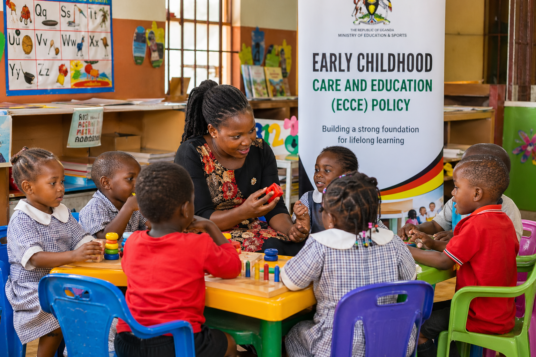
It establishes uniform standards for providers and introduces a structured system that separates childcare and early learning into two categories: daycare for children aged 0–3 years, and pre-primary education for those aged 3–6.
Officials say the distinction is intended to better match services with children’s developmental needs at different stages. However, even as the policy has been welcomed as overdue, concerns are emerging about whether it will be effectively implemented.
Sector stakeholders point to a history of well-crafted policies that failed to translate into practice due to limited funding and weak enforcement.
Hellen Namulwana, Chairperson of the National Early Childhood Development Association, questioned whether the government has the political commitment and financial capacity to ensure the policy delivers tangible results.
“The response to these concerns will determine whether this policy becomes transformative or simply another document that gathers dust,” she noted.
In response, Dr Kedrace Turyagyenda, Permanent Secretary at the Ministry of Education, expressed confidence in the policy’s rollout, emphasizing a decentralised approach.
She explained that responsibility for implementation and enforcement will rest largely with local governments, supported by active participation from communities and parents.
“Success will depend on discipline, coordination, and alignment among all stakeholders,” Turyagyenda said, adding that partners must adhere to the established standards and guidelines.
Some education actors see the decentralisation model as a potential strength. Harriet Ssegane Musoke, a parent and member of the Mothers’ Union, observed that involving local communities could improve accountability and increase the chances of success compared to previous top-down reforms.
Still, education officials caution that policy adoption alone is not enough. Dr Cleophas Mugenyi, Commissioner for Basic Education, urged stakeholders to move beyond rhetoric and fully engage with the policy’s content, warning that implementation will require deliberate effort and strict compliance, especially by local authorities now tasked with licensing ECCE centres.
He stressed that the policy will need sustained support, including funding and institutional protection, before it can deliver meaningful impact.
Meanwhile, Frances Atima, Director of Education Standards, said the ministry will prioritise nationwide dissemination of the policy to ensure it reaches key actors at all levels—from district officials and inspectors to caregivers and school administrators.
“We must understand where centres are, what they offer, and whether they meet safety and child protection standards. That is how policy translates into real change for children,” she said.
Civil society organisations have also signaled their intent to use the policy as a benchmark for accountability.
Angella Kasule Nabwowe, Executive Director of the Initiative for Social and Economic Rights, said advocates will now shift focus toward monitoring implementation and pushing for reforms where gaps emerge.
Among its key provisions, the policy introduces shorter school hours—from 9:00am to 1:00pm—to avoid overburdening young learners.
It also sets strict safety rules for transporting children, bans boarding facilities for those under six, and requires all centres to be licensed and governed under clear regulatory structures. Local governments will also have increased authority to regulate school fees and eliminate non-essential charges.
The policy comes against a backdrop of persistent challenges in access and quality. Data shows that as of 2019, only about 52.7 percent of children aged 3 to 5 were enrolled in some form of ECCE, leaving nearly half without early learning opportunities.
Of the more than 28,000 pre-primary centres operating at the time, only a small fraction were officially registered, raising concerns about standards and child safety.
Experts widely agree that investing in early childhood education yields long-term benefits for individuals and the economy.
Research indicates that by the age of five, a child’s brain has developed to about 90 percent of its adult size, making early years critical for cognitive, emotional, and social growth.
International partners, including the World Bank, have repeatedly highlighted ECCE as a cornerstone for building human capital and unlocking Uganda’s demographic potential, calling for increased investment in the sector.
As the new policy takes effect, its success will likely depend not on its ambitions, but on whether the government and stakeholders can turn commitments into sustained action on the ground.

































 English