


















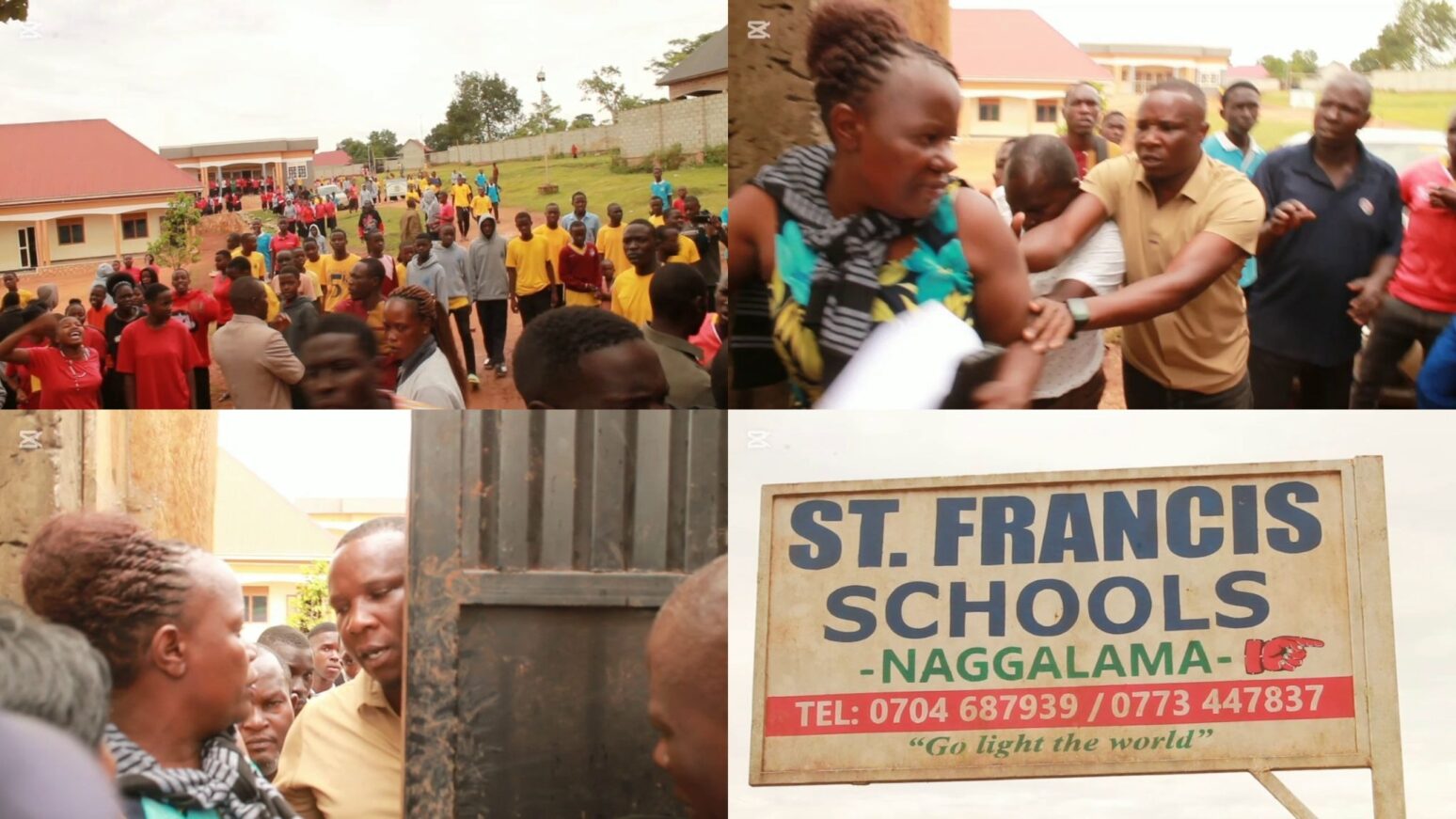
Violence erupted at St. Francis Schools Naggalama following a simmering dispute over a blocked access road, drawing in parents, residents, school authorities, and students in clashes that left several people injured and prompted police intervention.
For weeks, residents had raised concerns about a perimeter wall constructed by the school that sealed off a long-standing public access route leading to a government facility.
To the community, the closure was not merely physical; it signaled a breach of an earlier understanding that a 12-foot passage would remain open. Many of those affected were parents with children at the school, adding a deeply personal dimension to the dispute.
Tensions reached a breaking point when aggrieved residents and parents stormed the school premises demanding accountability.
Efforts to engage the administration quickly collapsed after the school director, Fred Kafumbe, allegedly blocked Hajji Juma Lubega from accessing the compound.
The two reportedly confronted each other at the gate, and the altercation ignited tempers, tipping an already volatile situation into open conflict.
What followed was chaos. Students and teachers were seen rallying behind the director, while community members surged forward, and within moments, both sides were engaged in stone-throwing.
Several people sustained injuries, though no fatalities were reported. Learning was abruptly disrupted, and the school grounds—meant to be a place of order and growth—descended into disorder.
Most troubling was the involvement of learners in the confrontation. Schools are expected to nurture discipline, critical thinking, and peaceful conflict resolution.
Drawing students into violent disputes between adults represents a serious lapse in responsibility. It risks normalizing aggression and undermines the very values education is meant to instill, sending a dangerous message that disputes are settled through force rather than dialogue.
Calm was eventually restored after intervention by security forces from Uganda Police Force, led by ASP Kiggundu and Community Liaison Officer ASP Annet.
An emergency meeting bringing together all stakeholders was convened, with authorities urging restraint and emphasizing lawful, peaceful resolution of grievances.
During the meeting, residents maintained that the access road predated the school’s acquisition of the land and should not have been blocked.
They demanded immediate restoration, stressing its importance to their daily movement. While emotions remained high, the presence of security officials helped steer discussions away from further confrontation.
A breakthrough was reached when the school director agreed to secure alternative land to create a new access route. In a show of compromise, two parents offered to sell portions of their land to facilitate the road.
A partial payment was made on the spot, and a formal agreement signed, with the balance to be cleared within an agreed timeframe. Police issued a one-week ultimatum to finalize the arrangement, warning that any further disturbances would attract firm legal action.
The incident in Nagalama underscores the dangers of unresolved grievances and poor communication. While the community’s concerns over access and land rights are legitimate, the descent into violence came at a high cost—eroding trust, disrupting education, and placing learners directly in harm’s way.
Schools, as pillars of their communities, carry responsibilities that extend beyond academics. Engagement with surrounding residents must be transparent, inclusive, and sensitive, particularly on matters affecting shared spaces. Decisions that impact public access demand consultation, not unilateral action.
Above all, the events highlight an urgent imperative: learners must be shielded from adult conflicts. Children should never be drawn into, or exposed to, violence. Their environment must remain one of safety, stability, and learning—regardless of the disputes unfolding beyond the classroom.












 English