


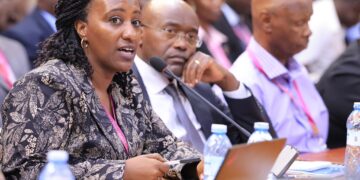

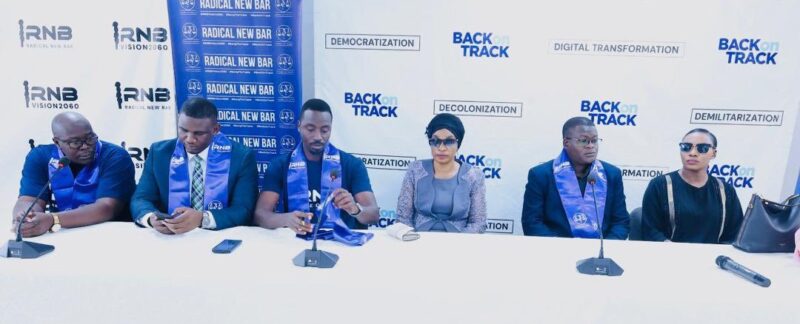
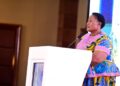
Before a packed gathering of legal practitioners at the Uganda Law Society headquarters, Zalwango Lukwago fought to steady her emotions as she recounted the ordeal her family has endured since the detention of her husband, former Kampala Lord Mayor Erias Lukwago.
Her testimony, at times interrupted by emotion, drew quiet attention from the room as she expressed gratitude to the legal fraternity for rallying behind her family during what she described as a period marked by anxiety, distress, and uncertainty.


“It encourages me deeply to see the Law Society and fellow advocates standing with us as a family,” she said, pausing briefly to compose herself.
The briefing was convened against a backdrop of heightened concern among members of the legal profession over Lukwago’s arrest and ongoing prosecution on charges related to misprision of treason.
Seated next to her was the couple’s second-born daughter, a law student at Makerere University, who, according to her mother, has been deeply affected by the incident and has struggled to maintain focus on her studies.
Zalwango told the gathering that the emotional impact on her daughter had been severe, saying she had found it difficult to attend lectures or concentrate since her father’s detention.
“She is meant to be in class, but since the arrest of her father, her mind has not been at peace,” she said, adding that she has been offering her continuous reassurance and support.
As she revisited the morning of the arrest, the atmosphere in the room grew tense. Zalwango explained that the family had received prior indications that security personnel were operating in the vicinity of their home. Despite the growing concern, she said she still prepared breakfast in an attempt to maintain a sense of normalcy.
Moments later, she recalled, loud knocks echoed through the house.
“There was a heavy bang on the main door,” she said. “After that, another forceful knock came from the bedroom area where Counsel Lukwago was.”
She alleged that armed officers entered the residence and demanded that he surrender himself. According to her account, an attempt to resist their entry resulted in her being pushed down before the arrest was carried out inside the home.
“I realized immediately they had come for him,” she said. “When I tried to intervene, I was overpowered.”
She described the following days as deeply distressing for the family, noting that they had no direct communication with Lukwago and relied instead on fragmented updates circulating on social media to piece together information about his condition and location.
“Our daughter kept checking her phone repeatedly, hoping for any update,” she said. “It was the only source of information we had.”
Zalwango also raised concerns about her husband’s health, saying he has been managing ongoing medical complications linked to previous injuries sustained during earlier arrests.
She recounted that in a prior incident, he allegedly sustained spinal injuries after being forcefully handled by security personnel, leaving him under long-term medical care with strict treatment requirements.
She explained that he continues to follow a regulated recovery routine involving prescribed medication and carefully guided physical care due to his condition.
The family later saw him at Kira Police Station, where, according to Zalwango, he described experiencing both physical discomfort and psychological distress while in custody.
“He told me he was in severe pain and had been treated harshly,” she said.
She further alleged that he was slapped repeatedly, which she claimed worsened existing hearing issues, and that he was held in conditions she described as poorly ventilated despite his respiratory challenges.
Zalwango added that his breathing difficulties had intensified, citing complaints of chest and lung discomfort following detention.
She also claimed that one of his arms, already weakened by a previous surgical procedure, had become further impaired due to the circumstances of his confinement.
While her remarks largely focused on her husband’s condition, Zalwango used the platform to appeal for greater compassion within the justice system. She urged judicial officers to weigh human dignity more carefully when making custodial decisions.
“I respectfully ask the Judiciary to consider the human side of these processes,” she said. “The principles of justice must always include humanity.”
She also questioned why alternative legal measures had not been considered in light of his health challenges, arguing that detention may not have been necessary under the circumstances.
Throughout her address, she repeatedly expressed appreciation to the legal team representing her husband, particularly advocate Medard Lubega Sseggona and other counsel involved in the case, commending their continued commitment.
She also thanked journalists, civil society actors, and the Uganda Law Society for maintaining public attention on the matter.
As the case proceeds in court, Zalwango said the family remains hopeful but continues to endure emotional strain and uncertainty about what lies ahead.
“We are asking for continued support,” she said quietly. “We do not know how this ends, but knowing we are not alone gives us strength.”
Her account turned a legal update into a deeply personal testimony—one that reflected the emotional toll on a family navigating arrest, separation, and an uncertain judicial process while holding on to the hope of eventual justice.



 English