















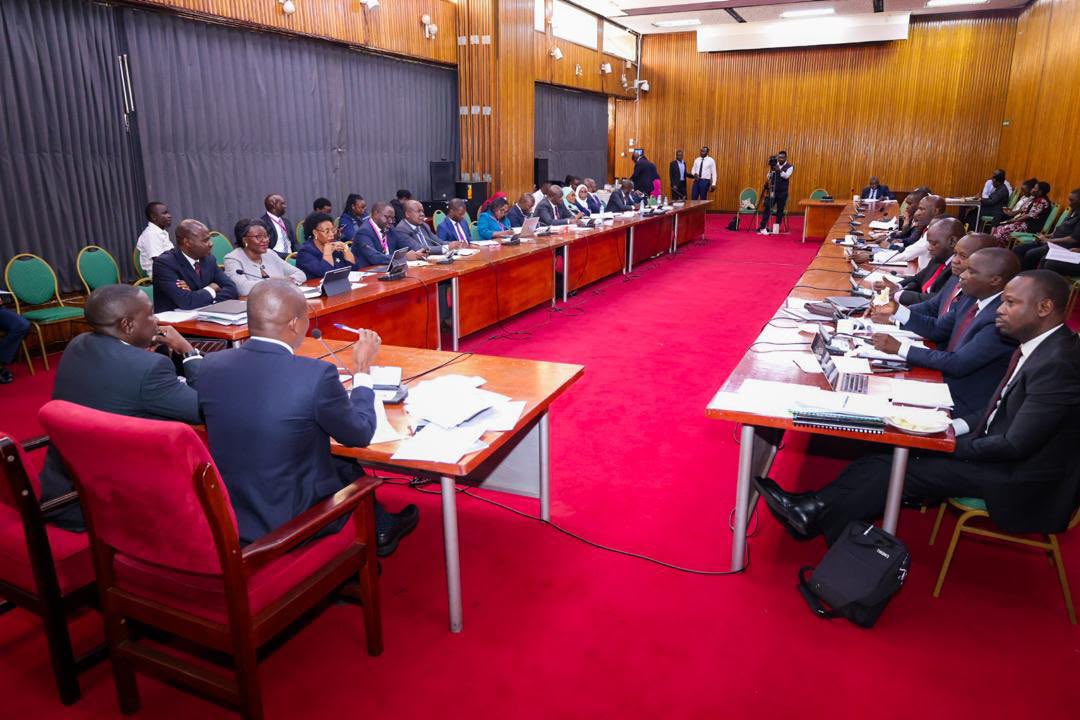
The Parliamentary Committee on Commissions, Statutory Authorities and State Enterprises (COSASE) has suspended its examination of the Insurance Regulatory Authority (IRA) after a dispute over the regulator’s leadership prevented MPs from proceeding with questions arising from the Auditor General’s report.
The committee had summoned IRA officials to respond to audit findings for the 2024/2025 financial year, alongside concerns about the authority’s administration following the expiry of the contract of its long-serving Chief Executive Officer, Alhaj Ibrahim Kaddunabbi Lubega.
However, Tuesday’s session was largely taken up by a legal and administrative dispute over who currently has the authority to head IRA and act as its accounting officer before Parliament.
Kaddunabbi’s five-year contract expired on May 31, 2026, ending his nearly 16-year tenure at the regulator. The IRA Board subsequently declined to recommend him for another term and appointed Dr Protazio Sande, the former Director of Strategy and Market Development, as acting CEO from June 1.
Kaddunabbi challenged the decision in the High Court and later appeared before COSASE, arguing that court orders had preserved his position.
He presented the committee with a certified copy of an administrative order issued on May 29, 2026, restraining IRA and its Board from implementing the decision not to recommend him for contract renewal pending determination of his application.
He also tabled an interim injunction dated July 7, 2026, which halted the process of substantively filling the CEO position pending determination of the main case.
The interpretation of the two court orders became a central issue during the hearing.
IRA Director of Legal Affairs, Francesca Nakaggwa Kakooza, initially referred to provisions governing ex-parte interim orders and argued that the first order could not remain effective beyond three days.
MPs, however, questioned her interpretation, prompting her to acknowledge that the provision she had cited applied specifically to ex-parte orders and did not cover the order under consideration.
COSASE Chairperson Muwada Nkunyingi subsequently questioned whether Sande’s appointment as acting CEO on June 1 complied with the May 29 court order.
Sande, for his part, maintains that his appointment was lawful, arguing that he assumed the acting position after Kaddunabbi’s contract had expired.
The dispute has also raised questions about who is legally responsible for IRA’s finances and other official affairs.
Nkunyingi observed that Kaddunabbi appeared to retain possession of some IRA assets, while Sande occupied the office of CEO without a clear mandate to act as the authority’s accounting officer.
The committee had expected Secretary to the Treasury Ramathan Ggoobi to provide guidance on the matter, particularly on the authority of the acting CEO and the process of appointing an accounting officer.
Ggoobi, however, did not attend the hearing. He instead delegated Bob Munene and Musa Lukwago to appear on his behalf.
The two officials told MPs that Ggoobi had sought guidance from the Solicitor General on how to proceed with the appointment of a substantive CEO and accounting officer while the dispute remains before court.
With the Treasury unable to provide a definitive position on who should account for IRA before Parliament, the committee could not proceed with the substantive audit examination.
The unresolved leadership question also overshadowed a number of serious financial and governance issues raised by the Auditor General.
Among the findings was a significant increase in Kaddunabbi’s gross monthly salary, which rose from Shs46.344 million in the 2021/2022 financial year to Shs57.733 million in 2024/2025 and Shs60.850 million in 2025/2026.
Although the salary adjustments were included in IRA budgets approved by the Board, the Auditor General said there was no evidence that the Board had specifically considered and recommended the increases to the responsible minister as required under ministerial guidance.
The audit also identified Shs36.832 million paid to Kaddunabbi as a leave allowance and another Shs87.179 million in compensation for untaken leave.
According to the Auditor General, the payment for unused leave was inconsistent with the Employment Act and the terms of Kaddunabbi’s contract because there was no evidence that he had been prevented from taking leave or that his employment had been terminated at the time of payment.
The audit further examined Kaddunabbi’s travel activities as a director of the Africa Reinsurance Corporation.
Investigators found that IRA paid him full per diem for several Africa Re engagements even though the activities were sponsored. IRA’s Human Capital Manual provides that an employee attending a sponsored engagement should receive only 30 per cent of the normal per diem.
The resulting financial impact was estimated at about Shs57.4 million.
The Auditor General also questioned IRA’s recruitment practices, finding that 39 employees had been recruited against 30 approved positions. Six of the additional appointments were reportedly made without documented specific approval from the Board.
The salaries and associated benefits arising from the recruitment were estimated at Shs647.6 million.
Beyond personnel and financial management, the audit raised concerns about IRA’s oversight of security deposits maintained by insurance companies.
The deposits serve as a regulatory safeguard under the Insurance Act, which requires insurers to maintain prescribed amounts and places restrictions on their utilisation.
COSASE had intended to interrogate IRA management on these and other audit findings before the leadership dispute derailed the session.
After deliberations, a majority of committee members voted to adjourn the hearing until the legal position regarding IRA’s leadership and accounting authority is clarified.
The committee is expected to resume consideration of the audit findings once the uncertainty over who has the legal mandate to lead and account for the authority is resolved.




 English