


















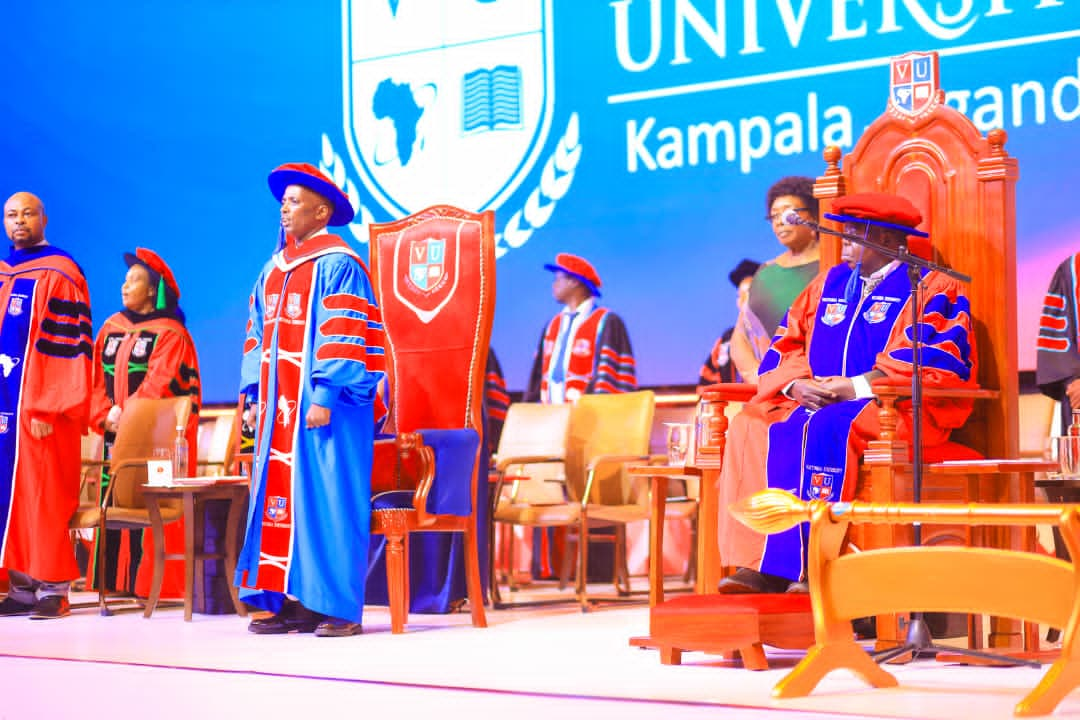
Victoria University Chancellor Prof. John Opuda-Asibo has called for the integration of Artificial Intelligence (AI) into all university programmes, warning that institutions risk falling behind if they fail to adapt to emerging technologies and changing industry demands.
Speaking at the university’s 10th graduation ceremony at Speke Resort Munyonyo, Opuda-Asibo said universities must regularly review their curricula to reflect technological advancements, emerging disciplines and the evolving needs of the labour market.


A total of 2,600 students graduated at the ceremony, which was held under the theme “The Future is Here”. The graduates came from various academic programmes, including Software Engineering, Information Technology, Business, Humanities and Health Sciences.
Opuda-Asibo said modern professions increasingly rely on data and technology, making it essential for universities to equip students with relevant digital skills. He urged institutions to teach AI comprehensively, covering its potential benefits, associated risks and ethical implications.
“If we don’t teach both the power and the danger of AI, we are not preparing students for the real world,” he said.
He also challenged graduates to appreciate the value of their education, describing knowledge as a foundation for independence, competitiveness and a better understanding of the world around them.
The Chancellor urged them to embrace lifelong learning, question the information they encounter and take responsibility for their communication, noting that what they say and write influences how others perceive them.
Supporting the Chancellor’s call, Victoria University Vice Chancellor Dr. Lawrence Muganga warned that Uganda risks being left behind in the global AI revolution unless access to digital technology is expanded, particularly among learners.
Muganga called on the government to introduce a nationwide One Laptop Per Child policy, proposing that every learner from Primary Five to university, including students in technical and vocational institutions, be provided with a laptop.
He argued that expanding access to digital devices would help prepare young people for a technology-driven economy and support Uganda’s ambition of growing its economy to $500 billion by 2040 under the Tenfold Growth Strategy.
Muganga also proposed the use of solar-powered laptops and satellite internet to extend digital learning to underserved communities and hard-to-reach areas where access to electricity and reliable internet connectivity remains limited.
“At Victoria University, every programme is now AI-driven. We are not preparing students just to pass examinations, but to live and thrive in an AI economy,” he said.
He revealed that the university’s student population had increased from 180 in 2020 to 16,000 currently, while the number of graduates had grown from 48 in 2021 to 2,600 this year.
Muganga said the growth reflected the university’s expansion and its efforts to align academic programmes with changing educational and technological needs.
He also announced plans to construct a new campus in Naguru, which will include a teaching hospital to support the university’s medical school. Construction is expected to begin in January 2027.











 English
