


















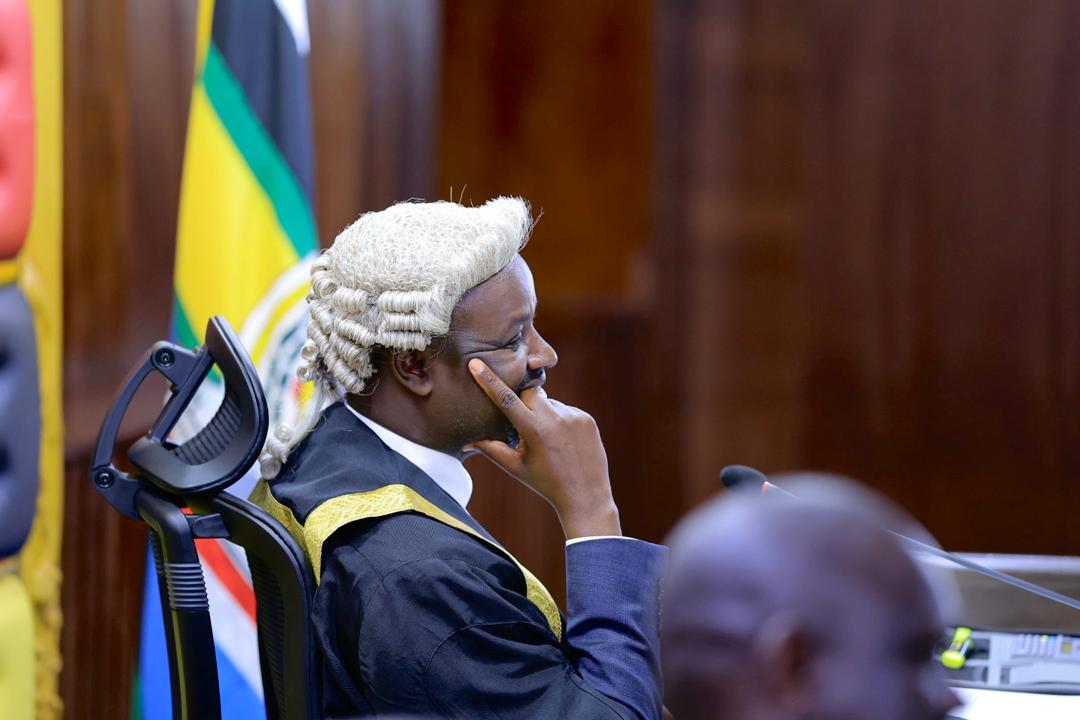
The Deputy Speaker of Parliament, Thomas Tayebwa, has directed the Ministry of Finance to return to the House next week with a comprehensive explanation of the continued depreciation of the Ugandan Shilling against the United States Dollar.
Tayebwa said the statement should clearly explain the factors behind the weakening currency and the measures being taken by government to contain its impact on businesses, traders and consumers.


The directive followed concerns raised in Parliament over the sharp decline in the value of the Shilling, which reached a record low at the beginning of the week.
The Finance Minister, Henry Musasizi, had been expected to brief Parliament on the exchange rate during Wednesday’s afternoon plenary sitting. However, Tayebwa said Musasizi needed more time to consult institutions responsible for economic management before presenting the statement.
Tayebwa said he held discussions with Musasizi on Wednesday morning and advised him to consult the Bank of Uganda, Uganda Bureau of Statistics and other key stakeholders so that the statement presented to Parliament is supported by data and reflects a coordinated government position.
“I told him that we want a comprehensive statement and we discussed and came to a conclusion that he needs to consult deeply with other stakeholders, especially the Central Bank, UBOS and other critical players,” Tayebwa said.
He warned that an inadequately prepared statement could create further uncertainty in the market instead of reassuring the public and the business community.
“A Minister of Finance can come here and make a statement, and it causes more trouble in the market than what we would have expected, or it is also very insufficient considering what we want,” Tayebwa said.
The Deputy Speaker explained that Musasizi was engaged in consultations with the relevant institutions and would return to Parliament next week to address the matter.
The Leader of the Opposition, Joel Ssenyonyi, had earlier raised concern over the continued weakening of the Shilling, saying the development was increasing the cost of doing business.
At the time of filing this report, the Shilling was trading at about Shs4,025 against the Dollar.
Ssenyonyi said the depreciation was particularly concerning for importers and businesses that rely on foreign currency to pay for goods, services and production inputs.
He also cited remarks attributed to Bank of Uganda Governor Michael Atingi-Ego during parliamentary consideration of the Protection of Sovereignty law. Ssenyonyi said the Governor had warned that Uganda could experience substantial depreciation of the local currency if the country’s balance of payments was destabilised.
“We are going to have a substantial depreciation of the Ugandan currency because of our balance of payments, which is to be greatly destabilised by the Sovereignty Bill,” Ssenyonyi quoted Atingi-Ego as saying while appearing before a joint parliamentary committee.
Ssenyonyi called on government to explain the steps it was taking to stabilise the currency, arguing that the effects of the depreciation were already being felt across the economy.
“It is important that government tells us what they are doing about this situation because it is biting hard,” he said.
MPs also raised concerns about the effect of the exchange rate on imported goods that were bought or shipped when the Shilling was stronger.
Karim Masaba, the Mbale City Industrial Division MP, asked government to consider suspending the monthly adjustment of the exchange rate used by the Uganda Revenue Authority to assess taxes on imports.
Masaba said traders feared that the weaker Shilling would result in higher tax assessments for goods purchased when the Dollar was trading at a lower rate.
“Some of these goods have just arrived, and some others are still in transit. The prayer of these traders is that URA and the Ministry of Finance hold on to the previous rate, because their goods were purchased at the older lower rate,” he said.
Masaba also questioned the Central Bank’s decision to raise the cash reserve requirement for commercial banks, instead of using part of Uganda’s foreign exchange reserves to support the local currency.
He said Uganda’s reserves had increased to about $6.5 billion and asked the Finance Ministry to explain why part of those reserves could not be used to ease pressure on the Shilling.
“The Minister for Finance can explain to us why this move has been taken, because we would expect in such a situation that these reserves would be used to stabilise the Shilling such that many of our traders do not lose out,” Masaba said.
Cohen Amanya, the Igara County West MP, similarly warned that traders could face higher tax bills if their imports were assessed using the current exchange rate, despite having bought the goods when the Dollar was cheaper.
He said the continued depreciation could also push up the cost of fuel and other inputs needed by businesses and manufacturers.
“Yesterday we were told that the current rate is temporary, but as of today it has not changed and is still going up. This will affect the prices of fuel and factors of production. I beseech the Finance Minister to look into this issue,” Amanya said.
The weakening Shilling is likely to increase the cost of imported goods, fuel, machinery and industrial inputs, with businesses potentially passing the additional costs on to consumers through higher prices.
Eddie Kwizera, the Bukimbiri County MP, called for a comprehensive tax policy to provide greater predictability for businesses and guide government revenue mobilisation.
The concerns raised in Parliament come as Uganda’s economy remains heavily dependent on imports, meaning sustained pressure on the exchange rate could have wider consequences for production costs, consumer prices and the overall cost of doing business.











 English