

















Uganda’s latest extractive-sector transparency report has exposed significant inconsistencies in official mineral trade records, including an almost Shs11.7 trillion difference between two reported values for the country’s mineral exports.
The report also presents conflicting figures on gold exports held by government institutions and highlights difficulties in establishing the origin of gold traded through Uganda.


The discrepancies have raised questions about the country’s ability to accurately track minerals from production and purchase to refining and export, as well as determine the taxes and public revenue arising from the trade.
The findings are contained in the fifth Uganda Extractive Industries Transparency Initiative (UGEITI) report, covering the 2023/24 financial year.
One section of the report places Uganda’s total mineral exports at about Shs11.8 trillion. However, another table, based on information attributed to the Uganda Revenue Authority, puts the value of mineral exports at only Shs119.2 billion.
The difference between the two figures is nearly Shs11.7 trillion.
The detailed mineral export table shows that Uganda exported 9.73 billion kilogrammes of minerals valued at Shs119.2 billion. Non-agglomerated iron ore accounted for 68.7 per cent of the value, followed by vermiculite, perlite and chlorites at 20.6 per cent.
The figures become more complicated when gold is considered separately.
According to a gold trade analysis contained in the report, Uganda exported gold worth Shs11.816 trillion during the financial year while imports were valued at Shs11.477 trillion.
Semi-manufactured gold alone accounted for Shs11.363 trillion, equivalent to about US$1.631 billion.
This means the reported value of gold exports was nearly 99 times the total mineral export value presented in the other table.
The report does not reconcile the two sets of figures. Instead, it describes Uganda as an important regional centre for gold refining and trade, noting that gold represented less than one per cent of reported domestic mineral production despite being the country’s leading extractive export commodity.
The inconsistency also affects assessments of the mining sector’s contribution to Uganda’s exports.
In another section, the report uses the much lower mineral export figure when estimating mining’s share of the country’s total exports, producing a contribution of only 0.0004 per cent.
That calculation sits uneasily alongside the report’s separate record of gold exports worth Shs11.816 trillion.
Where does Uganda’s gold come from?
The difference between reported gold exports and domestic production provides another major point of concern.
Data from the Directorate of Geological Survey and Mines show that Uganda’s gold production was valued at only Shs785.4 million in 2023/24, compared with Shs702.1 million the previous year.
Gold therefore represented just 0.17 per cent of the Shs464.7 billion worth of mineral production recorded during the year.
The low domestic production figure does not necessarily mean that all gold exported through Uganda was mined within the country.
Uganda has developed into a regional gold refining and trading centre, meaning minerals produced in other countries can enter Uganda, undergo processing or trading and subsequently be exported.
However, the huge difference between recorded domestic production and gold exports leaves an important question about the ability of authorities to trace the source of the gold moving through the country.
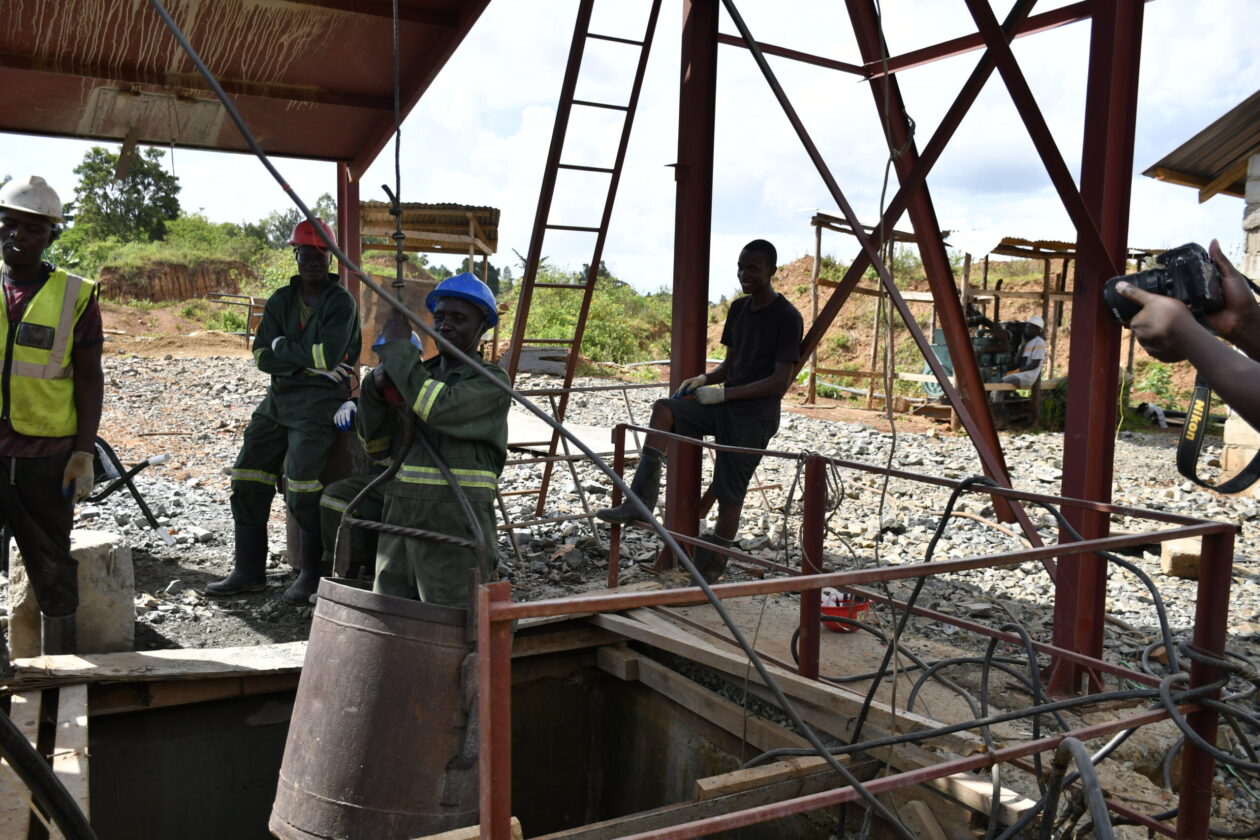
Lawrence Muwonge, the Uganda Revenue Authority manager responsible for extractive industries, attributed part of the challenge to the informal nature of artisanal mining.
He said authorities have difficulty establishing how much individual artisanal miners produce, what quantities they sell and who purchases the minerals.
Muwonge said monitoring such operations continuously would require officials to be present at mining sites around the clock, something he described as impractical.
The challenge does not end at the mining site.
According to Muwonge, gold refiners provide a more identifiable point in the supply chain because they operate from established premises and their exports can be monitored. However, tracing the people and businesses from whom refiners purchase their gold remains difficult.
He also questioned some transactions reported by refiners, saying certain purchase and sale figures appear difficult to reconcile with the costs involved in operating a refinery, including labour, electricity and rent.
The inability to establish the source of gold purchased by refiners makes it harder for authorities to independently verify the mineral’s origin and determine whether all applicable taxes and regulatory requirements have been met.
Gold imports and exports also differ
The UGEITI report provides further evidence of gaps in the gold trade data.
Five major gold businesses reported combined gold imports of Shs11.477 trillion and exports of Shs11.816 trillion during 2023/24.
Thaba Investments Limited recorded exports worth Shs2.763 trillion, followed by Bullion Refinery Limited at Shs2.899 trillion, Simba Gold Refinery Limited at Shs1.746 trillion, Metal Testing and Smelting Company Limited at Shs1.568 trillion and Faru Trading Uganda Limited at Shs1.178 trillion.
Overall, reported gold exports exceeded imports by approximately Shs339.4 billion.
The report notes that differences between imports and exports can result from factors such as timing, valuation, refining, changes in stocks and variations in reporting classifications.
However, it does not identify which of these factors explains the differences in Uganda’s case.
The quantities reported by individual companies also show discrepancies.
Thaba Investments, for example, recorded imports of 12,377,803 kilogrammes and exports of 12,657,815 kilogrammes.
Simba Gold Refinery reported imports of 7,619,029 kilogrammes against exports of 7,798,408 kilogrammes, while Metal Testing and Smelting recorded imports of 6,454,565 kilogrammes and exports of 6,881,358 kilogrammes.
The differences should not, by themselves, be treated as evidence that gold was illegally sourced. The report does not provide enough information to determine whether the variations resulted from stock movements, timing, valuation or other accounting and reporting adjustments.
Nevertheless, they demonstrate the difficulty of following gold through the formal supply chain.
Government agencies give different export figures
The inconsistencies extend beyond companies to government institutions.
URA records show that Uganda exported approximately 46,263 kilogrammes of gold during the financial year, with a value of about US$2.98 billion.
Bank of Uganda records, however, put gold exports at approximately 48,620 kilogrammes, valued at about US$3.09 billion.
The difference is about 2,357 kilogrammes.
This means the challenge is not only establishing the amount of gold produced or traded but also ensuring that government institutions are working from compatible and reconciled datasets.
Muwonge also raised concerns about ownership and control within the mining sector.
He said URA had encountered mining operations that appeared to be owned by Ugandan companies but where foreign nationals were allegedly involved in running the businesses.
In one case in western Uganda, he said officials found more than 50 excavators and numerous Chinese nationals at a mine that appeared on paper to be Ugandan-owned.
In another operation in northern Uganda, he said more than 60 Chinese nationals were staying at a mining camp even though the company had reported having only three expatriate employees.
Such cases make beneficial ownership information particularly important because authorities need to know who ultimately controls mining businesses and who should be held responsible for production, taxation and regulatory compliance.
Officials from the Uganda Registration Services Bureau told the same extractive-sector meeting that companies are required to provide beneficial ownership information when they are registered.
The information is intended to identify the individuals who ultimately control companies or hold ultimate voting rights.
However, Muwonge said company registration alone does not resolve challenges at mining sites, particularly where individuals can leave an operation after an assessment and authorities cannot establish whether they have left the country or moved to another jurisdiction.
Agencies struggle to share information
The report also points to weaknesses in coordination among institutions responsible for Uganda’s mineral value chain.
These include the Directorate of Geological Survey and Mines, URA, Bank of Uganda and the Uganda Registration Services Bureau.
Muwonge argued that production, licensing and taxation cannot be treated as isolated responsibilities because information collected by one institution is often necessary for another to establish the true scale of mineral production and revenue.
The Petroleum Authority of Uganda has similarly called for stronger cooperation among regulators, URA and URSB, including the use of common identifiers to establish beneficial ownership and strengthen compliance.
Broader problems in extractive-sector revenue
The problems identified in the gold trade are part of a wider challenge in reconciling data on Uganda’s extractive industries.
The UGEITI reconciliation exercise found that government agencies initially reported Shs911.115 billion in payments from extractive companies.
After an independent reconciliation, Shs256.099 billion was removed because the payments related wholly or partly to activities outside the extractive sector.
Tororo Cement accounted for the largest adjustment at Shs225.061 billion, followed by Mota-Engil with Shs28.603 billion and MHK General Agencies with Shs2.435 billion.
The adjustments covered several tax categories, including customs payments, VAT, income tax, PAYE and withholding tax.
After reconciliation, company payments stood at Shs655.015 billion.
The final extractive-sector revenue figure reported through the EITI process was Shs663.283 billion. This included additional unilateral disclosures, social and environmental expenditure and payments to sub-national authorities.
The figure represented an increase of about 25 per cent from the Shs530.174 billion reported as extractive-sector government revenue in 2022/23.
Mining contributed Shs336.191 billion, while oil and gas contributed Shs327.092 billion.
The reconciliation demonstrates the importance of comparing company declarations with government records before determining the amount of revenue generated from extractive activities.
Royalty figures also fail to align
The report identifies another inconsistency in mineral royalties.
URA reported collecting Shs19.686 billion in mineral royalties during 2023/24.
Of this amount, Shs1.968 billion was transferred to local governments, while Shs984.3 million went to lawful or bona fide occupants of land where mining activities take place.
However, the main revenue reconciliation table does not show royalties among the reconciled payment streams.
A separate government disclosure lists only Shs143.1 million in royalties, while mineral rents are separately reported at Shs22.720 billion.
The report does not clearly explain how these different royalty figures relate to one another, leaving another gap in understanding the public revenue generated from Uganda’s mineral resources.
Petroleum fund faces investment concerns
The transparency report also raises questions about the management of petroleum revenues as Uganda moves towards full-scale oil production.
Uganda established the Petroleum Revenue Investment Reserve to invest petroleum revenues for the benefit of present and future generations.
However, the UGEITI review of available Petroleum Fund financial statements found that significant investments required under the Public Finance Management framework had not been undertaken.
The report records an investment of US$108.8 million made in 2017, which generated approximately US$1 million in interest.
Subsequent publicly available Petroleum Fund reports, including the 2023/24 report, do not show significant new investment activity.
UGEITI attributes the lack of further investment partly to the absence of a fully approved and implemented comprehensive investment policy. The Auditor General has also raised concerns over the matter.
Social and environmental spending drops sharply
The report records another major change in spending by extractive companies on social and environmental activities.
Such expenditure fell from Shs48.45 billion in 2022/23 to only Shs562 million in 2023/24, representing a decline of about 99 per cent.
The report does not provide a detailed explanation for the dramatic fall.
It therefore remains unclear whether the reduction reflects an actual decline in company spending, changes in the projects captured during the reporting exercise or weaknesses in disclosure.
Companies also reported Shs592.5 million in payments to sub-national authorities during the year.
A transparency problem with wider implications
Taken together, the findings point to a recurring problem within Uganda’s extractive sector.
Different institutions collect information on mineral production, ownership, taxation, imports, exports and company payments, but the resulting figures do not always produce a single, consistent picture.
The gold sector illustrates the problem most clearly.
Uganda reported gold exports worth Shs11.816 trillion, while domestic gold production was valued at only Shs785.4 million.
At the same time, URA and Bank of Uganda reported different quantities and values for gold exports, while separate tables within the same transparency report provide sharply different figures for total mineral exports.
The discrepancies do not, on their own, prove that gold was illegally sourced or that public revenue was lost.
They do, however, expose weaknesses in Uganda’s ability to trace minerals from their point of production through purchasing, refining and export, and to reconcile information held by different government institutions.
That has direct implications for taxation, regulation and public accountability.
The challenge is becoming even more important as Uganda prepares for full-scale oil production, a sector expected to generate significant public revenues and requiring strong systems for tracking payments, ownership and resource flows.
The EITI process is designed to make financial flows associated with natural resources more transparent and easier for the public to scrutinise.
But the 2023/24 report leaves several important questions unanswered: the actual value of Uganda’s mineral exports, the origin of gold moving through the country, the basis for differing mineral royalty figures, the reason for discrepancies between government trade records and the extent to which petroleum revenues are being invested.
Ultimately, the central issue is whether Uganda has the systems needed to account accurately for its natural resources from extraction to export and to establish how much public revenue should accrue from that trade.










 English