














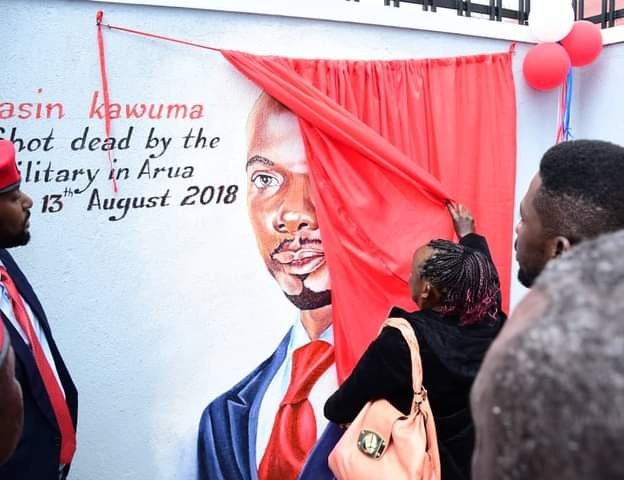
The High Court in Arua has directed that an inquest be conducted into the fatal shooting of Yasin Kawuma, the former driver of National Unity Platform (NUP) president Robert Kyagulanyi Ssentamu, nearly eight years after he was killed during the 2018 Arua Municipality parliamentary by-election campaigns.
In a ruling delivered on Monday, Justice Harriet Grace Magala ordered the Chief Magistrate of Arua Chief Magistrate’s Court to conduct the inquiry, saying the circumstances surrounding Kawuma’s death require an independent judicial investigation in the interest of justice.
The application was filed by Kawuma’s widow, Alice Mwesigwa, who asked the court to compel the then Minister of Internal Affairs, Gen. Jeje Odongo, to appoint a coroner to investigate the killing.
Mwesigwa argued that her husband’s death was violent and unnatural and therefore qualified for an inquest under the Inquests Act.
Court documents show that Kawuma was shot dead on August 13, 2018, during campaigns for the Arua Municipality parliamentary by-election.
A postmortem report from Arua Regional Referral Hospital attributed his death to severe brain injuries caused by gunshot wounds.
The Attorney General opposed the application, maintaining that the High Court lacked jurisdiction to direct the minister to appoint a coroner and arguing that the applicant had not exhausted the remedies available under the law.
However, Justice Magala rejected those arguments, noting that the government had not disputed the medical evidence confirming that Kawuma died from gunshot wounds.
She ruled that the available evidence clearly established that the death was violent and unnatural, making it appropriate for an inquest to be held.
The judge explained that the purpose of an inquest is to establish the circumstances under which a person died, including how, when and where the death occurred, rather than determining criminal responsibility.
She added that such proceedings are important in promoting public confidence in the administration of justice while providing answers to the deceased’s family.
Justice Magala further observed that although the court could not compel the Minister of Internal Affairs to appoint a coroner, Section 27(a) of the Inquests Act gives the High Court powers to order an inquest. Since chief magistrates serve as coroners under the law, she directed the Chief Magistrate of Arua to preside over the inquiry.
“The court finds that it is just and fair to order an inquest into the deceased’s death,” Justice Magala ruled, adding that each party would bear its own legal costs.
Kawuma was killed during the violence that erupted in the run-up to the August 2018 Arua Municipality parliamentary by-election, an incident that drew widespread national and international attention. The unrest led to the arrest and prosecution of several opposition politicians, including Robert Kyagulanyi, popularly known as Bobi Wine.
Despite the public attention surrounding the incident, no judicial inquest had previously been conducted into Kawuma’s death. The High Court’s latest decision is expected to reopen official scrutiny into the circumstances surrounding one of the most high-profile killings linked to Uganda’s political unrest.



 English