

















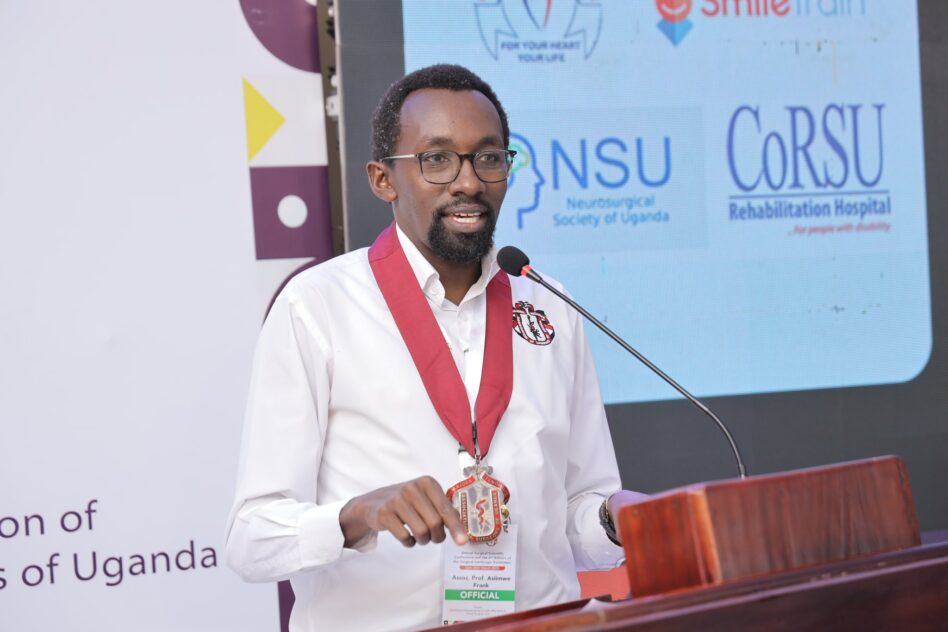
The Uganda Medical Association (UMA) has dismissed a government proposal to provide lunch to medical interns as an alternative form of support, insisting that trainee doctors require comprehensive welfare and financial facilitation to effectively carry out their duties.
Speaking on the matter, UMA President Dr. Frank Asiimwe said the suggestion falls far short of addressing the challenges faced by interns, who often work long hours under demanding conditions in public health facilities across the country.


According to Asiimwe, medical interns need support that goes beyond a single meal, including transport, accommodation, healthcare, and other basic necessities. He argued that interns, who serve as probationary officers during their training, should instead receive remuneration equivalent to 75 percent of a medical officer’s salary.
“As interns, they are expected to provide essential services in hospitals, yet many struggle to meet their daily needs. A lunch package cannot replace the financial support necessary for them to perform their responsibilities effectively,” he said.
The UMA’s response follows remarks by Health Minister Dr. Chris Baryomunsi, who revealed that Cabinet had instructed the Ministry of Health to assess the financial implications of providing meals to the approximately 2,000 medical interns deployed annually.
Baryomunsi explained that government-sponsored students would continue to receive full support during their internship period, while authorities are exploring the possibility of offering lunch to graduates from private institutions as a way of facilitating their work.
Speaking during a ministerial handover ceremony at the Ministry of Health headquarters, the minister said discussions were ongoing and that claims suggesting government had completely withdrawn support for interns were not entirely accurate.
The controversy stems from the government’s new National Education and Training for Health Policy, scheduled to take effect in August.
The policy introduces major reforms to health training, including integrating the mandatory one-year internship into academic programs and making completion of internship a requirement for graduation.
While several provisions of the policy have been generally accepted, the decision to eliminate internship allowances has sparked widespread criticism from medical professionals, students, and sections of the public.
Historically, medical interns received a monthly allowance of about Shs2.4 million before the amount was later reduced to Shs1 million.
Critics argue that scrapping the allowance altogether places an unfair burden on young health workers who already shoulder significant responsibilities within the healthcare system.
The issue also reached Parliament this week, where Leader of the Opposition Joel Ssenyonyi questioned the rationale behind withdrawing financial support from interns despite their critical role in service delivery.
Ssenyonyi noted that medical interns routinely work shifts stretching between 36 and 48 hours and form a vital component of staffing in public hospitals.
He suggested that funds previously allocated to national public holiday celebrations, estimated at Shs24 billion and recently suspended as part of government cost-cutting measures, could be redirected to support intern doctors.
As debate over the policy intensifies, medical professionals and lawmakers are continuing to call on government to reconsider the removal of internship allowances and develop a support system that adequately caters for the welfare of future healthcare workers.









 English