

















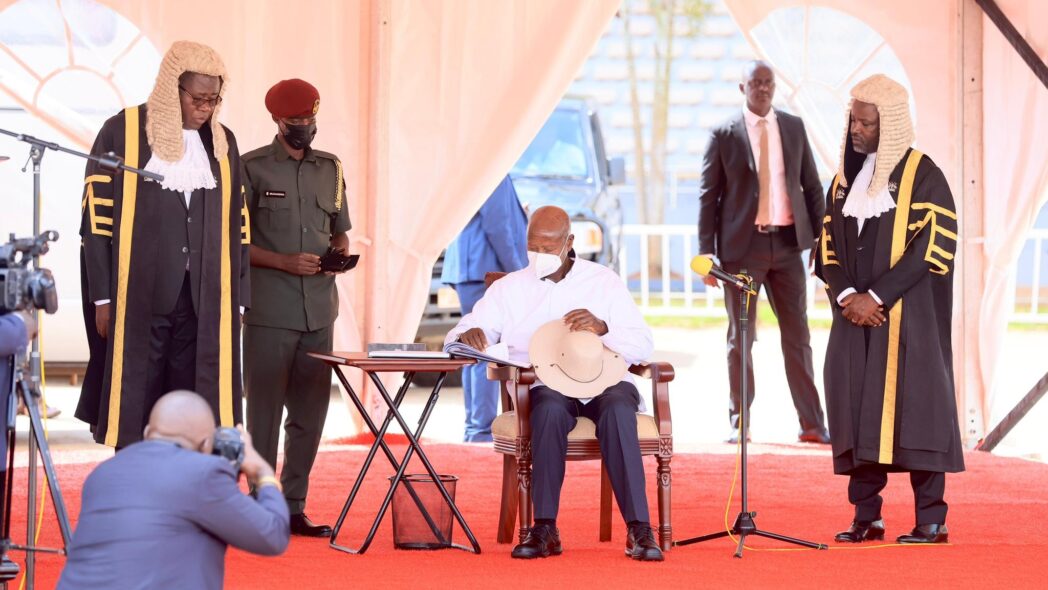
President Yoweri Kaguta Museveni has unveiled the government’s legislative programme for the current session of the 12th Parliament, outlining plans to table 38 Bills covering key sectors of the economy and public administration.
Addressing Parliament, Museveni said the legislative agenda would be introduced through the Prime Minister and relevant line ministers, noting that the proposals span finance, health, education, energy, agriculture, transport, lands, ICT, and internal affairs.

“I present the government’s legislative programme to Parliament. It is in Annex Two. There are so many,” he said.
The Ministry of Finance, Planning and Economic Development dominates the programme with 20 Bills, reinforcing government’s focus on domestic revenue mobilisation and fiscal consolidation. Among the key proposals are amendments to the Income Tax, Excise Duty, Value Added Tax, Stamp Duty, and Tax Procedures Code Acts, all slated for 2027.
The ministry will also table the Appropriation Bill for FY2027/28, alongside the Draft Estimates of Revenue and Expenditure, the National Budget Framework Paper for FY2027/28–FY2031/32, and the Budget Speech. These documents are expected to shape Uganda’s fiscal direction in the coming financial year.
Officials say the proposed tax reforms build on earlier changes that revised tax rates, strengthened compliance systems, and introduced investment incentives, including the removal of stamp duty on agreements and mortgage deeds to ease business costs and improve access to credit.
Parliament is expected to closely scrutinise whether the new measures can boost revenue without increasing pressure on households and businesses amid rising expenditure demands and public debt obligations.
Beyond taxation, several sector ministries are set to introduce reforms aimed at modernising service delivery and regulatory frameworks.
The Ministry of Health will present three amendment Bills targeting the Pharmacy and Drugs Act, the Nurses and Midwives Act, and the Allied Health Professionals Act, while the Ministry of Education and Sports will table amendments to tertiary education laws alongside a new Curriculum, Assessment and Admissions Bill.
The Ministry of Internal Affairs is expected to revive the Small Arms and Light Weapons Control Bill, 2023, while the Ministry of Energy and Mineral Development will introduce the Building Substances Bill, 2025.
In the lands sector, government plans to table the Real Estate Bill, 2025, aimed at tightening regulation of Uganda’s expanding property market. Other proposed laws include the National Legal Examinations Centre Bill, 2026, the Information and Communications Bill, 2023, and the Workers Compensation (Amendment) Bill, 2024.
The Ministry of Works and Transport is set to present the Uganda Railway Bill, 2026, while agriculture will see proposals including the Food and Agriculture Regulatory Authority Bill, 2026, and amendments to the Animal Disease Act.
Additional legislative proposals include amendments to the Local Government Act, updates to tourism laws, and an Intelligence Services Policy Framework from the Office of the President.
Speaker of Parliament Jacob Marksons Oboth-Oboth said the House will begin considering the legislative agenda immediately after the national budget presentation, signalling a busy and high-stakes parliamentary session focused on economic reform and sector restructuring.








 English