

















As Uganda’s healthcare sector continues to face growing pressure from rising patient numbers, limited resources, and changing technology, graduates entering the profession are increasingly being challenged to redefine what service truly means.
That message took centre stage during the 13th graduation ceremony of St. Francis Schools of Health and Allied Sciences in Namataba, where religious leaders, education administrators, and health professionals urged graduates to embrace compassion, integrity, and innovation as the foundation of their careers.


The ceremony, attended by parents, guardians, lecturers, and hundreds of graduates, carried the theme: “Transforming Healthcare Service Delivery for the Betterment of Humanity.”
For the institution and its guests, the theme was more than a ceremonial slogan. It was a call for a new generation of professionals to rebuild trust and dignity within healthcare and public service.
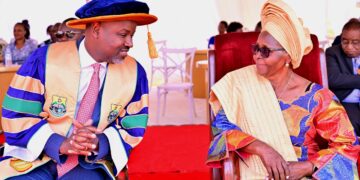
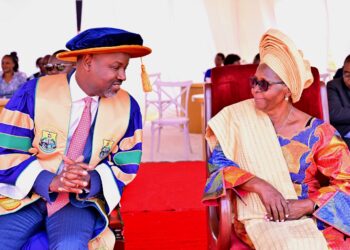
The Vice Chancellor of the University of Kisubi, Br. Dr. Deogratius Mugema, described the graduating students as a “complete force” capable of transforming society through teamwork and ethical service.
Addressing graduates, Mugema said healthcare transformation does not happen only in hospital wards and theatres, but through interconnected systems driven by compassion, efficiency, and innovation.
“To the nursing and allied health graduates, you are the frontline of healing. To the management graduates, you are the architects of systems that make service possible. To the applied sciences graduates, you are the innovators bringing modern solutions into healthcare,” he said.
He challenged the graduates to move beyond routine work and instead embrace empathy in every interaction with patients and communities.
“Every patient, every client, and every laboratory sample represents human life. Never allow routine to kill your compassion,” he said.
Throughout the ceremony, speakers repeatedly warned young professionals against corruption, negligence, and the growing obsession with quick wealth, arguing that these tendencies continue to weaken service delivery in Uganda.
Mugema used the story of Mother Teresa to illustrate the spirit of genuine service. He recalled how a journalist once told Mother Teresa that he could never clean the wounds of a dying patient for a million dollars, to which she reportedly replied: “Neither would I. I do it for love.”
For many graduates in attendance, the message resonated deeply in a profession where patients often remember kindness more than medication.
The Institution Rector, Peter Kiwanuka Bbosa, said graduates were leaving the institution not merely with qualifications, but with a responsibility to serve society with humility and integrity.
“These cadres are not trained simply for career advancement. They are prepared to lead with integrity, humility, and service to humanity,” he said.
He also urged graduates to reject shortcuts to success and instead invest in continuous learning, collaboration, and research.
“Education should not be viewed as a final destination. The world is changing rapidly and professionals must continue improving themselves,” he added.
According to the Academic Registrar, Immaculate Asherure, a total of 566 students graduated in different disciplines during the ceremony.
Among the top performers was Lydia Angio, who emerged best overall with a CGPA of 4.70 in Diploma in Medical Records and Health Informatics.
Other outstanding students included Abdukadir Aminah Kaudha in Clinical Medicine and Community Health, Dorah Sabuwah in Health Promotion and Education, Brian Kyeterekera in Pharmacy, and Patience Nakabugo in Certificate Nursing.
Asherure reminded graduates that the transition into the labour market would require resilience, innovation, and adaptability.
“In today’s global economy, competition is intense. Employers are looking for people who are innovative, adaptable, and committed to lifelong learning,” she said.
But perhaps the strongest message of the day came during the graduation Mass led by Rev. Fr. Prof. John Chrysotom Maviiri, who urged graduates to combine professional competence with empathy and patience.
“You have the professional training and the knowledge, but you also need the heart to serve human beings,” he said.
Maviiri warned against becoming rough or insensitive toward patients, especially in stressful medical environments.
“Sometimes patients may be rude because of pain and fear. But healthcare workers must remain patient, compassionate, and hopeful because healing also comes through kindness and encouragement,” he said.
Drawing inspiration from St. Francis of Assisi, whose death marks 800 years in 2026, Maviiri urged graduates to reject greed and selfishness in favour of sacrifice and service.
He narrated how St. Francis abandoned a life of luxury to serve the poor and defend human dignity, saying modern society desperately needs professionals willing to stand against corruption and exploitation.
“We are living in a generation where people want quick wealth. Corruption, negligence, and selfishness have affected institutions and services. But graduates must go out and make a difference,” he said.
He linked the failures in healthcare and public infrastructure to dishonesty and greed, noting that negligence in hospitals, roads, and buildings often stems from compromised ethics.
For the graduates, the ceremony marked not only academic success but entry into professions where mistakes can cost lives and compassion can restore hope.
As families celebrated their sons and daughters, the dominant message remained clear: Uganda’s future depends not only on educated professionals, but on professionals who choose integrity over shortcuts and humanity over self-interest.
In a country where complaints about poor healthcare services, corruption, and negligence remain common, the graduates were reminded that true transformation begins with individual choices made daily in clinics, offices, laboratories, and communities.
For many of them stepping into the world of work, the challenge ahead is not simply to earn a living, but to restore dignity and trust in the services they provide.











 English