


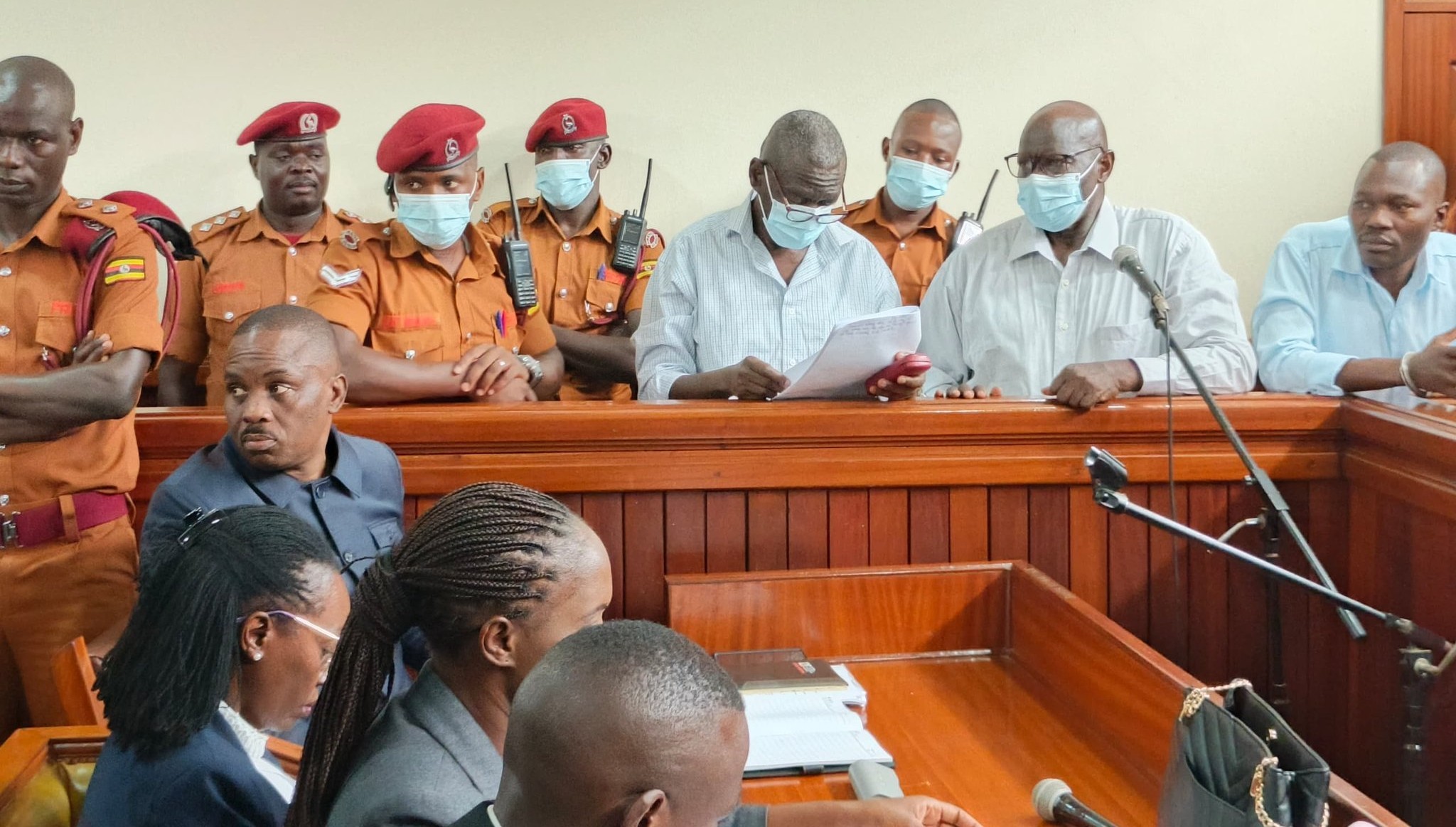
In the fortified walls of Luzira Maximum Security Prison, Dr. Kizza Besigye, a retired colonel, veteran opposition leader, and former presidential candidate, awaited trial under the heaviest treason charges in Uganda’s recent history.
Beside him stood his longtime personal assistant, Hajji Obeid Lutale, and a serving Uganda People’s Defence Forces officer, Captain Denis Oola.

Together, they were accused of orchestrating a sweeping plot to violently overthrow the government of President Yoweri Kaguta Museveni.
According to documents from the Office of the Director of Public Prosecutions, the alleged conspiracy reached across continents, involved secret meetings in Europe and Africa, and was driven by detailed plans to destabilize Uganda’s government using trained insurgents, counterfeit currency, and targeted assassinations.
The story began in 2021 when Andrew Wilson, a Ugandan-born security expert and founder of a firearms and tactical training company, was contacted by Joel Wakhaima, a Ugandan living in Switzerland.
Wakhaima allegedly sought Wilson’s assistance to obtain weapons and train Ugandans with the intention of toppling the government.
Sensing the dangerous implications of the request, Wilson informed a senior UPDF officer deployed in Somalia.
This encounter marked the beginning of Wilson’s role as a government informant.
He began working under the supervision of the Chieftaincy of Military Intelligence, reporting all developments and secretly recording his communications with the suspects.
Over the next two years, Wilson would become deeply embedded in the operation, gaining access to the inner circles of what prosecutors now describe as an organized treasonous plot.
In a Zoom meeting recorded by Wilson in early 2023, former FDC Vice President Hon. Salaam Musumba allegedly requested training in espionage and covert communication for opposition members.
That meeting would be the first of many. Later that year, Wilson traveled to Brussels, where he met Musumba and other prominent opposition figures, including Kampala Lord Mayor Erias Lukwago, Member of Parliament Ibrahim Ssemujju Nganda, activist Lubega Mukaku, and political commentator Charles Rwomushana.
According to the DPP’s evidence summary, this Brussels meeting was recorded in its entirety.
During the discussions, Wilson reportedly agreed to serve as the group’s military and security advisor.
Musumba then arranged for Wakhaima to introduce Wilson to the central figure of the alleged conspiracy, Dr. Kizza Besigye.
That introduction occurred in Geneva on October 29, 2023. The meeting was attended by Besigye, Wakhaima, Frank Kihehere Atukunda, and Wilson.
It was there that prosecutors claim the plot evolved into a coordinated effort.
Besigye is alleged to have requested Wilson’s assistance in destabilizing Uganda through armed rebellion.
He also reportedly asked for the training of his supporters in covert intelligence and paramilitary tactics.
The indictment states that Besigye requested counterfeit Ugandan currency to flood the economy and devalue the national currency.
He also allegedly discussed using insiders within the Bank of Uganda to facilitate the operation.
In the same meeting, Besigye and his associates are said to have requested ricin poison to target specific government officials.
A list of military installations marked for attack was presented, including Simba Barracks in Mbarara, Makenke 2nd Division, Bugembe Barracks, and Kakyoma Mountain Brigade.
Following the Geneva meeting, Wilson reportedly received five thousand dollars to help organize a training camp in Kisumu, Kenya.
The plan involved transporting thirty-six FDC supporters, in small groups to avoid detection.
However, before the training could begin, Kenyan authorities arrested the group.
The recruits were deported to Uganda along with various exhibits and handed over to the Uganda Police. They were subsequently charged at the Nakawa Magistrates Court.
Despite this setback, the alleged conspiracy continued. In January 2024, Besigye reportedly met Wilson again in Geneva, where he reaffirmed his commitment to the cause.
During this meeting, Besigye and Wakhaima allegedly proposed the assassination of President Museveni using a drone strike.
Besigye is accused of promising to provide details about the President’s movements and security arrangements.
In exchange for Wilson’s help, the group allegedly offered access to Uganda’s banking systems for laundering money and permission to use Ugandan airfields for trafficking and other illicit operations.
A subsequent meeting in June 2024 included more requests for drones, weapons, counterfeit currency, and training in espionage and drone operations.
At this meeting, Besigye reportedly shared the coordinates of an airstrip in the Democratic Republic of Congo, identified as Aerodrome De Managi, to be used for smuggling arms.
In September 2024, Besigye and Wilson allegedly met in Athens to plan a drone attack on Nakasongola Airbase.
The goal was to destroy military helicopters and disrupt Uganda’s air defense capability.
A follow-up meeting occurred in Nairobi, where Besigye introduced Lutale as his assistant and co-conspirator.
They discussed the next phase of the operation, including plans for civil unrest and a renewed assassination attempt in March 2025.
The following day, Ugandan security forces arrested Besigye and Lutale at the Malaba border.
Authorities seized two pistols, encrypted communication devices, and other evidence.
Captain Denis Oola was also arrested and linked to the plot through WhatsApp messages exchanged with Wakhaima.
Originally charged under the UPDF Act, the case was later moved to the civilian courts following a Supreme Court ruling.
The suspects were declared mentally sound, and their communications and travel records were presented as part of the prosecution’s evidence.
According to the DPP, Wilson recorded every meeting, every call, and every strategic conversation he had with the accused.
These recordings, along with intercepted communications, financial transactions, and physical evidence, are expected to be central to the prosecution’s case.
As the trial began, the nation found itself divided. For some, the proceedings confirmed long-held fears of insurgency and internal betrayal.
For others, the case symbolized the government’s ongoing efforts to stifle political dissent and silence its most vocal critics.
Regardless of the verdict, the trial of Dr. Kizza Besigye has already reshaped Uganda’s political landscape.
It has exposed deep fault lines between authority and opposition, raised questions about the limits of protest, and cast a long shadow over the future of democratic resistance in the country.




 English