


















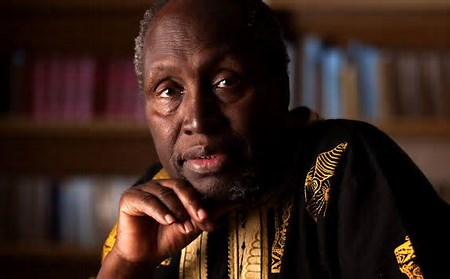
Renowned Kenyan author, scholar, and activist Ngũgĩ wa Thiong’o has died at the age of 87.
His family announced his passing on the evening of Wednesday, May 28, 2025, saying he “lived a full life, fought a good fight.”


“It is with a heavy heart that we announce the passing of our dad, Ngũgĩ wa Thiong’o,” his daughter Wanjiku wa Ngugi wrote in a heartfelt Facebook post.
“As was his last wish, let’s celebrate his life and his work. Rîa ratha na rîa thŭa. Tŭrî aira,” a Gikuyu phrase that translates loosely to “With joy and sorrow. We are proud.”
Plans for memorial services and public tributes are expected to be shared in the coming days.
The family’s spokesperson, Nducu wa Ngugi, will provide details of his celebration of life.
Ngũgĩ was a towering figure in African literature. His influence reached across continents and generations, inspiring writers, scholars, and readers with his unapologetic commitment to African languages and justice.
He is best known for novels such as A Grain of Wheat, Petals of Blood, and Devil on the Cross, works that examined the legacy of colonialism and the challenges of post-independence Africa.
Born in 1937 in Kamiriithu, Limuru, Ngũgĩ’s life was shaped by Kenya’s turbulent journey to independence.
The upheavals of colonial rule and the Mau Mau rebellion found their way into his stories, which combined literary brilliance with deep political conviction.
In 1977, his play Ngaahika Ndeenda (I Will Marry When I Want), written in Gikuyu and performed by non-professional actors in a village setting, drew the ire of the Moi regime.
Seen as subversive, it led to his arrest and imprisonment without trial. During his time in detention, he famously wrote Devil on the Cross on prison-issued toilet paper.
Following his release, Ngũgĩ went into exile. He would live and teach abroad for many years, holding positions at prestigious institutions such as Yale University and the University of California, Irvine.
Despite the physical distance, he remained rooted in Kenya through his language and activism.
From the 1980s onward, Ngũgĩ refused to write fiction in English, choosing instead to use Gikuyu.
He believed that true liberation could not be achieved without linguistic decolonization, and he argued forcefully for the elevation of African languages in literature and education.
As news of his death spread, tributes began pouring in from around the world.
“Sad to learn of the passing on of a literary giant whose words shaped African thought and inspired generations,” said Homa Bay Governor Gladys Wanga.
“Ngũgĩ’s works challenged oppression and celebrated the power of indigenous voices. Though he has left us, his legacy lives on in every story, every struggle, and every dream of a just world.”
Kong’amano la Mapinduzi remembered him as a revolutionary voice who “gave power to the oppressed through language, memory, and resistance.
His stories live on in books, classrooms, and the hearts of generations.”
Dr. Ezekiel Mutua described him as “a towering figure and a celebrated thinker. A literary legend and one of Africa’s greatest voices has passed away. My deepest condolences to his family and friends.”
Ngũgĩ is survived by his children and grandchildren, many of whom have continued his legacy as writers, academics, and activists.
Though he has departed, his presence endures. In the quiet of a library, the pages of a well-worn novel, the cadence of a village play performed in Gikuyu, his spirit lives on.
He asked not for silence but for celebration, not for mourning but for remembrance in song and story.
Rîa ratha na rîa thŭa. Tŭrî aira.
With joy and sorrow, we are proud.
Rest well, Ngũgĩ wa Thiong’o. Your words remain.








 English