






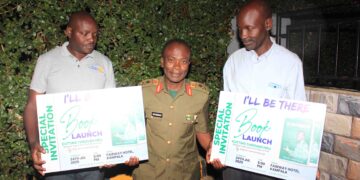




Hongera Sana, an organization unveiled as a national effort to counter violent extremism under the office of the president, is now at the centre of controversy following an official denial of its existence.
What began as a body focusing on Preventing and Countering Violent Extremism (PCVE) has since spiralled into allegations of interference, the loss of billions of Shillings, arrests, and abuse of authority, alongside troubling questions about the expanding role of security agencies in civilian programmes.
Earlier in December 2025 , the organisation’s national coordinator, Ashirafuh Muyomba, was arrested by the State House Anti-Corruption Unit, arraigned in court and charged with 24 counts related to forgery and uttering false documents to a number of suppliers.
Notably, the particulars of the offences revealed a startling detail that raised serious questions, suggesting that Muyomba had been misleading stakeholders all along by lying that he was affiliated to the Office of the president.
“Investigations further revealed that Hongera Saana Uganda had no affiliation or relationship with the Office of the President, contradicting the claims made in the fraudulent bid advertisement,” the Anti-Corruption Unit statement reads in part.
Hongera Saana, a Swahili expression meaning “big congratulations”, was officially launched on February 26, 2025 at Fairway Hotel in Kampala, before later opening its physical offices in Ntinda on April 7, 2025.
Assistant Inspector General of Police David Wasswa Ssengendo, the Director in charge of Counter Terrorism in the Uganda Police Force, officiated at the launch as the chief guest. He was accompanied by several senior security officials, including Major Stephen Chwinyaii, Director of Counter Terrorism at the Internal Security Organisation (ISO), Muhamood Onyii, Deputy Director of Counter Terrorism at ISO; Major Edris Ssempa, Director of Security at ISO; and ASP Ali Kakooza, the former Divisional Community Liaison Officer for Wakiso District.
The majority of attendees were Muslim clerics and a few born-again Christians. Subsequent events organized by Hongera Saana were also attended by Muslim clerics, including Sheikh Muhammad Yunus Kamoga, the head of Jamatil Dawatil Tabligh Salafiyah alias Amir Ummah who preached against violent extremism, presenting himself as a living example of disengagement from radical ideologies.
Months after its launch, Hongera Saana, whose offices are guarded by soldiers, began carrying out community outreach activities, focusing primarily several groups including but not limited to Muslims, and cultural leaders across the country.
The organisation provided agricultural inputs and foodstuffs while also promoting programmes on preventing violent extremism (PCVE).Its activities later expanded to include youth empowerment, health initiatives, and services targeting the boda boda industry, such as offering free GPS tracking to “ensure the safety of motorcycles.”
In November, 2025, the organisation’s national coordinator was summoned to report to the State House Anti-Corruption Unit following reports that several allegations had been filed against him.
It was during this period that he was arrested and reportedly beaten while in transit to police custody. Investigators also searched his offices and took several files, CCTV recordings, an IPad, mobile phones and 150 million shillings said to be proceeds from land Muyomba had recently sold.
Muyomba was held at the Kampala Central Police Station for nine days and was subsequently taken to Buganda Road Court for arraignment, which did not occur. Instead, he was later transported to Nakawa and then to City Hall on the same day and he was remanded. He was eventually granted bond on December 23.
However, questions linger over the creation, funding and oversight of the said organization. Journalists seeking clarification have several times met closed doors. Agencies named at the launch denied formal links. Officials insisted no records existed. Some claimed organisers acted independently.
For instance, when contacted, the Director General of ISO, Arthur Mugenyi, said he first learned of Hongera Saana through the Anti-Corruption Unit maintaining that to the best of his knowledge, the organisation was never linked to ISO.
“I don’t know it (Hongera Saana Uganda). I also got the information that they were working with us from the Anti-Corruption Unit. But I don’t know it. I have heard about it but it is not associated with us”, Mugyenyi told Uganda Radio Network in telephone interview.
But, the denial contrasts sharply with publicly available evidence. Photographs and video footage from the launch show senior security officials in attendance, confirming a connection between the organisation and the “Office of the President” a term URN understands is often used to refer to ISO in public communications.
Event programs bore official logos, and statements delivered during the function positioned Hongera Saana within national security messaging, with senior officials actively participating.
URN, which has been investigating the developments surrounding this organisation for several weeks, finally secured an interview with its national coordinator, who is currently out on bail.
In the interview, Muyomba maintained that his organisation operated under the Office of the President, specifically through ISO, though he did not provide any documents showing how the relationship began.
However, URN reviewed multiple pieces of correspondence between Hongera and several top security officials from the Police, ISO, the Office of the President, and the Ministry of Agriculture, which was providing some of the supplies distributed by the organisation.
The documents indicate some level of interaction, with officials acknowledging awareness of the organisation’s existence and activities and making recommendations on various grants, including tax exemptions on several donations.
One piece of correspondence from ISO, dated October 6, 2025, referenced a memorandum of understanding with Hongera Saana for “joint mobilisation to ensure peace building and community resilience in areas vulnerable to extremism…its activities being jointly coordinated by the office of the director general ISO and office of the minister for security under Office of The President.”
The letter bears the signature of the ISO Director General, Arthur Mugenyi who, in an interview, denied having heard of Hongera Saana before the Anti-Corruption Unit brought it to his attention.
Muyomba, on his part, said that the public narrative only scratches the surface, and that the real issue revolves around a struggle over control of Hongera Saana and the funds allocated for its activities.
“What you are seeing is far deeper. But all I can say is that it’s not about what you see; it’s purely about money and control of the Hongera Saana office,” he said.
He alleged that much of the controversy stems from a sum of around 30 billion shillings from IFAD for the organisation, which was intended to among other things pay various suppliers but never reached the organisation’s bank account.
“That is where the trouble started,” he said, naming one of the senior ISO officers he alleges was behind the mismanagement. He added that further disagreements arose when the ISO officers allegedly sought to have their preferred companies take over the supply of services and items distributed by Hongera saana.
Muyomba further claimed that there were attempts to seize control of the organisation and that its offices were allegedly used for political activities.
“They started using our offices to meet opposition Members of Parliament and gave them large sums of money between 200 and 300 million shillings each,” he said naming some MPs from Kampala, Wakiso, Mpigi and Bukomansimbi.
He added that when he questioned these developments, the officials allegedly responded by attempting to take over the organisation’s leadership, replacing nearly all staff with their own appointees, including relatives.
Another issue concerns a Ford double-cabin vehicle, registration number UA 682AN, which was acquired to support the organisation’s activities but is currently unaccounted for. Muyomba claims the vehicle was taken by a family member of one of the ISO officers at the centre of the saga.
With the vehicle’s whereabouts still unknown, URN has obtained a letter from Motorcare addressed to the Office of the President, indicating that payment for the vehicle of USD49,500 (approximately 179,615,155 shillings), had not been made.
With the Internal Security Organisation guarded in its responses on the several issues alleged by Muyomba, URN turned to the Police Counter Terrorism Directorate, the lead agency on preventing and countering violent extremism and terrorism (PCVET) under the Joint Intelligence Committee.
AIGP David Wasswa Ssengendo, the Director Counter Terrorism, acknowledged that the counter-terrorism unit and other security agencies had agreed to work with Hongera. “We agreed to work with Hongera because of the role they played in the PCVE function.” he said.
AIGP Wasswa added that through the partnership, they registered some successes in reaching out to vulnerable populations prone to recruitment into violent extremism, noting that such organizations proved to be a critical missing link in efforts to prevent and counter violent extremism and terrorism.
He explained that while security agencies focused on community outreach and dialogue, affected communities often required more tangible support. “We would handle the community engagement,” he said. “This we have been doing, but most of the affected people need more support than just talking to them. That is where Hongera could come in, by supporting the economic side.”
The economic support involved assisting individuals identified by security agencies, was by provision of agricultural inputs, basic household supplies and other livelihood support. However, he added that the police had never directly funded Hongera, as there was no such budget allocation in Uganda Police Force.
From the information available to Wasswa, Hongera’s activities were funded by the International Fund for Agricultural Development (IFAD), which was meant to finance the inputs distributed to groups identified as vulnerable to recruitment into violent extremism activities including terrorism.
Wasswa, however, said he was unaware of any further details and declined to comment on the allegations raised by Muyomba. He explained that his engagement with Hongera was strictly limited to PCVE-related activities and that he had no knowledge of the organization’s operations beyond that mandate. He added that he was surprised by the recent developments surrounding the group and its national coordinator and his arrest.
From the interviews and available information, it is clear that Hongera worked with ISO, an agency that ordinarily operates under President’s Office. This raises questions about why ISO would later deny knowledge of the organisation.
When URN enquired from sources in the intelligence community, they indicated that much of Hongera’s work was carried out during the late Charles Oluka’s tenure as head of ISO. According to the sources, the current Director General assumed office at a time when the organisation was already facing challenges, which may explain the apparent distancing by the agency from Hongera.
The matter, however, raises further concerns amid reports that some senior ISO officials were allegedly involved in channeling large sums of money and using Hongera for activities beyond its stated mandate of PCVE.





 English