
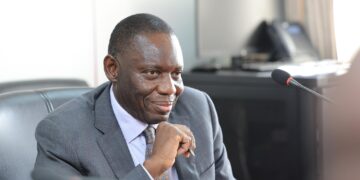
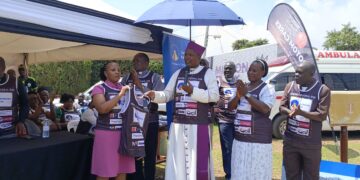





In a stunning twist that shocked absolutely no one, Nobert Mao has been “elected” President of Uganda’s Democratic Party (DP) for a fourth glorious term because of course the third time wasn’t charming enough.
With a commanding 969 votes, Mao left his two competitors choking in his democratic dust: Dr. Lulume Bayiga with a modest 339 votes and the almost mythically unknown Alitia Elia, who managed to gather a tear-inducing 52 votes (presumably including his own).


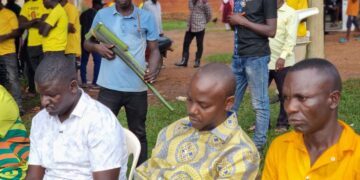
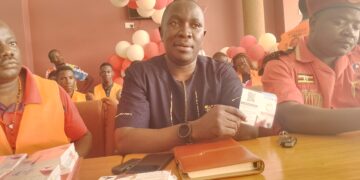
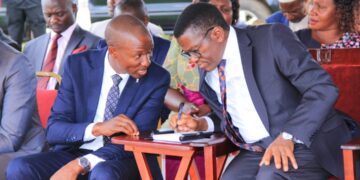
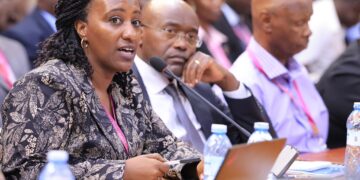
The results were announced at a glittering national delegates’ conference where party loyalty was thick in the air, along with the scent of political déjà vu. For those keeping score, that’s roughly Mao 70%, Bayiga 25%, and Elia… well, rounding error.
Observers described the election process as “democratic” with that familiar Ugandan flavor: overwhelming support for the incumbent, an electorate of loyal cadres, and just enough opposition to pretend it was competitive.
Political analysts whispered that the contest resembled more of a coronation than an election but hey, at least no one was tear-gassed this time.
In his victory speech, Mao graciously thanked his competitors for “participating,” a euphemism many interpreted as “thanks for helping legitimize the inevitable.”
He also promised to “rebuild and modernize the party,” which has been under his stewardship since 2010, a journey marked by passionate speeches, lukewarm electoral performances, and the occasional government appointment that raised eyebrows higher than Uganda’s inflation rate.
Dr. Lulume Bayiga, the perennial challenger and internal reformist, once again played his role with Shakespearean consistency — earnest, idealistic, and tragically doomed.
His promise to “bring back DP to its ideological roots” was met with polite clapping and a tidal wave of Mao-branded T-shirts.
Alitia Elia, on the other hand, remained a mystery to many, like a bonus track on an old cassette tape. Some delegates were overheard asking if he was standing for party president or head prefect.
The reelection of Mao raises interesting questions about the Democratic Party’s future, or rather, its cyclical present.
Under his leadership, the party has consistently failed to win major elections but has succeeded in consistently winning internal ones. A true legacy of continuity.
With his fourth term now secured, political commentators expect Mao to continue his unique brand of oppositional cooperation, critiquing the government on Twitter while occasionally popping into Cabinet meetings as Minister for Justice and Constitutional Affairs.
Because nothing says multiparty democracy like running a party while serving in the government you’re supposed to be opposing.
As one delegate put it, “We just can’t imagine DP without Mao. Mostly because we haven’t been allowed to.”







 English