


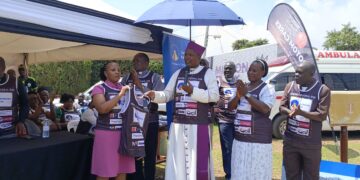














A new dawn for water access and climate resilience has broken in Kalungu District following the commissioning of a solar-powered piped water system under the Sustainable Climate Impact Fund (SCIF), an initiative implemented by Water-Aid Uganda and funded by the Water Fund.
The facility, launched on July 24, 2025 at Mukoko Muslim Primary School, is anchored on an 18-cubic-metre high-yield borehole and is expected to benefit hundreds of residents in Mukoko and surrounding communities.
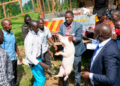

The project, valued at UGX 598 million, was executed by Robic Construction Company and marks a pivotal step in improving public health, productivity, and access to safe water in water-stressed areas.
Constructed with future expansion in mind, the water scheme is set to serve schools, homes, places of worship, and other public institutions. The initiative also advances the government’s broader goal of enhancing climate resilience in rural Uganda.
Presiding over the event, Hon. Aisha Ssekindi, Minister of State for Water, hailed the initiative as more than a basic utility.
“This is not just a water project, it is an investment in dignity, health, and economic transformation,” she said. “We call upon the community to protect this facility and use it responsibly.”
She further revealed that SCIF has invested over UGX 900 million in water projects across Kalungu and Lyantonde districts under its safe water and climate action drive.
The commissioning drew leaders and stakeholders from both Kalungu and Lyantonde, the two SCIF focus districts in Greater Masaka. Area MP Francis Katabaazi described the project as a model of what is possible through unity of purpose.
“This is evidence that when the government and partners work together, real transformation is possible,” he said.
Lyantonde District was represented by its Chief Administrative Officer, Mr. Edmond Ntimba, who delivered remarks on behalf of CAOs from both districts.
“Lyantonde and Kalungu are among the most water-stressed districts in the region. This intervention will reduce waterborne disease, improve school attendance, and boost agricultural productivity,” he noted.
The district chairperson of Kalungu, Mr. Richard Kyabaggu, commended the collaborative approach taken by WaterAid Uganda, SCIF, and local leadership.
“This project is proof that strong leadership attracts meaningful development. We thank our partners for walking this journey with us,” he said.
Mr. Bbale Aloysious, the Kalungu District Water Engineer and project focal point, provided a technical breakdown of the installation. He emphasized the solar-powered system’s low operational costs and future scalability.
“This system is designed to grow with the community. We encourage users to report faults early to ensure uninterrupted service,” he said.
For residents like Mr. Lubega Siraje, the new water system is more than infrastructure—it’s a lifeline.
“Our children will no longer skip school to fetch water. We’ve waited for this moment, and we are thankful,” he said.
The SCIF leadership expressed optimism about deepening community engagement and expanding the program’s reach.

Mr. John Starmer, Director of SCIF, praised Kalungu and Lyantonde residents for embracing the initiative.
“The core of our mission is empowering women and girls, especially those who have had to walk long distances for water, some of whom have dropped out of school due to early pregnancies,” he said. “Real change happens when communities lead. Kalungu and Lyantonde must now take charge of this transformation.”
Mr. Ola Bankole, Head of Operations at SCIF, pledged continued support and hinted at new interventions in climate adaptation.
“Kalungu District will spearhead our upcoming climate resilience efforts. We are proud of this partnership and the strides made so far,” he said.
While Kabarole District, also a SCIF beneficiary, did not send representation, the commissioning symbolized a growing momentum for sustainable development in the region.
As Kalungu positions itself at the forefront of rural water innovation, the Mukoko piped water scheme stands as a model for replicable, community-owned progress—offering not just water, but renewed hope for healthier and more productive lives.










 English