


















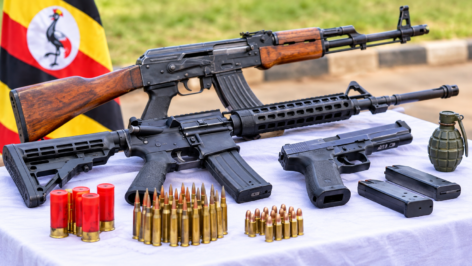
Cabinet has approved the proposed Small Arms and Light Weapons Control Bill, 2026, which seeks to strengthen the regulation, licensing and management of firearms in Uganda amid growing concerns over illegal possession and misuse of weapons.
The proposed legislation is intended to address gaps in the existing legal framework governing the possession, use and management of firearms while strengthening the country’s capacity to prevent the illicit circulation of small arms and light weapons.


According to a statement signed by the Minister of ICT and National Guidance and Government Spokesperson, Rt. Hon. Justine Kasule Lumumba, Uganda currently relies on several laws to regulate firearms, but none provides a comprehensive framework specifically addressing small arms and light weapons.
“There is a lack of a comprehensive law on Small Arms and Light Weapons,” Lumumba said.
The existing legal framework includes the Firearms Act, Uganda Peoples’ Defence Forces Act, Penal Code Act, Police Act, Prisons Act and Anti-Terrorism Act, 2000.
However, Lumumba said the various laws contain gaps that undermine effective regulation and control, necessitating stronger legislative and administrative measures.
The proposed Bill seeks to address several shortcomings, including the absence of clear legal provisions governing the management and disposal of firearms, inadequate training requirements for firearm licence holders and weak border controls resulting from insufficient surveillance.
It will also introduce measures to combat the illegal manufacture and hiring of firearms while strengthening licensing and registration procedures, marking and tracing systems, safe storage requirements and enforcement mechanisms.
Lumumba said Uganda remains committed to preventing and controlling the illicit proliferation of firearms, ammunition and related materials, both within its borders and across the region.
Regional efforts to establish a coordinated framework for controlling small arms and light weapons in East Africa date back to 2002, when countries adopted the Nairobi Declaration on the Prevention, Control and Reduction of Illicit Small Arms and Light Weapons in the Great Lakes Region, the Horn of Africa and neighbouring states.
The declaration later resulted in the 2004 Nairobi Protocol, a regional agreement binding 15 countries, including Uganda.
According to Lumumba, Uganda has continued to support regional and international initiatives aimed at preventing the proliferation of illicit firearms.
Small arms are firearms designed for individual use, including handguns, rifles, carbines, submachine guns, assault rifles and light machine guns.
Light weapons, on the other hand, include portable crew-operated weapons such as heavy machine guns and grenade launchers.
The proposed legislation is expected to establish a more comprehensive regulatory framework, improve accountability in firearm ownership and management, and strengthen national and regional efforts to curb the illegal circulation of weapons.








 English
