

















For decades, the official narrative surrounding road carnage across Uganda has followed a predictable and comfortable script. Whenever the Uganda Police Force Traffic and Road Safety Directorate releases its annual crime and safety statistics, or whenever a horrific crash occurs along the Masaka Highway, the Northern Bypass, the Kampala to Jinja arterial road, or any of the major transport corridors that feed into Kampala, the public diagnosis remains identical.
The driver was speeding. The driver was overtaking recklessly. The driver was driving under the influence of alcohol. The driver was fatigued. While human error is indisputably a factor on our roads, this singular institutional focus has created a massive and deadly blind spot in how we understand, investigate, and prevent road fatalities.
By attributing virtually every highway disaster to driver fault, state authorities ignore a far more organized, lucrative, and lethal threat operating right under the bonnet of the vehicles that carry millions of Ugandans every day. That threat is the widespread market distribution of counterfeit automobile spare parts.
The link between counterfeit parts and death on our roads is not theoretical. It is mechanical and immediate. When a driver makes a mistake in a vehicle equipped with genuine safety systems, those systems are designed to respond. Genuine brake pads maintain friction under extreme heat and allow a vehicle to decelerate.
Genuine tires retain integrity at high speed and under load. Genuine steering joints, suspension arms, and wheel bearings hold together under the stress of potholes, corners, and sudden maneuvers. But when a compromised safety component fails, control is lost instantly. A brake pad made of compressed wood dust and scrap metal filings does not fade. It disappears.
A tire with a counterfeit casing delaminates at speed. A ball joint cast from porous metal snaps without warning on a bend. At that moment, driver skill, sobriety, and road design become irrelevant. The automobile becomes an unguided kinetic missile.
Yet because violent collisions destroy evidence, our crash investigation teams default to recording “loss of control” or “careless driving” in their registry books. The real perpetrator, the network that imported and distributed the fake component, remains completely invisible to judicial scrutiny.
We need to pause here and speak with the seriousness this deserves, because the numbers we read in police reports are not mere figures. They are human beings. Behind every statistic is a father who will not come home to his children, a mother who will not cook dinner, a student who will not sit for final exams, a breadwinner whose family will now face eviction.
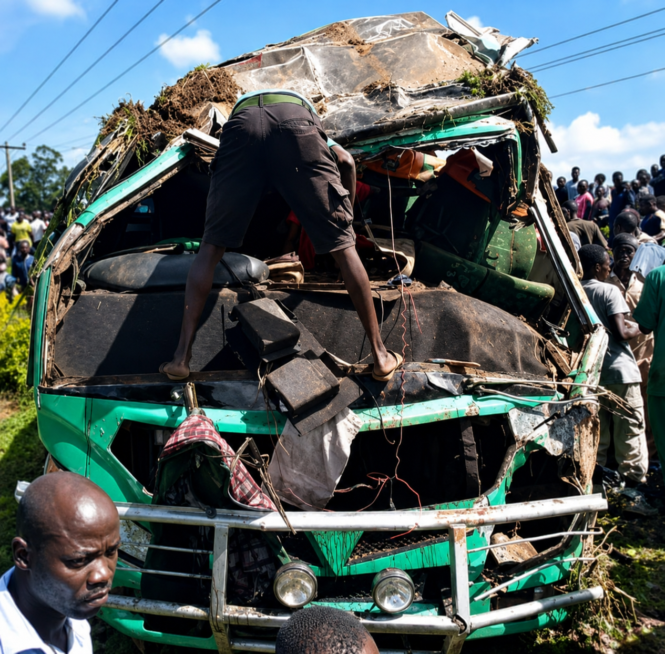
When we hear on the news that a bus has perished on the highway, or that a commuter taxi has overturned and 14 people are dead, that is beyond normal. That is a community shattered in minutes. Widows are created in an instant. Children are orphaned. Parents bury their own children. And we, as a country, have become accustomed to saying “accident” and moving on.
But what if the forensic examination, if we bothered to do it, discovered that the brakes failed not because the driver pumped them too hard, but because the brake pads were fake? What if the steering collapsed not because the road was bad, but because the joint was cast from scrap metal sold in Kisekka as “original”? If that is the case, then why would we not treat the person who put that part on the road the same way we treat someone who plants a bomb or vandalizes a power line? The result is the same. People are dead because of a deliberate choice to put profit before life.
And this brings me to a question I have wrestled with for years. Why would a person choose to buy duplicate spare parts knowing the risk they are exposing themselves, their passengers, and other road users to? At first I thought it was simply because of rising fuel costs and the general economic squeeze. Maybe people are cutting corners to stay afloat.
But the more I looked, the more that explanation fell apart. A fake brake pad does not save you money. It costs you your life, your vehicle, your insurance, and potentially years in prison if you survive and are found liable. No rational person, if properly informed, would trade a few thousand shillings for the possibility of dying on a highway. So the reason must lie elsewhere.
It lies in ignorance, in deception, and in the failure of the institutions that are supposed to protect us. Many buyers genuinely do not know the difference. They walk into a shop and are asked, “Do you want original or Taiwan?” The vendor assures them the “Taiwan” is just as good, and because there is no clear labeling, no certification, and no consequence, the buyer believes it. Others know but assume “it won’t happen to me.” That is where the state must intervene.
Which leads to the next question. Where is UNBS in all this? The Uganda National Bureau of Standards exists precisely to ensure that what is sold to Ugandans meets minimum safety requirements. Are the standards for brake pads, tires, ball joints, and suspension components even declared, gazetted, and enforced? If they are, why are markets like Kisekka, Katwe, and Wandegeya still full of fakes? Is UNBS sleeping on duty, or is it overwhelmed, underfunded, or worse, compromised?
When substandard products that are clearly a threat to life circulate openly for years, the public is forced to wonder whether regulators are accomplices by omission. We cannot keep pretending that this is only a consumer problem. If the standards body is not testing, not raiding, and not prosecuting, then it is effectively licensing the killing. The same way we asked hard questions when electricity infrastructure was being vandalized, we must now ask hard questions of the institutions mandated to keep fake parts off our roads.
Globally, the trade in counterfeit automobile parts is a transnational criminal enterprise valued at over 45 billion dollars. In India, transport research institutes estimate that up to 20 percent of highway collisions are directly linked to substandard components, costing tens of thousands of lives each year. In Kenya, surveys conducted by major manufacturers found that eight out of ten vehicles on the road had at least one counterfeit replacement part. In the United Kingdom, one in six motorists admitted to purchasing fake parts, often without understanding the structural hazard involved.
Across Africa, where pre-owned vehicle fleets dominate and informal retail markets thrive, the proportion of vehicles operating on unverified hardware is even higher. In Uganda, the markets of Kisekka, Katwe, Wandegeya, and upcountry trading centers openly display options labeled “Taiwan,” “Dubai copy,” or “aftermarket standard.” Vendors routinely ask buyers whether they want “original” or “cheap,” and economic pressure pushes individual motorists, commuter taxi operators, boda boda riders, and fleet managers toward the cheaper option. Each time that choice is made, high-risk hardware is embedded into the national transport grid.
This problem persists not because Ugandans are indifferent to safety, but because the incentives are misaligned and the legal framework is broken. Illicit distributors operate with low manufacturing costs and high profit margins. Authorized distributors must pay import tariffs, comply with standards, and remit taxes. That price gap creates constant demand.
The resulting shadow economy destabilizes legitimate automobile commerce, deprives the national treasury of revenue, and funds criminal distribution networks that operate across borders. More critically, it is enabled by a foundational legislative void. Uganda currently operates without a dedicated statutory Anti-Counterfeit law. Our regulatory agencies and law enforcement default to the Trademarks Act of 2010. That Act was designed to protect corporate intellectual property, not human life.
Under its provisions, counterfeiting is treated as a civil infringement of a registered mark. The state can only prosecute if the registered trademark holder, usually a manufacturer based in Japan, Europe, or the United States, files a formal complaint.
Multinational corporations do not maintain legal teams to patrol Kisekka Market. Local vendors have no standing to sue. As a result, counterfeit syndicates operate virtually unchecked. The law treats a lethal brake component as a private property dispute rather than a public safety hazard.
Over the past decade, Parliament and civil society have repeatedly attempted to address this gap. Bills to create a comprehensive Anti-Counterfeit law have been drafted, debated, and stalled. Advocates such as *Fred Muwema* and other legal experts have pushed for legislation that would establish criminal penalties and grant enforcement powers to standards inspectors and customs officers without requiring private brand intervention. But lobbying from commercial interests, jurisdictional disputes between agencies, executive delays, and concerns about the informal sector have kept the bill off the books.
This legislative standstill leaves our transport system without statutory protection against dangerous hardware. At the borders, the problem is compounded by technical limitations. URA Customs officers lack the forensic equipment and metallurgical testing protocols needed to distinguish genuine parts from sophisticated fakes during routine clearances. As a result, consignments of unverified components enter the country and flow directly into garages and retail outlets.
Other countries have shown that this can be reversed when governments decide to treat counterfeiting as an organized crime threat to public safety. In the European Union, Europol and the EU Intellectual Property Office coordinate cross-border operations to intercept illicit auto parts before they reach consumers.
In the United Kingdom, garages that fit unverified safety components can be prosecuted for corporate manslaughter. In India, regulators require digital authentication such as holographic seals and QR codes so that mechanics and buyers can verify origin. These measures work because they shift the burden from the consumer to the state and to the supply chain.
Uganda has precedent for this kind of decisive action, and it is precedent rooted in both logic and public outrage. When electricity vandalism was costing the government billions of shillings and causing blackouts in hospitals, schools, and factories, the state stopped treating it as simple theft. Vandals were charged with terrorism and economic sabotage. Penalties were made severe, investigations were prioritized, and the vice reduced tremendously. The message was clear.
If your actions endanger public infrastructure and public safety, you will face the full weight of criminal law. The logic was simple. You are not just stealing copper. You are plunging a hospital into darkness while a patient is on oxygen. You are shutting down a factory and throwing hundreds out of work. That is why the law responded with terrorism charges.
The same approach was taken with wildlife crime and narcotics. The enactment of the Uganda Wildlife Act and the Narcotic Drugs and Psychotropic Substances Act came with stringent provisions precisely because those crimes destroy life, livelihoods, and national assets.
Possession, trafficking, and distribution carry heavy sentences because the state recognized the scale of harm and chose to respond with criminal law, not civil fines. No one argues that a poacher who kills an elephant is just “trading.” No one argues that a drug dealer who sells heroin is just “doing business.” We recognized that these acts have consequences that ripple through families and communities, and we responded accordingly.
We must apply that same logic to counterfeit automotive parts. When a dealer imports fake brake pads knowing they will fail under highway conditions, when a distributor sells counterfeit tires knowing they will burst at speed, when a mechanic fits a fake steering joint knowing it will snap under load, that is not just bad business. It is a conscious decision to place profit above human life. Under the Penal Code Act, causing death through an unlawful act or through criminal negligence constitutes manslaughter.
The elements are met. The dealer knows the product is fake. The dealer knows the product is safety-critical. The dealer also knows, or ought to know, that failure will likely result in death. To sell it anyway is to act with reckless disregard for human life.
That is why the Directorate of Public Prosecutions must begin charging importers, distributors, and garages that knowingly deal in fake safety-critical parts with reckless endangerment, negligent acts causing death, and manslaughter when fatalities occur. In egregious cases where there is clear prior knowledge and repeated conduct, murder charges should even be considered. Let the courts determine the degree of culpability, but let the charges reflect the true nature of the act.
Imagine a scenario. A commuter taxi leaves Kampala for Mbarara full of passengers. Among them is a teacher returning home, a trader with goods, a young couple visiting relatives. Midway, the brakes fail on a downhill. The vehicle veers off and 12 people die. The police report says “brake failure and over speeding.”
The driver is blamed. But a proper forensic investigation finds that the brake pads were counterfeit, purchased from a dealer who knew they were fake and sold them anyway. Tell me, why should that dealer not face manslaughter charges?
If a vandal who cuts a power line and causes a blackout can be charged with terrorism because of the potential harm, why should a dealer who sells a part that he knows will kill not face the same logic of criminal responsibility? The harm is not potential. It is real. The bodies are real. The widows and orphans are real.
Treating this as manslaughter will change behavior in the same way that treating electricity vandalism as terrorism changed behavior. Right now, the risk to a dealer is minimal. At worst, goods may be confiscated. At best, business continues. If the risk becomes 10 years in prison for causing death, the calculation changes. Importers will vet their suppliers. Distributors will demand documentation.
Mechanics will refuse to fit unverified parts. Consumers will begin to ask questions because the people selling to them will be afraid of the consequences. That is how deterrence works. That is how we saved the power grid. That is how we began to protect wildlife. That is how we must now protect our roads.
To make this possible, four things must happen immediately. First, Parliament must prioritize and pass a comprehensive Anti-Counterfeit Act. The law must explicitly criminalize the production, importation, distribution, and sale of counterfeit safety-critical automobile components. It must grant the Uganda National Bureau of Standards, the Uganda Revenue Authority Customs Division, and the Uganda Police Force independent powers of seizure, testing, and prosecution without requiring a complaint from a foreign brand owner.
The law must define fake brake pads, tires, steering parts, and suspension components as inherently dangerous goods. UNBS must also be funded and empowered to declare clear standards, test products at the border and in the market, and be held accountable when those standards are not met.
Second, the Directorate of Public Prosecutions and the Judiciary must apply existing homicide provisions to this trade. Investigators must be trained to look beyond the driver. Prosecutors must be willing to file charges that reflect the reality that a fake part, not just a mistake, killed people. This will require evidence, which leads to the third step.
The Uganda Police Force Traffic and Road Safety Directorate, in partnership with UNBS, must establish dedicated automobile forensic investigation units. Mechanical engineers must be deployed to analyze wreckage in laboratories. They must determine whether a pre-impact component failure occurred. Forensic findings must be used to trace the part back to the importer and the retailer. Without this, every case will default to driver error and the real killer will walk free.
Fourth, we need enforcement at the point of entry and at the point of sale. URA must invest in scanners and authentication tools at border posts. UNBS must conduct regular, intelligence-led raids in major parts markets and publish the results. The Ministry of Works and Transport must work with standards bodies to introduce mandatory digital traceability for all imported safety components.
Tamper-evident seals and scannable QR codes should be required so that a mechanic or a buyer can verify authenticity before installation. Public awareness campaigns must run in partnership with transport unions, driver associations, and civil society to explain that saving money on a fake part can cost a life. People must be told directly: this is not about saving money. It is about staying alive.
I speak to this matter with authority. My dissertation research that led to the award of a Masters of Diplomacy and Security Studies was comprehensive and focused on the nexus between counterfeit goods and organized crime, with a specific focus on Kampala.
During that research, I became deeply invested in the subject after discovering the extent to which counterfeit goods destroy humanity and economies. It was in that process that I realized that counterfeit automotive spare parts are rarely mentioned in public discourse, yet they have occasioned many road carnages. This gap in both research and policy must be closed if we are to save lives.
Highway fatalities will not be curtailed so long as counterfeit automobile parts circulate under outdated trademark laws and unmonitored market conditions. Automobile mechanical integrity is an essential component of national security.
When we allowed electricity vandalism to be treated as a petty crime, the country bled money and lost power. When we elevated it to terrorism, the crime reduced. When we made wildlife trafficking and drug dealing serious criminal offenses with stringent penalties, we sent a signal that the state would not tolerate activities that destroy life and national assets.
The same signal must now be sent to the dealers of fake automobile parts. Every fake brake pad sold is a potential death sentence. Every counterfeit tire is a potential massacre on the highway. Every dealer who knows this and sells anyway is not simply a trader. In the eyes of the law, and in the eyes of the families who bury their loved ones, that dealer is a manslayer.
We cannot continue to read police statistics as if they are abstract. They are mothers, fathers, and children. They are futures cut short. And we cannot continue to ask why people buy fakes without also asking why the state has failed to protect them from that choice. It is time we called it what it is and prosecuted it accordingly.
By Twiine Mansio Charles











 English