


















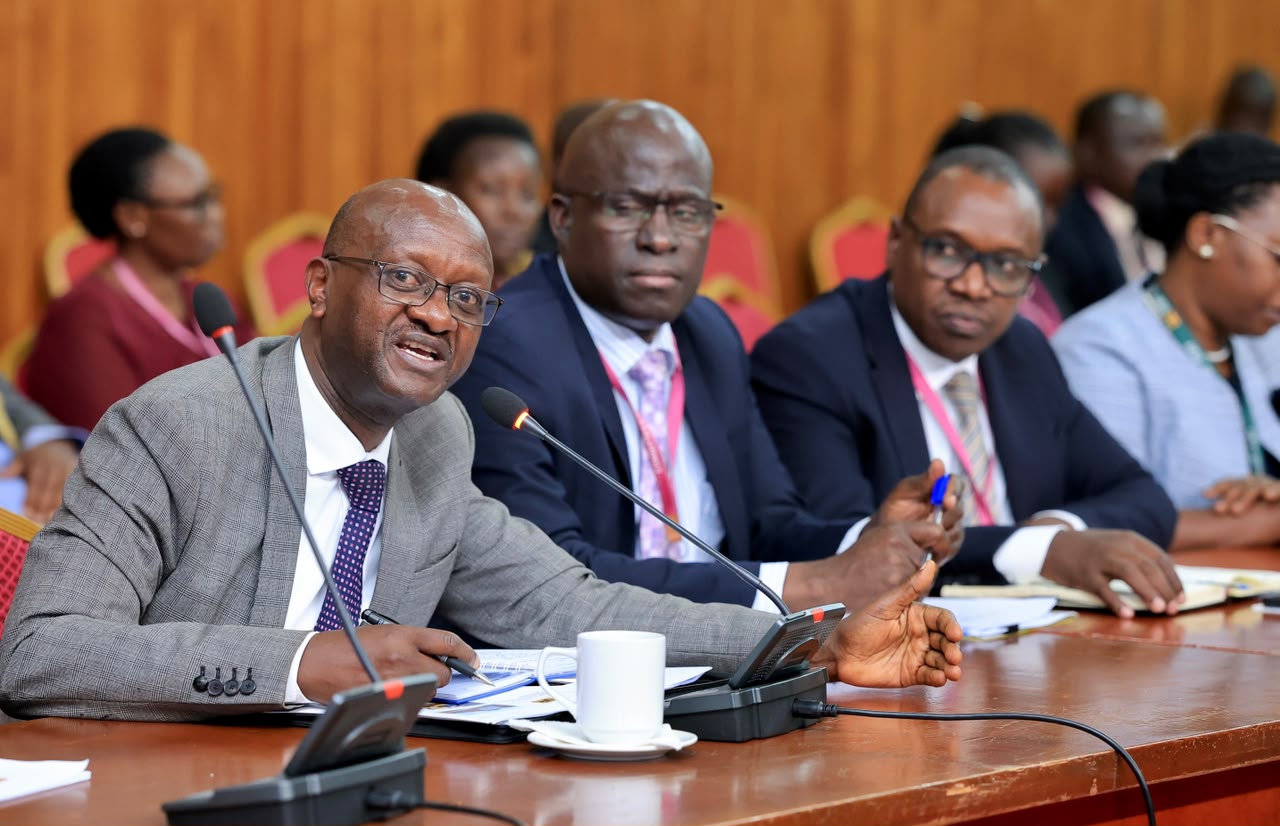
Parliament has directed the Managing Director of the Uganda Railways Corporation (URC) to record a statement with the Criminal Investigations Directorate (CID) over the disappearance of 394 railway wagons valued at approximately UGX 220.8 billion.
The directive, issued on Thursday, July 23, 2026, followed growing concern by lawmakers over accountability at the state-owned railway corporation, which plays a critical role in Uganda’s regional trade and cargo transportation.

The order was issued by Parliament’s Committee on Physical Infrastructure after URC officials failed to satisfactorily explain the whereabouts of the missing wagons during a tense committee meeting.
Committee Chairperson Mwine Mpaka gave URC management one hour to produce documentary evidence of joint efforts with Kenya Railways Corporation to trace the missing wagons. However, lawmakers said the documents presented did not provide any confirmation from the Kenyan side acknowledging possession of the missing assets.
“The assumption is they are in Kenya, but there is also an assumption that some are sold in Uganda,” Mpaka said.
“The Managing Director is going to go and record a statement at police, and if he does not provide evidence within a week, the next time he reports, then we shall officially open the fire regarding the disappearance of the wagons.”
The matter stems from the Auditor General’s December 2025 report, which revealed major weaknesses in URC’s asset management and verification systems.
According to the audit, 131 URC-owned wagons could not be physically verified as of November 2024. Although 18 were later traced, 113 remain unaccounted for.
The report further found that all 281 Kenya Railways Corporation wagons that had been entrusted to URC were also missing, bringing the total number of unaccounted-for wagons to 394.
Budyebo County MP Eng. Ssebbugga Kimeze warned that the disappearance of Kenyan government property could damage relations between the two neighbouring countries.
“As if that is not enough, we actually lost 281 wagons for the Kenyan railways. Property belonging to a neighbouring country goes missing here. In fact, it is stolen by our own thieves here. This is going to cause us a diplomatic problem one of these days,” Kimeze said.
Batooro County MP Emmanuel Ilukol noted that each railway wagon is valued at approximately US$150,000, meaning the losses amount to hundreds of millions of dollars.
He called for the involvement of the State House Anti-Corruption Unit, arguing that public officials responsible for safeguarding government assets must be held personally accountable.
“It seems we are taking it lightly. Up to when must we burden the taxpayer for acts of people that are not accountable to their jobs?” Ilukol asked.
URC Managing Director Benon Kajuna, who took office in early 2025, told the committee that tracing railway wagons across two countries is a complex process that requires joint verification exercises.
He said URC and Kenya Railways Corporation have established joint technical committees, held several bilateral meetings and continue to exchange documentation in an effort to resolve the matter amicably.
His explanation, however, failed to satisfy members of the committee.
Kole North MP Samuel Opio questioned how hundreds of railway wagons fitted with unique identification numbers could simply disappear without a trace.
“We don’t know whether they were stolen, we don’t know whether they have been sold, we don’t know whether they are in Kenya. Wagons cannot just be stated to have disappeared. They are supposed to have wagon numbers, identification numbers and traceability of their locations,” Opio said.
Railway wagons are a critical component of Uganda’s freight transport network, carrying imports and exports along the metre-gauge railway linking Uganda to the Kenyan port of Mombasa.
The Auditor General’s findings have exposed significant gaps in asset tracking, inventory management and cross-border accountability, raising fresh concerns over the protection of public assets.
The Public Finance Management Act requires accounting officers to safeguard government property and account for any losses arising from negligence or abuse of office. The disappearance of the wagons could also attract investigations under Uganda’s anti-corruption and criminal laws if evidence of theft, fraud or abuse of office is established.
The case comes at a time when Uganda is pursuing major investments in railway infrastructure, including the Standard Gauge Railway project, with lawmakers warning that restoring confidence in the management of existing railway assets is essential to strengthening public trust and attracting future investment in the sector.









 English