


















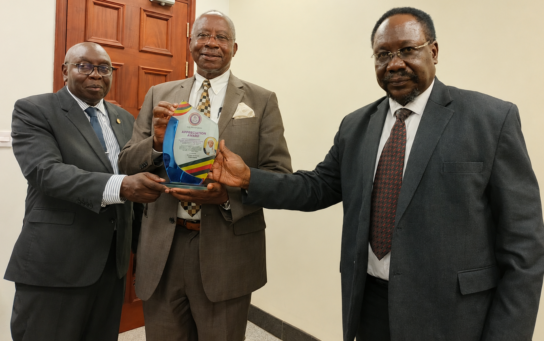
Retiring Court of Appeal and Constitutional Court Justice Dr. Frederick Martin Stephen Egonda-Ntende says he is leaving the Judiciary with a sense of fulfilment, describing his departure as that of a “satisfied parent” after seeing technology reforms he championed nearly 30 years ago mature into systems transforming justice delivery in Uganda.
Speaking on Thursday in Kampala after receiving an Appreciation Award from the Judiciary’s ICT and Documentation Committee, Justice Egonda-Ntende likened the Judiciary’s digital transformation journey to raising a child through different stages of growth into adulthood.


“At this stage, I feel like a parent watching a child grow from infancy, through youth, and eventually into a mature adult capable of making its own decisions. I therefore leave as a satisfied parent,” he said.
The ceremony took place in Chief Justice Dr. Flavian Zeija’s boardroom at the Supreme Court, where members of the ICT and Documentation Committee honoured the veteran judge for his foundational role in introducing and promoting information and communication technology within Uganda’s Judiciary.
In his remarks, Justice Egonda-Ntende traced his interest in judicial technology to a fellowship at the University of Minnesota in the United States between 1996 and 1997, where he focused on courts and emerging technologies.
Upon returning to Uganda, he advised then Chief Justice Benjamin Odoki Wambuzi on the need to establish a dedicated committee to guide the Judiciary’s adoption of technology. He said his proposal led to the formation of the committee he was later asked to chair.
“I prepared a report recommending the establishment of a technology committee to advise the Judiciary on ICT matters. That recommendation was accepted, and I was appointed to lead it,” he noted.
Nearly three decades later, that initiative has grown into a central pillar of judicial operations, driving innovations such as electronic case management systems and virtual court hearings.
Justice Egonda-Ntende also highlighted what he considers his most impactful contribution to the legal profession—not his rulings, but his role in supporting the creation of the Uganda Legal Information Institute (ULII).
“Many may point to judgments I have written, but I would rather highlight ULII. Supporting its establishment is, in my view, one of my most meaningful contributions to the legal profession,” he said.
Founded in 2007, ULII provides free online access to case law, legislation, and other legal resources. It has since evolved into a modern digital platform widely used within the justice system and beyond.
While reading the citation, Court of Appeal and Constitutional Court Justice Geoffrey Kiryabwire commended Justice Egonda-Ntende’s long and distinguished service, particularly his pioneering work in integrating technology into judicial administration.
The citation noted that he served as the first chairperson of the Judiciary’s Technology Committee in 1997 and led the development of the Computerized Case Administration System (CCAS), which later evolved into the Electronic Court Case Management Information System (ECCMIS).
He was also credited with introducing court recording and transcription systems, pioneering video conferencing in commercial court proceedings in the mid-2000s, promoting electronic filing, and supporting the rollout of virtual hearings, as well as playing a key role in establishing ULII.
Presenting the award, Supreme Court Justice Christopher Izama Madrama, chairperson of the ICT and Documentation Committee, described Egonda-Ntende as a forward-thinking jurist who anticipated the role of technology in justice delivery long before it became mainstream.
He said the Judiciary’s ongoing digital transformation owes much to Egonda-Ntende’s early leadership, which helped transition courts from manual, paper-based systems to modern electronic platforms.
“We are building on a foundation laid by pioneering work that continues to shape the Judiciary’s future,” Justice Madrama said, adding that these reforms have positioned the institution to adopt emerging technologies, including artificial intelligence, to enhance efficiency, transparency, and access to justice.
Justice Egonda-Ntende, who has served in multiple senior judicial roles including in Uganda, Seychelles, Kosovo, and East Timor, previously noted during a special sitting held in his honour in May 2026 that his wife, Margaret, played a supportive role in his early technological work, including allowing him to use her laptop in the 1990s.
Born in 1956, he studied law at Makerere University, earning a Bachelor of Laws degree with honours, before obtaining a Postgraduate Diploma in Legal Practice from the Law Development Centre and later a Master of Laws in Information Technology and Telecommunications Law from the University of Strathclyde in the United Kingdom.
His judicial career has included service as a High Court Judge (1991–2000), Justice of the Court of Appeal and Constitutional Court (2000–2026), Acting Justice of the Supreme Court of Uganda (2008–2009), Chief Justice of the High Court of Seychelles (2009–2014), and international judicial appointments in Kosovo and East Timor.
Justice Egonda-Ntende is set to retire from the Judiciary on June 15, 2026, upon reaching the mandatory retirement age of 70.











 English