


















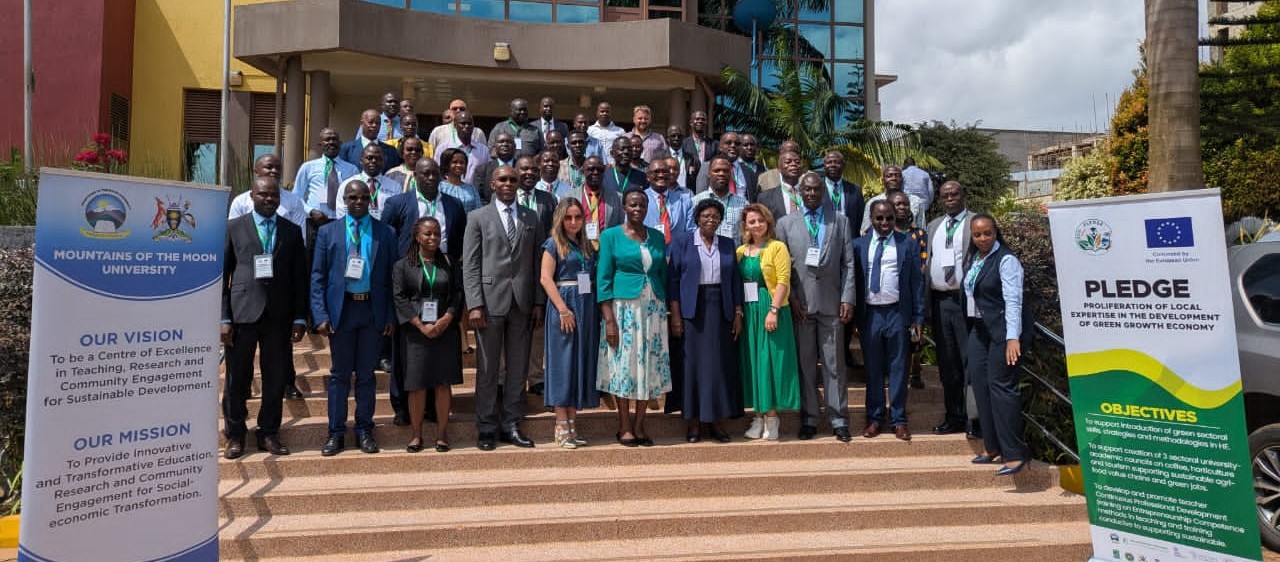
Uganda has launched a major higher education reform initiative aimed at shifting universities and colleges away from theory-heavy training toward hands-on, skills-based learning, particularly in agriculture and green growth sectors.
The initiative, known as the Proliferation of Local Expertise in the Development of Green-Growth Economy (PLEDGE) Project, will run for four years and is funded by the European Union under the Erasmus+ Programme to the tune of about 1 million Euros (approximately Shs4 billion).


It is designed to strengthen competency-based education in higher institutions, with a focus on agriculture, horticulture, coffee production and tourism, sectors seen as central to Uganda’s green economic transition.
Speaking at the launch, Dr Kedrace Turyagyenda, the Permanent Secretary in the Ministry of Education and Sports, said the project comes at a time when countries are increasingly prioritising sustainability, climate resilience and innovation-driven development. She noted that the green economy presents wide-ranging opportunities in climate-smart agriculture, renewable energy, sustainable industrialisation, waste management and green entrepreneurship.
She said universities must move beyond producing graduates with certificates and instead focus on producing innovators and problem-solvers capable of responding to real societal challenges. Dr Turyagyenda added that initiatives like PLEDGE will help young people acquire relevant skills for emerging green sectors while boosting employment, innovation and sustainable development outcomes. She further noted that the programme aligns with Uganda’s Vision 2040, the National Development Plan and the Sustainable Development Goals.
The project is being implemented by a consortium led by Mountains of the Moon University, working alongside Ugandan and European partners, the Ministry of Education and Sports and the National Council for Higher Education (NCHE).
Mountains of the Moon University Vice Chancellor, Prof. Pius Coxwell Achanga, said the initiative is intended to close the long-standing gap between classroom learning and real-world agricultural practice. He observed that although agriculture employs more than 70 percent of Uganda’s population, many graduates leave university without adequate practical experience.
He said the university has identified 350 farms across the Rwenzori region, 80 of which will be developed into structured training and placement centres for students. These farms will function as “living classrooms” where students will engage directly with farmers, learn market systems and gain exposure to value addition and agribusiness operations.
Prof. Achanga also pointed to challenges such as land fragmentation, limited research funding and weak practical exposure as constraints to agricultural productivity. He welcomed government’s move toward full competency-based learning by 2027, saying the traditional lecture-based model must give way to field-driven training if graduates are to remain relevant.
Professor Mary J.N. Okwakol, Executive Director of NCHE, described the project as a timely step toward improving the relevance and quality of higher education in Uganda. She said competency-based learning remains one of the most effective approaches for equipping graduates with practical skills, innovation capacity and problem-solving abilities demanded by the labour market.
NCHE, she added, is supporting reforms including the development of a national greening skills policy for higher education, an intersectoral supervision framework and a green competence framework.
Dr Vincent Ssembatya said the PLEDGE Project will significantly reshape how agriculture and related disciplines are taught. He explained that students will spend extended periods of between four and six months in real working environments such as farms, industries, hotels and tourism facilities.
Learners will also be required to complete capstone projects demonstrating their practical competencies before graduation. He said agriculture happens in farms, not only in classrooms, and stressed that longer placements will ensure students acquire the skills needed by the job market.
Representing European partners, Marko Stojanovic said the European Union supported the project because of its emphasis on employability, entrepreneurship and sustainability. He said the goal is to ensure that students graduate with practical abilities to create value in society and respond to labour market demands.
The PLEDGE Project is expected to serve as a pilot model for wider reforms in Uganda’s higher education sector, particularly in embedding practical learning, entrepreneurship and green growth principles into university training systems.











 English