
















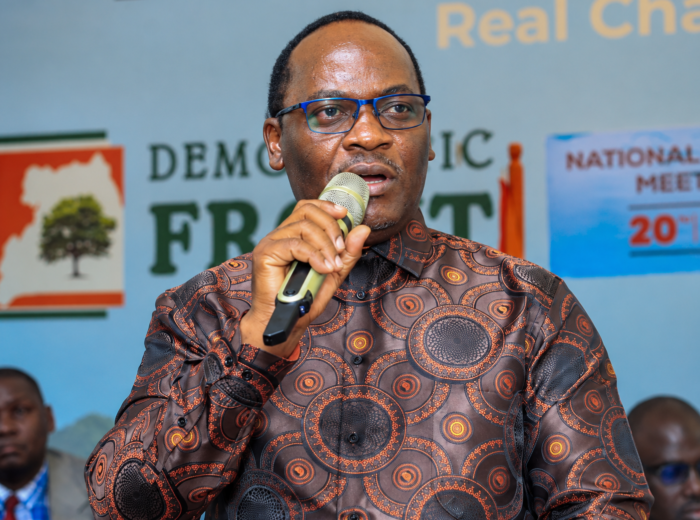
The decision by the Democratic Front (DF) to challenge the 2026 general elections in Uganda’s Constitutional Court reflects concerns that go far beyond the fortunes of one political party.
At the heart of the petition are questions about electoral credibility, institutional independence, constitutional compliance, and public trust in democracy.

Whether or not the petition ultimately succeeds in court, the issues it raises remain highly significant because they touch on the foundation of Uganda’s political system.
The 2026 elections were already contentious, with opposition groups alleging widespread irregularities, intimidation, and procedural failures.
DF’s petition consolidates many of the concerns that have repeatedly surfaced in previous Ugandan elections.
This repetition itself is important. When the same complaints arise election after election, it suggests unresolved structural weaknesses rather than isolated incidents.
One of the strongest issues raised in the petition is the involvement of the Uganda People’s Defence Forces (UPDF) in the electoral process.
Elections in democratic systems are expected to be managed by civilian institutions, particularly independent electoral commissions and the police where security is necessary.
When the military becomes visibly involved, it creates the perception that elections are being conducted under coercion rather than free political competition.
Even if authorities argue that deployment was necessary for security, the public perception of military interference damages confidence in electoral fairness.
This concern remains important because public trust is central to democratic legitimacy. Citizens must believe that their vote counts without fear or intimidation.
Another major concern is the use and procurement of biometric voter verification (VVR) machines without a clearly established legal framework.
Technology in elections can improve efficiency and reduce fraud, but only when it is transparent, reliable, and legally regulated.
Reports of biometric machine failures during voting raise questions about voter disenfranchisement and operational preparedness.
If voters were delayed, rejected, or unable to vote due to machine malfunctions, then the integrity of the process is inevitably questioned.
Moreover, procurement controversies surrounding electoral technology often fuel suspicion that systems may be manipulated for political advantage.
In Uganda’s context, where electoral trust is already fragile, such concerns become even more serious.
The issue of constituency demarcation following the 2024 census is also constitutionally significant. Electoral boundaries are meant to reflect population realities so that representation remains fair and balanced.
Failure to re-demarcate constituencies within the required timeframe raises concerns about unequal representation.
Some constituencies may have become overpopulated while others remain underpopulated, meaning votes in different areas may not carry equal weight.
This directly challenges the democratic principle of equal representation. While boundary reviews are often politically sensitive worldwide, delays or failures in implementing them undermine electoral fairness and can distort parliamentary representation for years.
DF also challenges the Electoral Commission’s requirement that presidential candidates collect endorsement signatures from at least 100 registered voters in two-thirds of Uganda’s districts.
Supporters of the rule may argue that it ensures only serious candidates contest for office. However, critics see it as an administrative barrier that disproportionately disadvantages smaller or emerging political movements.
In Uganda’s political environment, where opposition parties frequently complain about restricted political space, such requirements can appear less like regulation and more like exclusion.
The broader question raised here is whether electoral rules are designed to encourage political participation or to limit competition.
The controversy surrounding the voters’ register is perhaps among the most sensitive matters in any election.
DF alleges irregular and unlawful updating of the register, as well as unexplained expansion in voter numbers. Voter registers are the backbone of credible elections.
If citizens doubt the accuracy of the register, they may also doubt the validity of the final results. Concerns over ghost voters, duplicate entries, or unexplained increases in registered voters have historically been central in many disputed African elections.
Even if no direct fraud is proven, lack of transparency in voter registration creates suspicion that weakens public confidence in the outcome.
Equally important is the petition’s criticism of tallying and transmission procedures. Transparent result transmission is essential because elections are not judged only by voting day activities but also by how results are counted, verified, and announced.
DF’s claim that results were not properly harmonized with agents and observers points to concerns about accountability.
Modern elections increasingly depend on transparent digital and physical transmission systems. When candidates and observers are denied timely access to tally sheets or official returns, suspicions of manipulation inevitably emerge.
This issue remains highly relevant because disputes over tallying often become the focal point of post-election tensions across the continent.
The petition also raises broader democratic inclusion concerns, particularly the failure to facilitate voting for prisoners and Ugandans in the diaspora. In many countries, prisoner voting rights and diaspora participation remain contested issues.
However, modern democratic standards increasingly recognize that citizenship rights should not automatically disappear because of incarceration or residence abroad.
Uganda’s growing diaspora contributes significantly to the economy through remittances and maintains strong political interest in national affairs.
Excluding such groups weakens the principle of universal suffrage and leaves sections of citizens politically marginalized.
Another politically symbolic issue is DF’s complaint that it was not recognized and treated as a parliamentary party. Recognition determines access to parliamentary privileges, funding, committee representation, and political legitimacy.
While this issue may appear partisan on the surface, it also reflects broader concerns about political pluralism in Uganda.
Democracies function best when opposition groups are institutionally recognized and allowed to operate fairly within the political system.
Marginalizing smaller parties risks entrenching dominance by larger actors and narrowing democratic competition.
However, while the issues raised are important, the challenge for DF lies in proving that the alleged irregularities substantially affected the election outcome or violated constitutional principles in a legally actionable way.
Courts often distinguish between procedural imperfections and violations significant enough to invalidate an election.
Uganda’s judiciary has historically acknowledged irregularities in past elections while still upholding results on the grounds that the flaws did not fundamentally alter the outcome. This legal threshold is difficult to overcome.
There is also the political reality that election petitions in Uganda are not judged only in legal terms but also in the context of institutional trust.
Many opposition supporters view the courts with skepticism, believing they rarely challenge the status quo decisively.
On the other hand, government supporters argue that opposition parties frequently use courts and public rhetoric to delegitimize elections they fail to win.
This divide means that regardless of the judgment, public debate over electoral credibility is likely to continue.
Ultimately, the importance of DF’s petition lies less in whether it overturns the election and more in whether it forces national reflection on electoral reform.
Many of the issues raised; military involvement, voter register transparency, tallying procedures, electoral technology, and equal political participation, are not unique to the 2026 elections.
They are recurring concerns that have shaped Uganda’s electoral debates for decades.
If these issues remain unresolved, they risk deepening public cynicism toward democratic institutions.
Citizens who repeatedly hear allegations of irregularities without seeing reforms may gradually lose faith in elections as meaningful instruments of change.
That is dangerous for any democracy because legitimacy depends not only on winning elections but also on ensuring that the process is widely trusted.
For Uganda, therefore, the DF petition represents more than a courtroom dispute. It is part of a larger national conversation about whether future elections can become more transparent, inclusive, and credible.
Even critics of the petition would likely agree that strengthening public confidence in electoral institutions is in the country’s long-term interest.
Ivan Kimbowa is a senior journalist and political commentator. He can be reached on +256 701 584 195 or via email at ivankimbowa7@gmail.com












 English