

















Law, numbers, and a good dose of political drama—that’s the spicy cocktail Kawempe North’s by-election just served, with a side of “Wait, what?”
The results got nullified, and suddenly everyone’s pulling out calculators and legal briefs like it’s the World Cup of politics.


Baker Batte might’ve hinted at the numbers, but I figured, why not let my trusty Casio have a moment?
While the serious political, judicial, and legal minds digest the ruling, I’ll try to break down the math for us mere mortals.
The voter register grew by a neat 21 percent—about 35,000 new voters—bringing the total to 199,062. Why that matters?
Honestly, I’m not entirely sure. But since the opposition kicked up a fuss about it before the election, it’s worth a solid mention.
On voting day, only 28,659 people actually showed up. If you spot a statistical error here, blame my Casio FX991MS—or just accept that math isn’t really my strong suit.
But hey, even the Electoral Commission spent days wrestling with the numbers. In the end, their figures didn’t match what was on the official results forms.
Remember the UBOS data scandal? Clearly, I’m not the only one with math problems—and maybe not even the judge. (Sorry, Your Honor, no disrespect intended!)
Anyway, my Casio puts voter turnout at about 14.4 percent. Nambi bagged 9,058 votes (about 32.6 percent of those who voted), while Nalukoola took home 17,939 votes, a solid 63.5 percent.
Let’s not even get started on Aganaga, Moses Nseroko, or the invalid votes—they’re just background noise in this math concert.
Now here’s where the plot thickens. The judge pointed out that results from 14 polling stations could have changed the outcome.
Fourteen out of 197—that’s 7.11 percent of all polling stations. Might’ve been the secret sauce. It’s like saying if your least favorite party guest bails, the whole vibe changes. Sure, that can be true—but still.
Those 14 stations had 16,640 registered voters, about 8.35 percent of the total electorate. Based on the average turnout of 14.05 percent, you’d expect roughly 2,339 votes from those stations.
Here’s the spicy hypothetical: If every single one of those votes went to Nambi (hello, political unicorn!), she’d jump from 9,058 to 11,397 votes. Still not enough to beat Nalukoola.
But if, by some miracle, every single one of those 16,640 voters showed up and all voted for Nambi? She’d hit 25,698 votes—a full-on upset.
Unicorns may not be real, but courts apparently have to entertain the possibility.
Cue the judge: “Therefore, I reject the argument that the 1st respondent would still have won at the questioned 14 polling stations.
Accordingly, the decision of the court is that the disenfranchisement of 16,640 voters put the victory of the 1st respondent (Luyimbazi Elias Nalukoola) in doubt, which affected the result of the election in a substantial manner.”
I’m no lawyer or judge—heck, I don’t even play one on TV—but this math makes political and legal theater way more entertaining to watch (or read, if you’re one of those people).
Let’s keep our “kaliki” on and wait for another wave of numbers to roll in.
But elections aren’t just about numbers or laws. They’re a messy cocktail of both—and more.
So maybe, just maybe, the math can take a backseat while the human stories steal the spotlight.
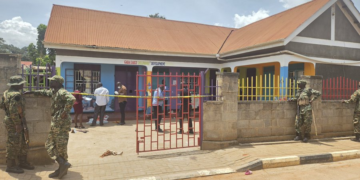
Before this court case kicked off, the Uganda Human Rights Commission had already thrown serious shade, pointing to voter suppression, violence, and security chaos on election day.
No surprise, then, that turnout limped in at just 14 percent.
And just when you thought the drama was enough—Nalukoola was accused of campaigning on polling day. And, as the lawyers say, he was found guilty on that count.
But here’s the real kicker: among the polling stations whose results weren’t counted was the very one where Nambi herself voted.
Yep—her own vote didn’t make it into the final tally. If that’s not candidate-level disenfranchisement, I don’t know what is.
Now I know some of you are itching to ask: “Who brought the Mamba to Mbogo?” Well, those security antics were part of the court’s examination.
The judge didn’t brush them off—they were considered carefully, along with everything else, and helped shape the final verdict.
And for the lazy ones: the judgment isn’t a brick of legalese. Just a few pages—give it a read. You might even get through it without needing a lawyer on speed dial.
Editorial-Insight Post








 English