









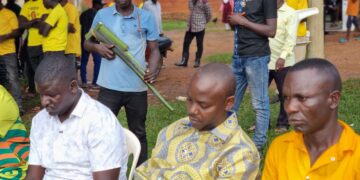









The High Court in Iganga has dismissed an election petition filed by former Busiki County parliamentary candidate Akamba Paul challenging the victory of incumbent MP Waiswa Joel Azalwa in the January 15, 2026 elections, upholding the Electoral Commission’s declaration of Azalwa as the winner.
In a judgment delivered electronically on November 10, 2026, Lady Justice Patience T.E. Rubagumya ruled that although there was an incident of violence and disruption at Budongo (A-I) polling station in Namutumba Primary School, the petitioner failed to prove that the irregularity substantially affected the election results.


The court also found that Akamba had failed to establish that Azalwa personally committed, or authorised, any illegal electoral practices or offences, including bribery, intimidation, ballot stuffing and violence.
The ruling means Azalwa retains his Busiki County parliamentary seat and is entitled to recover the costs of the petition from Akamba.
Azalwa was declared the winner after polling 20,065 votes against Akamba’s 19,093, giving him a majority of 972 votes. The Electoral Commission subsequently gazetted him as the directly elected MP for Busiki County, Namutumba District, on March 2, 2026.
Dissatisfied with the outcome, Akamba petitioned the High Court, alleging widespread electoral irregularities, including ballot stuffing, multiple voting, intimidation of voters, violence against his polling agents, obstruction of voters and failure by the Returning Officer to properly tally results from polling stations.
He also accused Azalwa and his alleged agents of engaging in bribery and other electoral offences before and during polling. Akamba asked court to nullify Azalwa’s election, declare him the rightful winner or, alternatively, order fresh elections.
However, Azalwa and the Electoral Commission denied the allegations, maintaining that the election was substantially free and fair and that the declared results reflected the will of the voters.
In evaluating the petition, Justice Rubagumya noted that the burden of proving electoral irregularities rested with Akamba, who was required to establish his claims on a balance of probabilities to the satisfaction of the court.
The judge observed that allegations in election petitions require credible and independent evidence, warning that political contests can encourage supporters to make claims against their opponents.
One of the key complaints concerned an incident at Budongo (A-I) polling station, where a group of youths reportedly invaded the polling area, assaulted an election agent, grabbed ballot papers and began ticking them before attempting to introduce them into the ballot box.
The court found that the incident caused disorder and disrupted voting for about an hour, amounting to non-compliance with electoral laws requiring the Electoral Commission to maintain peace and order during elections.
However, the judge ruled that Akamba had failed to prove that the pre-ticked ballot papers were actually stuffed into the ballot box or that they influenced the final results.
The court relied on evidence from the presiding officer, Munabi Joseph, who testified that police intervened before the ballot papers could be introduced into the ballot box. The seized materials were taken to the police station, after which election officials and agents returned to the polling station and voting resumed.
Justice Rubagumya also noted that Akamba’s evidence was inconsistent regarding the number of ballot papers allegedly stuffed, while his witnesses failed to establish how many votes had been cast before and after the disruption.
The judge further found that there was insufficient evidence linking the youths who disrupted the polling station to Azalwa or establishing that they acted with his knowledge, consent or approval.
The court consequently held that although the Electoral Commission failed to maintain order at the affected polling station, the irregularity did not substantially affect the election outcome.
Akamba had also accused the Returning Officer of failing to tally results from the Declaration of Results Forms before announcing the winner.
However, the court dismissed the allegation, finding that the certified tally sheet and the Return Form for Transmission of Results corresponded with the results recorded on the respective declaration forms.
The judge further noted that Akamba had not presented a witness to establish that the tallying process was not conducted in the presence of candidates or their agents as required by law.
On the allegation that he had formally complained to the Returning Officer about irregularities and requested cancellation of results from several polling stations, the court found that Akamba had failed to prove that the Electoral Commission received the complaint.
Although he presented a letter bearing a signature that appeared similar to that of the Returning Officer, the document lacked the Commission’s official receipt stamp. The Returning Officer, Harriet Margaret Kugonza, denied receiving it.
The judge ruled that similarity between the signature on the letter and the Returning Officer’s specimen signatures was not sufficient to establish that the complaint had been officially received.
The court also rejected several other allegations of violence, intimidation, ballot stuffing and interference with voting at different polling stations, citing insufficient evidence and inconsistencies in the witnesses’ accounts.
In a separate finding, the judge struck out affidavits sworn by four presiding officers who had testified for Akamba without obtaining the required authorisation from the Electoral Commission to disclose information acquired during their official duties.
The four were Isabirye Sulaiman, Muyando Kabibu, Kadama Salama and Butwawula Fred, who had served at Nalusolo Junction, Kigalama Primary School, Budongo (J-K) and Igerera C.O.U (N-Z) polling stations, respectively.
The court, however, rejected other objections raised against Akamba’s affidavits, including claims that some contained typographical errors in the gender descriptions of deponents or had jurats appearing on separate pages.
Justice Rubagumya also declined to admit video recordings, audio materials and call data records presented by Akamba after finding that their authenticity had not been sufficiently established. The experts involved in extracting and transcribing some of the electronic evidence had not appeared in court for cross-examination.
On the allegations of bribery, the court found that Akamba had not presented sufficient evidence linking the alleged payments to Azalwa or proving that they were intended to influence voters.
The judge similarly rejected allegations of violence, abduction of Akamba’s agents and defacement of his campaign posters, noting that the petitioner had failed to establish the alleged perpetrators’ connection to Azalwa or prove that the acts were committed with his knowledge or approval.
In her final determination, Justice Rubagumya held that the petitioner had failed to establish any of the legal grounds necessary to set aside the election under the Parliamentary Elections Act.
She dismissed the petition, confirmed Azalwa’s election as the directly elected Member of Parliament for Busiki County Constituency and awarded costs to Azalwa. The Electoral Commission was not awarded costs despite successfully defending the petition, with the judge citing the violence and disruption that occurred at Budongo (A-I) polling station.










 English
