

















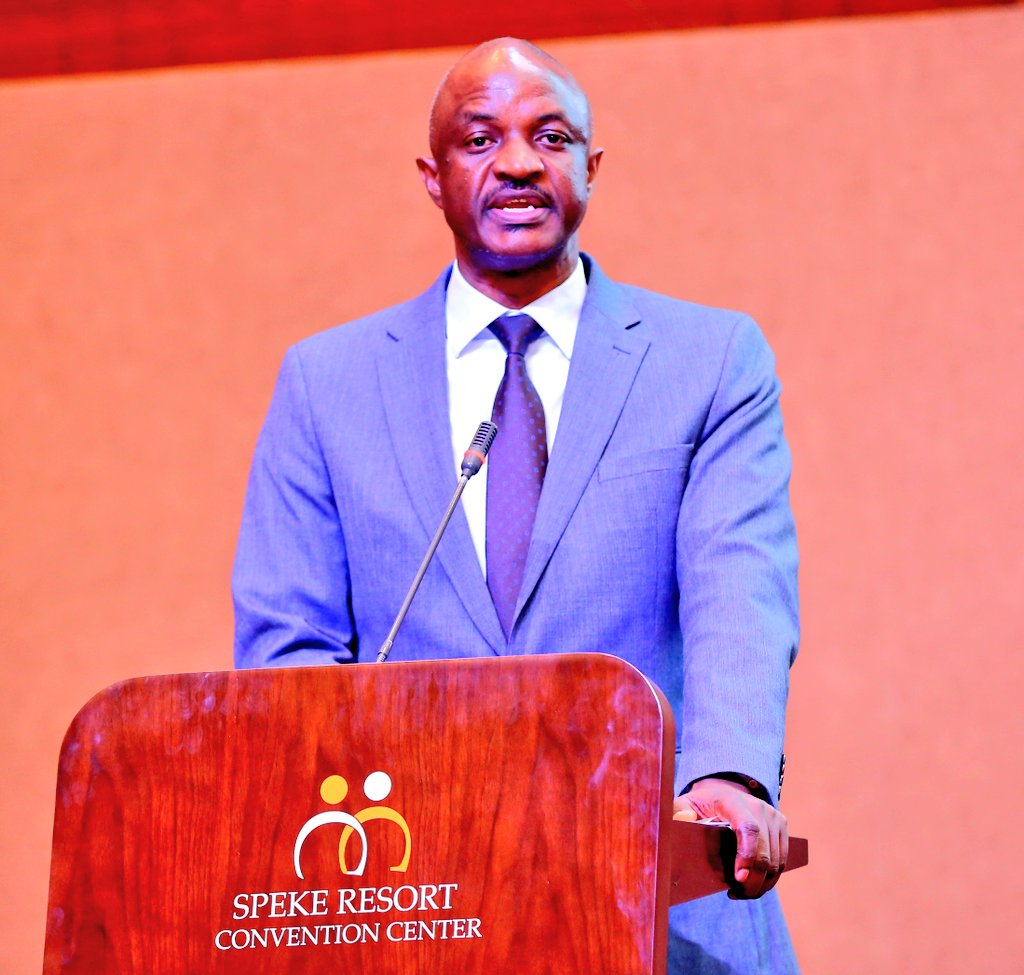
The Permanent Secretary and Secretary to the Treasury, Ramathan Goobi, has defended the government’s ongoing enforcement of trade order measures across the country, describing them as a necessary step toward economic transformation, improved investment attractiveness, and sustainable growth.
Speaking at the 2026 Absa Post-Budget Forum in Kampala, Goobi said Uganda’s development ambitions can only be achieved through organized business practices, stronger accountability, and strict implementation of economic reforms.


According to him, the country has reached a stage where growth will depend less on planning and more on the disciplined execution of policies aimed at boosting industrialization, job creation, tax compliance, and efficient use of public resources.
“Enforcement of trade order and ensuring that we have an orderly way of doing business in Uganda is critical,” Goobi said. “The culture where everyone claims special circumstances to justify operating anywhere, including in the middle of roads, is not good for the economy and undermines our ability to attract serious investors.”
He acknowledged that some of the reforms may create short-term inconveniences but argued that they are necessary if Uganda is to achieve its long-term economic goals.
“We are going to inconvenience some people going forward. The political leadership, led by President Museveni, has committed itself to this course because it is the only sustainable path to economic growth and investment attraction,” he added.
Focus on Productive Sectors
Goobi noted that the government’s priorities for the 2026/27 financial year remain centered on agro-industrialization, tourism development, mineral beneficiation, and science, technology and innovation.
While the national budget has been presented at more than Shs84 trillion, he explained that a substantial portion consists of debt refinancing and accounting adjustments that do not represent fresh expenditure.
According to the Treasury chief, the actual discretionary spending available for government programmes is approximately Shs57 trillion.
He said nearly 95 percent of this expenditure has been directed toward productive sectors and critical infrastructure such as roads, electricity networks, irrigation systems, and industrial parks, which are expected to stimulate economic activity and private sector growth.
Crackdown on Wasteful Spending
Goobi also emphasized the government’s renewed commitment to fiscal discipline and accountability, warning that public resources must be directed toward activities that generate measurable value.
He revealed that government has intensified scrutiny of expenditures on allowances, workshops, consultancies, conferences, and public events, with the aim of reducing waste and redirecting funds toward development priorities.
The Treasury has also raised concerns about government agencies hiring external consultants despite having qualified personnel within their own institutions, a practice Goobi described as unnecessary and costly.
To strengthen accountability, accounting officers across government ministries, departments, and agencies will be required to sign a Budget Discipline and Accountability Charter committing them to prudent expenditure management, proper procurement procedures, and responsible stewardship of public funds.
Procurement Reforms Planned
The PSST announced plans for major procurement reforms aimed at reducing delays, increasing efficiency, and improving accountability in government contracting.
He argued that the current procurement system has become overly bureaucratic and vulnerable to manipulation because too many individuals participate in decision-making processes.
“We want procurement professionals to take responsibility for procurement decisions. There are too many actors involved, making it difficult to establish accountability when problems arise,” he said.
The proposed reforms are expected to shorten procurement timelines, reduce administrative bottlenecks, and strengthen oversight mechanisms.
Trade Order Linked to Revenue Mobilization
Goobi said trade order enforcement is also a key component of the government’s Domestic Revenue Mobilization Strategy II (DRMS II), which seeks to expand the tax base and improve revenue collection.
He challenged the common perception that Uganda’s revenue challenges are largely caused by the informal sector, saying emerging evidence points to significant tax leakages within formally registered businesses.
“We now have evidence that much of what is described as informality actually exists within the formal sector. What we are seeing is not informality but tax evasion,” he said.
Government intends to adopt a whole-of-government approach involving public institutions, civil society organizations, the private sector, development partners, and international agencies such as the International Monetary Fund (IMF) to improve tax compliance.
The strategy aims to ensure that businesses contribute fairly to national revenue while reducing pressure on compliant taxpayers.
Strong Economic Fundamentals
Despite global economic uncertainties, Goobi maintained that Uganda’s macroeconomic outlook remains positive, citing low inflation, relative exchange rate stability, and continued growth in economic activity.
He said the country’s main challenge is ensuring that macroeconomic gains translate into improved household incomes, employment opportunities, and business expansion.
The Treasury chief also highlighted the growing contribution of Ugandans living abroad, noting that remittances reached approximately US$2.8 billion in the twelve months ending March 2026.
According to him, the inflows demonstrate confidence among Ugandans in the country’s economic prospects.
“Ugandans abroad are bringing their money home because they believe in the opportunities available here,” he said.
Private Sector Calls for Effective Implementation
Speaking at the same forum, Absa Uganda Chief Financial Officer Michael Segwaya welcomed government’s commitment to fiscal discipline and economic transformation.
Segwaya said Uganda’s growth prospects remain promising, particularly with continued investment in infrastructure and preparations for commercial oil production.
However, he cautioned that successful implementation of budget priorities will ultimately determine whether the expected benefits are realized.
“The success of the budget will not only be measured by the resources allocated but by how effectively those resources are translated into improved infrastructure, timely payment of suppliers, a more competitive business environment, and tangible opportunities for businesses and households,” Segwaya said.











 English