









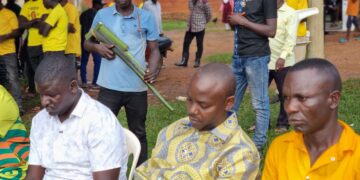









The High Court in Iganga has upheld the election of National Resistance Movement (NRM) candidate Mutebi Benard Mugoya as the directly elected Member of Parliament for Bulamogi County in Kaliro District, dismissing a petition by his rival, Bwiire Sanon Nadeeba, over alleged academic irregularities, vote manipulation and electoral violence.
In a judgment delivered electronically on Monday, November 9, 2026, Justice Patience T. E. Rubagumya ruled that Nadeeba had failed to prove that Mugoya was academically unqualified, that the alleged alterations of election results substantially affected the outcome, or that the successful candidate personally committed electoral offences or authorised them.


The court consequently confirmed Mugoya’s election and awarded costs of the petition to the respondents, including Mugoya and the Electoral Commission.
The dispute arose from the January 15, 2026 parliamentary elections in which Mugoya was declared the winner with 29,268 votes against Nadeeba’s 21,498, giving him a majority of 7,770 votes.
The other candidates in the race were Kenneth Lubogo and Godfrey Muyodi. Mugoya’s election was subsequently gazetted on March 2, 2026.
Dissatisfied with the outcome, Nadeeba petitioned the High Court, arguing that Mugoya had presented questionable academic documents during nomination and was therefore not qualified to contest for Parliament.
Nadeeba questioned the use of Uganda Certificate of Education (UCE) and National Certificate in Information Communication Technology documents issued by the Uganda Business and Technical Examinations Board (UBTEB) in the names of Mutebi Benard, while the National Council for Higher Education (NCHE) certificate confirming completion of education equivalent to Advanced Level was issued in the names of Mutebi Benard Mugoya.
He argued that the differences in names and dates of birth suggested that the academic documents belonged to two different people. He also questioned the duration of Mugoya’s ICT course, claiming that it had been completed in one year instead of the required two years.
However, Justice Rubagumya found that Nadeeba had failed to establish that the alleged academic irregularities were only discovered after the elections, observing that he had not exercised due diligence to inspect Mugoya’s nomination documents before polling.
The judge noted that Nadeeba admitted during cross-examination that he had not bothered to establish the authenticity of Mugoya’s academic documents before the election because he did not consider it necessary.
The court also established that another registered voter in Bulamogi County, Basule Faruku, had raised substantially similar concerns with the Electoral Commission before the elections.
In a decision dated January 10, 2026, the Commission dismissed Faruku’s complaint after examining Mugoya’s nomination documents and establishing that he had executed a Deed Poll, which was subsequently published in the Uganda Gazette, adopting the additional name Mugoya.
The Commission also found that there was no evidence of another person claiming ownership of the academic documents issued in the names of Mutebi Benard.
Justice Rubagumya observed that there was no evidence that the Commission’s decision had been appealed against, adding that Nadeeba could have raised the same concerns through the available legal procedures before the election.
The judge further noted that the discrepancies in the academic documents were apparent and could have been discovered through an inspection of the nomination papers, as provided for under Section 32 of the Parliamentary Elections Act.
Although the court considered the academic qualification issue, it held that Nadeeba was barred from raising it after the election because he had failed to challenge Mugoya’s nomination through the prescribed procedures when the opportunity was available.
On the alleged manipulation of election results, Nadeeba accused the Electoral Commission of failing to safeguard election materials, leading to alterations of results at 54 polling stations.
He presented a collection of Declaration of Results (DR) forms obtained from his polling agents, arguing that they showed that his votes had been substantially reduced during tallying.
Among the polling stations he cited was Bugoma Centre, where he claimed to have obtained 339 votes instead of the 154 reflected on the official tally sheet.
At Nakiyanja Centre, he alleged that his votes had been reduced from 239 to 37, while at Madibira Town Council Madibira B polling station, he claimed to have obtained 231 votes but was credited with only 81 during tallying.
He also cited several other polling stations, including Igulamubiri Primary School, Nabinyonyi Landing Site, Namukoge Catholic Church, Nakyere Church of Uganda, Kanankamba Church, Mayor’s Garden, Kanankamba Trading Centre and Busooba Trading Centre.
Based on his own calculations from the documents he presented, Nadeeba argued that he had actually obtained 31,238 votes against Mugoya’s 29,268, which would have given him victory by 1,970 votes.
However, the court rejected the evidence, noting that the Declaration of Results forms relied upon by Nadeeba were uncertified, while the respondents presented certified copies issued by the Electoral Commission.
Justice Rubagumya observed that although Nadeeba’s lawyers had written to the Electoral Commission on March 26 and March 31, 2026, requesting certified copies of the results forms, he had not made an application to court seeking an order compelling the Commission to produce the documents.
The judge said the petitioner should have exhausted the available legal procedures before relying on uncertified copies of public documents.
She further noted that Nadeeba had not presented expert evidence, such as a handwriting expert’s report, to demonstrate that the signatures on the certified results forms were forged or that the recorded results had been altered.
The court also found discrepancies within Nadeeba’s own uncertified documents, with some figures differing from those pleaded in his petition and affidavits.
Consequently, the judge ruled that the uncertified forms were inadmissible in the circumstances and could not be relied upon to establish that results had been manipulated at the 54 polling stations.
On the allegation that 315 registered voters at Universal Apostles Church polling station in Kanankamba Parish, Namugongo Sub-county, had been disenfranchised, the court found evidence of an actual disruption.
Nadeeba had argued that voting at the polling station took place within the legally prescribed hours but that the Electoral Commission failed to return the results, recording zero per cent on the tally sheet.
The Commission acknowledged that the results could not be ascertained and consequently were not included in the tally.
The court considered affidavits by the polling station’s presiding officer, Kahere Alex, and a registered voter, Mukwata William, who testified that voting had proceeded peacefully until the counting exercise was disrupted by an attack during the announcement of results.
According to Kahere, after counting the votes, the officials had recorded 287 votes for Nadeeba, nine for Mugoya, one for Lubogo Kenneth, two for Muyodi Godfrey and one invalid vote.
However, as the results were being announced, a group of people attacked the polling station and grabbed the Declaration of Results forms. The presiding officer said he subsequently returned the ballot box, biometric machine and lamp without the results forms.
The judge noted that the respondents had not cross-examined Kahere to challenge his account and that his evidence was corroborated by Mukwata.
Justice Rubagumya consequently found that there had been non-compliance with electoral procedures because the results from the polling station could not be ascertained and tallied.
However, she ruled that the irregularity did not substantially affect the election outcome, considering Mugoya’s declared victory margin of 7,770 votes. Even if all the 315 registered voters at the polling station had voted for Nadeeba, the votes would not have overturned the result.
The court also examined allegations of violence, ballot stuffing, pre-ticking of ballot papers and intimidation at 11 polling stations.
Nadeeba had accused Mugoya of organising a group of armed and masked individuals dressed in police and military uniforms who allegedly attacked his supporters and polling agents, chased them away, grabbed election documents, beat presiding officers and interfered with the voting process.
However, the judge found that the allegations were largely unsupported by independent and credible evidence.
She observed that several polling agents who claimed to have been chased away from polling stations had their names and signatures appearing on the certified Declaration of Results forms without any accompanying complaints.
The court also noted that Nadeeba admitted during cross-examination that his agents had signed the results forms without recording any objections or complaints about the conduct of the elections.
Justice Rubagumya said Section 65 of the Parliamentary Elections Act requires candidates’ agents and voters present at polling stations to raise and record complaints relating to the voting process.
The absence of such contemporaneous complaints, she observed, undermined the credibility of the allegations subsequently presented in court.
The judge also dismissed allegations of violence at some polling stations, including Railway Station and God’s Will Primary School, after finding that the petitioner had not produced sufficient evidence to substantiate the claims.
At God’s Will Primary School, for instance, Nadeeba’s agent, Wambuzi Owen, alleged that Mugoya arrived with a group of rowdy supporters and masked men in military attire, who allegedly assaulted voters, ticked ballot papers and stuffed them into ballot boxes.
However, the presiding officer, Woira Simon Peter, denied witnessing any such incidents and maintained that the voting process proceeded without disruption. The court found that the allegations had not been sufficiently proved.
The judge further declined to consider allegations of violence at Matia Mulumba Primary School and Kibuye Misairi polling stations, observing that they had not been specifically pleaded in the petition.
On the alleged electoral offences, including bribery, campaigning on polling day, impersonation, intimidation, obstruction of election officials and involvement of public officers in campaigns, the court found that Nadeeba had failed to establish Mugoya’s personal involvement or demonstrate that the alleged acts were committed by his agents with his knowledge, consent or approval.
The judge noted that Nadeeba admitted during cross-examination that he had not personally witnessed Mugoya campaigning on polling day. No photographs or video recordings were presented to support the allegation.
Justice Rubagumya emphasised that allegations of electoral offences must be supported by cogent evidence rather than suspicion or claims made by partisan witnesses.
In determining the petition, the judge relied on Section 80 of the Parliamentary Elections Act, which provides grounds upon which the High Court can set aside an election, including substantial non-compliance with electoral laws, proof that another candidate actually won, commission of electoral offences by a candidate or with his knowledge and approval, and lack of the required qualifications.
She concluded that although there had been an irregularity at Universal Apostles Church polling station, Nadeeba had failed to demonstrate that it substantially affected the election results.
The court also found that he had failed to prove that Mugoya was academically unqualified or that the successful candidate had personally committed electoral offences or authorised their commission.
Consequently, Justice Rubagumya dismissed the petition, confirmed Mugoya’s election as the directly elected Member of Parliament for Bulamogi County Constituency and awarded costs to the respondents.
The judgment was dated, signed and delivered electronically on November 9, 2026.





 English
